How AI Critique Improves Content Quality in 2026
How AI Critique Improves Content Quality in 2026

AI critique is the practice of using artificial intelligence to systematically evaluate content by pinpointing structural, logical, and stylistic issues without rewriting the original work. This distinction matters: the best AI feedback identifies what is broken and why, then leaves the fix to you. A systematic review of 34 studies across 19 countries confirms that AI-mediated feedback improves writing productivity and linguistic accuracy most effectively when it supplements human judgment rather than replaces it. For content creators and marketers, understanding how AI critique improves content means understanding how to use it as a thinking partner, not a ghostwriter.
How AI critique improves content structure and logic
The most valuable thing AI critique does is expose structural problems before you waste time polishing sentences that will later be cut. Most writers instinctively reach for sentence-level edits first. AI critique forces the opposite order.
Structural diagnosis covers the big picture: does the argument hold together? Does each section earn its place? Are two separate ideas crammed into one paragraph? Shifting focus to macro-level problems like article cohesion and argument clarity produces more durable improvements than fixing word choice. A well-structured article with average sentences outperforms a beautifully written piece with a broken argument.
Common structural issues AI critique surfaces include:
- Buried thesis: The main claim appears in paragraph four instead of paragraph one.
- Uneven argument weight: One supporting point gets 400 words while a stronger point gets 80.
- Section drift: A heading promises one topic but the body delivers another.
- Missing transitions: Ideas jump without logical connective tissue between them.
- Redundant sections: Two sections make the same point with different examples.
Once AI identifies these problems, you can reorganize before touching a single sentence. That sequence saves significant revision time.
Pro Tip: Use AI critique as a phase gate. Run structural feedback first, approve or reject those changes, then run a second pass for paragraph flow. Never mix structural and sentence-level critique in one session.
How to maintain your voice while using AI feedback
AI critique works best when it identifies problems without rewriting your text. The moment AI rewrites your draft, it replaces your voice with a statistical average of every writer it has trained on. That average is competent and forgettable.

Professional creators accept roughly 60% of AI-generated critique suggestions and reject the rest to preserve unique voice and avoid generic feedback. That 40% rejection rate is not stubbornness. It is editorial judgment. The suggestions you reject are often technically correct but tonally wrong for your audience.
Protecting your voice while using AI feedback requires deliberate prompting. Vague prompts produce vague feedback. Defining your audience and goal in every critique prompt prevents generic style notes and produces context-relevant recommendations instead. “Critique this for a senior B2B marketing director who reads fast and distrusts hype” generates sharper feedback than “make this better.”
Watch for these specific pitfalls:
- Hallucinated quotes: AI sometimes cites lines that do not exist in your draft. Always require specific line quotes when AI suggests a change, then verify the quote exists.
- Generic best-practice advice: Feedback like “add more examples” without specifying where signals the AI did not read your draft carefully.
- Voice flattening: If every paragraph starts to sound the same after edits, the AI is overwriting your style.
- Audience mismatch: Feedback calibrated for a general audience will dull content aimed at specialists.
Pro Tip: Tell the AI to preserve any phrasing that sounds unusual unless it genuinely obscures meaning. Idiosyncratic phrasing is often your most memorable writing.
Why iterative AI feedback loops produce stronger content
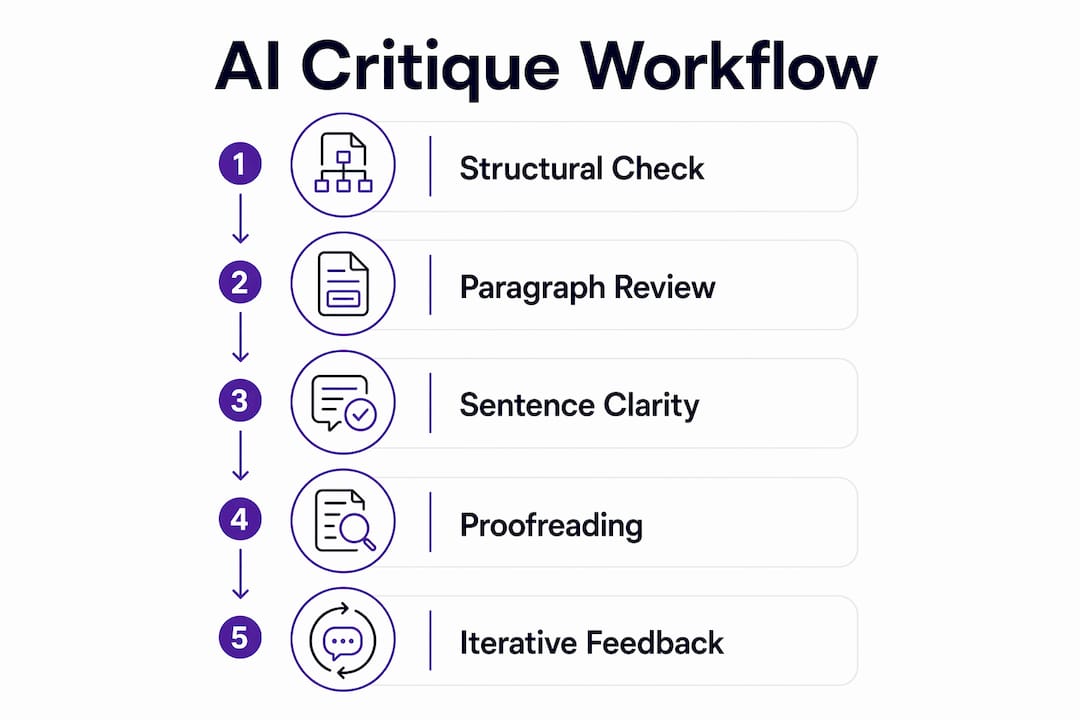
A single AI critique pass catches surface problems. Multiple structured passes catch everything else. The difference in output quality is significant.
Structured feedback loops where AI names the problem before suggesting a fix outperform single-pass generation. This recursive reflection approach forces the AI to diagnose before prescribing, which produces more specific and trustworthy feedback. Think of it as the difference between a doctor who examines you before writing a prescription and one who hands you a pamphlet at the door.
A practical multi-pass workflow looks like this:
- Pass 1: Structure. Ask AI to evaluate argument flow, section order, and whether the thesis is clear and early.
- Pass 2: Paragraph coherence. Ask AI to check whether each paragraph has one clear idea and whether the opening sentence delivers it.
- Pass 3: Sentence clarity. Ask AI to flag sentences over 25 words, passive constructions, and vague nouns.
- Pass 4: Proofreading. Ask AI to catch spelling, punctuation, and consistency errors only.
Separating structural, paragraph, sentence, and proofreading passes prevents a common error: polishing text that will later be reorganized or cut entirely. Each pass builds on a cleaner foundation than the last.
Pro Tip: After each revision, rerun the same AI critique prompt and compare the new feedback to the previous round. Shrinking feedback lists confirm real improvement. Recurring feedback on the same issue signals a deeper problem worth solving.
Practical uses of AI critique in digital marketing content
AI critique has direct, measurable applications for content creators and marketers working across LinkedIn, blog publishing, and B2B campaigns. The feedback loop that improves a 2,000-word article also sharpens a 200-word LinkedIn post.
For LinkedIn content specifically, AI critique checks whether the opening line earns a click, whether the argument fits the platform’s fast-reading format, and whether the call to action is clear without being pushy. AI critique accelerates publishing workflows and increases audience engagement when applied consistently to LinkedIn content. Faster iteration means more posts published, and better posts mean higher engagement rates over time.
The table below shows how AI critique applies across common content formats:
| Content format | Primary critique focus | Key benefit |
|---|---|---|
| LinkedIn posts | Opening hook, argument clarity | Higher engagement, faster publishing |
| Blog articles | Structure, thesis placement, flow | Better SEO performance, lower bounce rate |
| B2B marketing copy | Audience specificity, tone calibration | Stronger lead response, clearer value |
| Social media captions | Brevity, clarity, call to action | More clicks, shareable phrasing |
| Email newsletters | Subject line, paragraph length, CTA | Higher open and click-through rates |
Resonate integrates AI critique directly into the LinkedIn content workflow. Its specialized critique agents evaluate drafts for voice consistency, engagement potential, and structural clarity before publishing. For agencies managing multiple LinkedIn profiles, this means consistent quality across every account without manual review bottlenecks.
For B2B marketing teams, AI critique reduces the revision cycles between writers and approvers. When AI flags structural issues before a human reviewer sees the draft, the human reviewer spends time on judgment calls rather than basic corrections.
Common mistakes and best practices when using AI critique
The most frequent mistake creators make with AI critique is treating it as a rewrite service. Pasting a draft and asking AI to “improve it” produces a new draft that sounds like AI. Asking AI to “identify the three biggest problems with this draft” produces a list you can act on while keeping your voice intact.
| Common mistake | Better practice |
|---|---|
| Asking AI to rewrite the draft | Ask AI to name specific problems only |
| Running one combined feedback pass | Separate structural, sentence, and proofreading passes |
| Ignoring audience and goal context | Define audience and goal in every prompt |
| Accepting all AI suggestions | Reject suggestions that flatten your voice |
| Skipping hallucination checks | Require AI to quote the specific line it critiques |
Over-reliance on AI critique also creates a subtler problem: dependency. When creators stop reading their own drafts critically and wait for AI feedback instead, their editorial instincts weaken. AI critique builds skill when you engage with the reasoning behind each suggestion. It erodes skill when you accept suggestions without understanding why they improve the content.
Human reviewers remain necessary for complex content. AI critique catches structural and stylistic issues reliably. It does not catch factual errors, industry-specific nuance, or audience sentiment shifts. Final validation on high-stakes content should always include a human editor.
Pro Tip: After AI critique, write a one-sentence summary of the biggest problem the AI identified. If you cannot summarize it clearly, the feedback was too vague to act on. Prompt again with more context.
Key Takeaways
AI critique improves content most when it identifies structural and logical problems first, preserves the creator’s voice through selective acceptance, and runs as a structured multi-pass process rather than a single review.
| Point | Details |
|---|---|
| Structure before sentences | Run structural critique first to avoid polishing content that will later be reorganized. |
| Selective acceptance | Accept roughly 60% of AI suggestions and reject those that flatten your unique voice. |
| Multi-pass workflow | Separate passes for structure, paragraphs, sentences, and proofreading produce stronger output. |
| Context-specific prompts | Define audience and goal in every critique prompt to avoid generic, unhelpful feedback. |
| Hallucination checks | Require AI to quote specific lines when suggesting changes to verify feedback accuracy. |
What I have learned from treating AI as an editorial mentor
I used to treat AI critique the way most writers do: paste the draft, read the suggestions, accept the ones that felt right. The results were fine. The writing got cleaner. But it never got fundamentally better.
The shift happened when I stopped asking AI to improve my writing and started asking it to diagnose my thinking. “What is the central argument of this piece, and where does it get muddled?” That question produces a different kind of feedback. It forces the AI to engage with the logic of the piece, not just the surface of the sentences. And it forces me to confront whether I actually had a clear argument before I started writing.
What I have found is that AI critique is most useful as a mirror. It reflects your draft back at you with enough distance that you can see what you were too close to notice. The structural problems it identifies are almost always problems you already sensed but could not name. AI names them. That naming is the value.
The uncomfortable truth is that most content problems are thinking problems, not writing problems. A muddled paragraph is usually a muddled idea. AI critique surfaces that faster than any human editor I have worked with, because it has no social hesitation about telling you the argument does not hold together. It just says so.
The skill I have built from engaging with AI critique is not faster editing. It is faster diagnosis. I now read my own drafts looking for the same structural issues AI flags. That instinct did not come from accepting suggestions. It came from understanding why the suggestions were right.
- Tom
Resonate brings AI critique into your LinkedIn workflow
Content creators who want AI critique built into their publishing process, not bolted on afterward, should look at what Resonate offers. The platform trains on your individual writing patterns and generates LinkedIn content that sounds like you, not like a template.
Resonate’s specialized critique agents review drafts for voice consistency, structural clarity, and engagement potential before anything goes live. For agencies and solo creators alike, that means fewer revision cycles and more posts that actually perform. The platform connects with tools like Notion, Slack, and HubSpot to pull in real work context, so the content it helps you create and critique is grounded in what you actually do. If you want AI-powered LinkedIn content that reflects your real expertise, Resonate is built for exactly that workflow.
FAQ
What is AI critique in content creation?
AI critique is the process of using artificial intelligence to evaluate a draft by identifying structural, logical, and stylistic problems without rewriting the text. It functions as a diagnostic tool, not a replacement for the writer’s judgment.
How does AI critique improve writing quality?
AI critique improves writing quality by surfacing macro-level issues like argument coherence and section flow before creators spend time on sentence-level edits. A systematic review of 34 studies confirms AI feedback improves productivity and accuracy when used alongside human judgment.
How do I keep my voice when using AI feedback for writers?
Accept roughly 60% of AI suggestions and reject those that change your tone or flatten distinctive phrasing. Always define your audience and goal in the critique prompt to get context-specific feedback instead of generic style notes.
What is a multi-pass AI critique workflow?
A multi-pass workflow runs separate AI critique sessions focused on structure, paragraph coherence, sentence clarity, and proofreading in that order. Separating these passes prevents polishing content that will later be reorganized or cut.
How do I spot unreliable AI feedback?
Ask AI to quote the specific line it is critiquing. If the quote does not exist in your draft, the feedback is hallucinated and should be discarded. This check protects the trustworthiness of every critique session.
Recommended
- Resonate vs Evyai: Real Content vs AI Comment Automation in 2026
- Resonate for Agencies: Manage Multiple LinkedIn Profiles with AI in 2026
- LinkedIn Content vs LinkedIn Outreach: Which Drives More B2B Leads in 2026? · Resonate
- Content Repurposing: Turn Your Blog, Video, or Podcast Into LinkedIn Posts in 2026 · Resonate
See how Resonate's LinkedIn content generator handles this end to end - from voice training on your real writing to ban-safe scheduling via the official LinkedIn API.

Content Writer @ Resonate
Charlotte explores LinkedIn content, personal branding, AI writing, and founder-led marketing at Resonate. She believes the best content comes from real experience, not generic advice, and writes practical insights to help founders turn what they already know into content that people want to read.
Write LinkedIn content that sounds like you
with Resonate's AI Voice Engine