How CEO LinkedIn presence drives real company growth
How CEO LinkedIn presence drives real company growth

Most executives still treat LinkedIn as a digital resume or a place to share company announcements. That’s a costly mistake. High-visibility CEOs attract over 6x more inbound investor interest and generate dramatically higher lead volume compared to peers who stay quiet. The difference isn’t charisma or follower count. It’s a deliberate, insight-driven presence that signals credibility, builds market trust, and creates compounding business advantages that traditional marketing simply can’t replicate. This article breaks down the evidence, the mechanics, and the specific steps that turn a CEO’s LinkedIn profile into one of the most powerful growth assets a company has.
Key Takeaways
| Point | Details |
|---|---|
| CEO visibility amplifies growth | High-visibility CEOs generate greater leads, investor interest, and revenue than their low-profile peers. |
| Trust trumps vanity metrics | Executive authority on LinkedIn is built through authentic, expertise-driven content, not sheer posting volume. |
| Strategy beats influencer mimicry | Tailored LinkedIn tactics for CEOs deliver stronger pipeline and brand results than generic influencer strategies. |
| Marketing integration is key | Synchronizing CEO LinkedIn activity with overall company marketing magnifies both lead generation and brand equity. |
The data behind CEO LinkedIn visibility and company performance
Now that we’ve established why executive presence is more than a vanity metric, let’s examine the hard data that’s turning LinkedIn into a growth engine from the top. If you want to try this yourself, spin up a draft with Resonate's LinkedIn content generator.
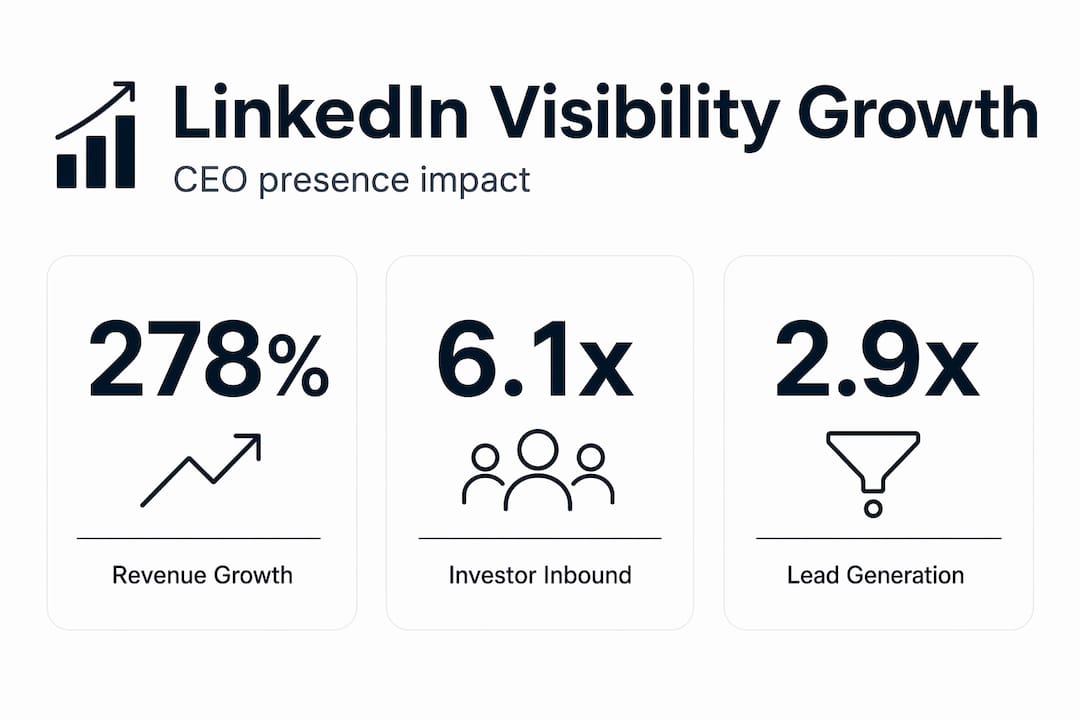
The numbers are striking. A Baden Bower study on founder media coverage found that revenue growth over five years reached 278% for high-visibility CEOs, compared to just 30% for their low-visibility counterparts. That’s not a marginal difference. It’s a structural competitive advantage built through consistent, credible public presence.
“Visibility is no longer optional for growth-stage companies. The CEO’s public profile has become a primary signal that investors, buyers, and partners use to evaluate organizational credibility and strategic direction.”
The 2025 Edelman-LinkedIn B2B Thought Leadership Impact Report reinforces this, showing that strong thought leadership directly correlates with improved buying receptivity and measurable commercial outcomes among B2B decision-makers. These aren’t soft brand metrics. They’re pipeline metrics.
Here’s a snapshot of what the data reveals across visibility levels:
| Metric | High-visibility CEOs | Low-visibility CEOs |
|---|---|---|
| 5-year revenue growth | 278% | 30% |
| Inbound investor inquiries | 6.1x more | Baseline |
| Lead volume | Significantly higher | Baseline |
| Buyer receptivity (B2B) | Measurably improved | Minimal impact |
| Partnership inbound rate | Elevated | Low |
The importance of networking for growth is well documented, but what this data adds is specificity. LinkedIn isn’t just a networking tool. For B2B companies, innovation-driven startups, and enterprise players, the CEO’s profile functions as a live trust signal that influences purchasing decisions before a single sales call happens.
Why does this matter more in B2B than in other sectors? Because B2B buying cycles are long, involve multiple stakeholders, and carry significant financial risk. Buyers don’t just vet products. They vet the people behind them. When a CEO consistently shares substantive perspectives on industry challenges, emerging trends, and strategic decisions, it reduces perceived risk for buyers and accelerates the trust-building process that sales teams spend months trying to manufacture.
You can explore CEO LinkedIn growth case studies to see how this plays out across industries, from SaaS to professional services to manufacturing.
How CEO LinkedIn presence drives trust, authority, and thought leadership
Understanding these powerful numbers, it’s crucial to unpack how definitive authority and trust are formed through executive presence on LinkedIn.
Not all LinkedIn activity is equal. A CEO who posts product announcements and company milestones is doing something very different from one who shares the reasoning behind a strategic pivot, a hard lesson from a failed initiative, or a nuanced take on a market shift. The second type of content builds authority. The first type is easily ignored.
The full-funnel business impact of CEO thought leadership has been verified across thousands of decision-makers in the Edelman-LinkedIn research. What drives results isn’t volume. It’s relevance, specificity, and the sense that a real leader with real expertise is speaking directly to real problems.
According to executive LinkedIn data from 2026, executive credibility on LinkedIn depends on expertise and trust signals, not post frequency or follower counts. This distinction matters enormously for CEOs who are tempted to delegate their LinkedIn presence to a social media manager who optimizes for engagement volume rather than credibility depth.

Here’s a practical breakdown of what builds trust versus what erodes it:
| Content type | Trust impact | Business outcome |
|---|---|---|
| Industry insight with personal perspective | High | Attracts qualified buyers and partners |
| Decision rationale and strategic thinking | Very high | Builds investor and board confidence |
| Generic company announcements | Low | Minimal engagement from key stakeholders |
| Trend commentary without a point of view | Medium | Awareness only, low conversion |
| Personal stories tied to business lessons | High | Humanizes leadership, builds loyalty |
| Promotional product posts | Very low | Often ignored by decision-makers |
Pro Tip: The most effective CEO posts on LinkedIn don’t start with “I’m excited to announce.” They start with a problem, a tension, or a counterintuitive observation. That structure signals intellectual depth, not marketing speak, and it’s what stops a CFO or procurement lead from scrolling past.
A strong thought leadership guide will tell you that authority is earned through consistent, specific, and courageous communication. CEOs who share what they actually think, including unpopular opinions, tend to attract higher-quality followers and generate more meaningful inbound conversations than those who play it safe with feel-good content.
The pipeline velocity impact is real. When a potential buyer has spent three months reading a CEO’s posts about the exact problem their product solves, the first sales meeting starts at a completely different trust baseline. The sales team doesn’t have to establish credibility from zero. The CEO’s LinkedIn presence has already done that work.
Benchmarks and best practices: What actually works for CEOs on LinkedIn
After understanding why expertise matters more than activity volume, let’s get tactical about what top-performing CEOs actually do to drive measurable results.
The executive LinkedIn data report is clear that executive posting should align to business goals like qualified engagement and inbound deal flow, not pure volume or broad virality. Here’s what that looks like in practice:
-
Post with a point of view, not just a perspective. Every post should take a clear stance. “Here’s what I think about X and why” outperforms “Here are five trends in X” every time for executive audiences.
-
Prioritize quality over frequency. Two to three substantive posts per week consistently outperform daily generic updates. The goal is to be memorable, not omnipresent.
-
Engage selectively and strategically. Comment thoughtfully on posts from potential partners, key customers, and industry analysts. A well-placed, insightful comment from a CEO carries more weight than ten likes.
-
Use personal stories as a delivery mechanism for business insight. A story about a hiring mistake that led to a better process teaches something real. It also makes the CEO human and approachable to buyers who are tired of polished corporate messaging.
-
Track the right metrics. Profile views from target accounts, inbound connection requests from decision-makers, and direct messages from qualified leads matter far more than likes and shares. Use enterprise lead scoring frameworks to evaluate which LinkedIn engagements are actually moving the needle for your pipeline.
The influencer approach that works for consumer brands rarely translates to executive LinkedIn strategy. Influencers optimize for reach and entertainment. CEOs need to optimize for trust and targeted relevance. That requires a fundamentally different content philosophy and a different definition of success.
Common mistakes to avoid:
- Posting for likes. If your CEO’s LinkedIn goal is to go viral, the strategy is already misaligned. Viral posts attract broad audiences. Executive LinkedIn strategy needs to attract the right audiences.
- Sporadic updates. Disappearing for six weeks and then posting a flurry of content signals inconsistency, which is the opposite of what you want to project as a leader.
- Generic content. “Excited to share our latest blog post” is not thought leadership. It’s noise. Decision-makers filter it out instantly.
- Ignoring comments. When a CEO posts and never responds to comments, it signals that the content is performative rather than genuine.
Pro Tip: Block 20 minutes twice a week for your CEO to respond personally to comments on their posts. That direct engagement creates disproportionate goodwill and signals authenticity in a way that no amount of polished content can replicate.
Developing a marketing strategy that incorporates executive LinkedIn presence as a core channel, rather than an afterthought, is one of the highest-leverage decisions a growth-stage company can make.
Integrating CEO visibility with company marketing and lead generation
With tactics clarified, it’s essential to see how a CEO’s LinkedIn presence scales when intentionally coordinated with marketing engines and companywide go-to-market efforts.
The research is unambiguous: CEO LinkedIn presence directly increases qualified inbound leads, partnership opportunities, and investor interest. But the impact multiplies when the CEO’s presence is deliberately woven into broader company marketing efforts rather than operating as a standalone personal brand.
Here’s how leading companies integrate CEO visibility into their go-to-market strategy:
- Align content calendars. When the CEO posts about a market problem on Monday, the company blog publishes a deep-dive solution on Wednesday, and the sales team references both in outreach on Friday. That sequencing creates a coherent narrative that reinforces itself across channels.
- Repurpose CEO content across company channels. A CEO’s LinkedIn post that generates strong engagement can become a newsletter section, a sales email opener, or a webinar topic. The CEO’s voice is often more compelling than brand-level content because it’s personal and specific.
- Use the CEO profile to unlock partnership conversations. A CEO who publicly engages with potential partners on LinkedIn, commenting on their content, sharing their perspectives, and tagging them in relevant discussions, creates warm relationship foundations that the business development team can then build on.
- Leverage CEO visibility for recruiting. Top candidates research leadership before accepting offers. A CEO with a strong, authentic LinkedIn presence signals a thoughtful culture and a credible vision, which is a meaningful competitive advantage in tight talent markets.
- Support investor relations. Investors follow portfolio company CEOs on LinkedIn. Consistent, strategic posting keeps investors informed and confident between formal updates, which reduces friction in future funding conversations.
Lead nurturing strategies work significantly better when the CEO’s LinkedIn content is part of the nurture sequence. A prospect who has been reading a CEO’s posts for two months is a fundamentally warmer lead than one who has only seen product ads.
Pro Tip: Create a shared content brief between your CEO and marketing team each month. Identify three to four themes the CEO will address on LinkedIn, then build supporting content around those themes across other channels. This creates a multiplier effect where every CEO post amplifies the company’s broader messaging without requiring additional budget.
AI-powered lead generation tools can help identify which LinkedIn engagements are converting into pipeline, giving your team the data to refine the CEO’s content strategy over time based on actual business outcomes rather than guesswork.
A contrarian take: Executive visibility done right means making trust, not noise
As the connections between executive visibility and growth become clear, let’s reflect critically on what most advice gets wrong and what future-minded leaders should actually prioritize.
Here’s the uncomfortable truth: most CEOs who decide to “build their LinkedIn presence” end up doing it wrong. They hire ghostwriters who produce polished but generic content. They post motivational quotes dressed up as leadership wisdom. They chase engagement by sharing hot takes on trending topics that have nothing to do with their actual expertise. And then they wonder why the results don’t match the promise.
The data from the executive data report is clear that authentic leadership and selective signaling outperform sheer content volume every time. But authenticity is harder than it sounds when you’re a CEO under constant pressure to project confidence and competence.
What we’ve seen from emerging research and C-suite interviews is that the most effective executive LinkedIn presences share a specific quality: they make the reader feel like they’re getting access to how the CEO actually thinks, not a curated version of it. That requires vulnerability, specificity, and a willingness to share perspectives that might not be universally popular.
The CEOs who treat LinkedIn as a content production challenge will always underperform compared to those who treat it as a trust-building practice. The platform rewards consistency and genuine expertise over time. A CEO who posts one deeply insightful piece per week for a year will build a more valuable presence than one who posts daily for three months and then burns out.
The future belongs to executives who operate as credible stewards of their industry’s conversation, not content machines optimizing for impressions. That means saying fewer things, saying them better, and being willing to stand behind them when challenged. That’s what builds the kind of trust that turns LinkedIn visibility into actual revenue, investment, and talent.
Unlock your growth advantage with an authentic CEO presence
Equipped with this research and perspective, you’re ready to take the next steps without guesswork. Translating executive insight into consistent, high-quality LinkedIn content is where most CEOs stall. The strategy is clear, but the execution gets buried under the demands of actually running a company.
That’s exactly the problem Resonate is built to solve. Rather than relying on generic AI tools that produce content that sounds like everyone else, Resonate trains on your specific voice, pulls context from your actual work in tools like Notion, Slack, and HubSpot, and surfaces post ideas grounded in what you’re actually doing and thinking. It predicts engagement, automates publishing safely with built-in guardrails, and amplifies reach through community boosts immediately after publication. For CEOs who want to build the kind of authentic, trust-centered LinkedIn presence the data demands, Resonate provides the infrastructure to do it consistently, without sacrificing the voice that makes it work.
Frequently asked questions
How often should a CEO post on LinkedIn to maximize impact?
Consistent, high-quality posts focused on thought leadership and trust outperform frequent, generic updates. Executive credibility on LinkedIn depends on trust-centric content, not post volume, so two to three substantive posts per week is a stronger strategy than posting daily without depth.
Can CEO LinkedIn activity really generate investor interest?
Yes, and the numbers are significant. Inbound investor interest is 6.1x higher for high-visibility CEOs compared to those with minimal public presence, making LinkedIn one of the most cost-effective investor relations tools available.
Does thought leadership on LinkedIn directly impact sales and brand reputation?
Absolutely. B2B decision-makers link thought leadership with improved commercial outcomes, meaning a CEO’s consistent, expert-driven content actively shortens sales cycles and raises the baseline trust level before the first sales conversation.
What mistakes do executives make when using LinkedIn for company growth?
The most common errors include mimicking influencer habits, chasing vanity metrics like likes and follower counts, and neglecting the trust-centered, expert-driven content that actually moves buyers. Blindly copying influencer playbooks consistently underperforms for senior leaders whose audiences expect depth and credibility, not entertainment.
Recommended

Content Writer @ Resonate
Charlotte explores LinkedIn content, personal branding, AI writing, and founder-led marketing at Resonate. She believes the best content comes from real experience, not generic advice, and writes practical insights to help founders turn what they already know into content that people want to read.
Write LinkedIn content that sounds like you
with Resonate's AI Voice Engine