How LinkedIn visibility drives more inbound leads
How LinkedIn visibility drives more inbound leads
 . If you want to try this yourself, spin up a draft with a LinkedIn content generator.
Most LinkedIn users operate under a simple assumption: post more, get more leads. It feels logical. But the data tells a different story. Visibility on LinkedIn is not a numbers game - it is a precision game. The professionals who consistently attract warm inbound inquiries are not necessarily the ones posting every day. They are the ones showing up in the right feeds, saying the right things, to the right people. This guide breaks down exactly how visibility works, why targeting matters more than volume, and what you can do to turn your LinkedIn presence into a reliable inbound channel.
Key Takeaways
| Point | Details |
|---|---|
| Quality beats quantity | Consistent, credible posts are more effective than frequent, low-quality ones at attracting real leads. |
| Target your audience | ICP-focused content dramatically increases the quality and conversion of your inbound leads. |
| Reduce conversion friction | Streamlined on-platform actions lead to higher conversion from LinkedIn visibility. |
| Engagement signals matter | Posts that earn real interaction are more likely to be surfaced and generate meaningful inbound results. |
| Visibility compounding | Trust and recognition from repeated, relevant contributions make prospects more likely to reach out. |
What LinkedIn visibility really means for inbound leads
Visibility on LinkedIn is not simply about how many people see your posts. It means being seen, recognized, and remembered by the specific people who are most likely to hire you, buy from you, or refer you. That distinction changes everything about how you should approach your content strategy.
A post that reaches 10,000 random people is far less valuable than one that reaches 500 decision-makers inside your target market. The first scenario might feel impressive. The second one actually moves your pipeline. Real visibility is about building a credible, consistent presence in front of a defined audience over time.
“Visibility works because content that earns attention establishes professional credibility and familiarity over time, which makes inbound outreach more effective.” - leadership visibility on LinkedIn
This credibility effect is what separates passive impressions from active inbound interest. When someone sees your content repeatedly, reads your perspective on a problem they are wrestling with, and recognizes your name in their feed week after week, you stop being a stranger. You become a familiar voice. And familiar voices get the first call.
Here is what genuine LinkedIn visibility actually looks like in practice:
- Consistent presence in a defined niche, so your name becomes associated with a specific problem or expertise area
- Content that speaks directly to buyer pain points, not generic professional advice
- Engagement that signals authority, such as thoughtful comments from respected voices in your space
- Profile alignment, where your headline, about section, and featured content all reinforce the same message your posts deliver
- Showing up in improving post reach contexts, meaning your content gets surfaced to second and third connections who match your ideal audience
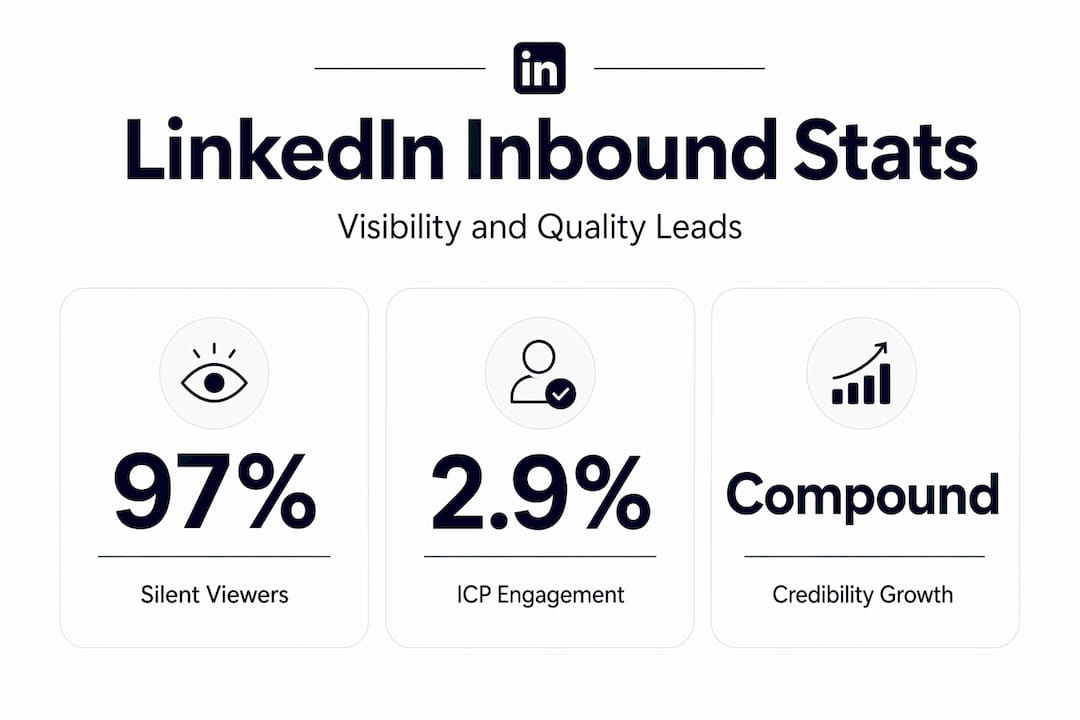
One critical reality check: research suggests that roughly 97% of your LinkedIn engagement often comes from people who are not your ideal customers. That means most of your likes and comments, while encouraging, are not directly generating leads. The goal is not to eliminate that engagement but to layer in content that specifically attracts and resonates with the 3% who actually matter to your pipeline.
Why targeted visibility trumps broad reach for lead quality
Not all visibility is created equal. A post that goes viral on LinkedIn can generate thousands of reactions and still produce zero qualified leads. Why? Because virality often means your content resonated with the broadest possible audience, not your ideal customer profile (ICP). Your ICP is the specific type of person or company that is most likely to buy what you sell.
The data on this is striking. Only 2.9% of LinkedIn engagements came from prospects matching the ideal customer profile, while niche and industry-specific content was associated with ICP-fit engagement rates of 15 to 22 percent, compared to less than 1 percent for viral or generic content. That is a massive gap. It means that writing a post specifically for your niche, even if it reaches fewer people overall, can generate 15 to 22 times more qualified engagement than a broadly appealing post.
| Content type | Average reach | ICP-fit engagement rate | Estimated conversion |
|---|---|---|---|
| Generic/viral post | High (5,000+) | Less than 1% | Very low |
| Industry-specific post | Medium (500 to 2,000) | 15 to 22% | Moderate to high |
| ICP-targeted post | Lower (200 to 800) | 20%+ | High |
The table above illustrates a counterintuitive truth: shrinking your audience on purpose, by writing for a specific reader, actually increases the quality and conversion potential of the people who do engage.
Pro Tip: Before writing your next post, write one sentence that starts with “This post is for [specific role] who struggles with [specific problem].” You do not need to publish that sentence, but it should guide every word you write. When your content feels like it was written specifically for someone, it converts at a dramatically higher rate.
The underlying mechanism here is relevance. LinkedIn’s feed algorithm rewards content that generates meaningful engagement quickly after posting. When your ICP-fit audience sees your post and responds because it speaks directly to their world, the algorithm interprets that as a signal of quality and surfaces it to more similar people. Targeted content creates a compounding loop: the right readers engage, which attracts more right readers, which builds the kind of visibility that actually fills your pipeline.

Reducing friction: Turning visibility into inbound conversions
Getting the right people to see your content is only half the equation. The second half is making it easy for them to take the next step. This is where friction becomes the silent killer of inbound results. Friction refers to any obstacle between a prospect’s interest and their ability to contact you or learn more.
Imagine someone reads your post, finds it genuinely useful, clicks your profile, and then sees a vague headline, an empty featured section, and no clear way to connect or learn more. That person, who was warm and interested, bounces. The visibility worked. The conversion failed.
LinkedIn’s own platform tools are designed to reduce exactly this kind of friction. LinkedIn Lead Gen Forms typically achieve conversion rates averaging around 10 percent, with high-performing campaigns reaching 15 percent or more. Compare that to external landing pages, which often convert at 2 to 5 percent. The cost per lead using platform-native forms also runs 20 to 30 percent lower than driving traffic off-platform.
| Lead capture method | Average conversion rate | Cost per lead comparison |
|---|---|---|
| LinkedIn Lead Gen Form | 10 to 15% | Baseline (lower) |
| External landing page | 2 to 5% | 20 to 30% higher |
| Direct message CTA | Varies (3 to 8%) | Depends on targeting |
Here is a step-by-step approach to optimizing your LinkedIn presence for inbound conversion:
- Rewrite your headline to speak directly to the outcome you deliver for your ICP, not just your job title
- Update your featured section with one clear, high-value resource or offer that your ideal client would want
- Add a call to action in your about section that tells visitors exactly what to do next (book a call, download a guide, send a message)
- Use LinkedIn Lead Gen Forms in any sponsored content rather than sending people to external pages
- Pin a post that demonstrates your expertise and includes a soft next step for interested readers
- Respond to every comment quickly in the first hour after posting, which boosts algorithmic reach and signals responsiveness to potential buyers
Pro Tip: Streamline your profile so that every element, from your banner image to your most recent post, tells a consistent story about who you help and how. Visitors should be able to understand your value and take action within 30 seconds of landing on your page.
The goal is to build a frictionless path from “I saw your post” to “I want to talk.” Every unnecessary click, every unclear message, and every missing link in that journey costs you leads that your visibility already earned.
Visibility pitfalls: Why volume without engagement fails
Here is where many well-intentioned LinkedIn creators go wrong. They commit to a posting schedule, show up consistently, and produce a steady stream of content - and then wonder why their inbound pipeline is not growing. The problem is almost always the same: volume without engagement.
LinkedIn’s algorithm does not reward effort. It rewards outcomes. Specifically, it rewards content that generates meaningful engagement signals quickly after publication. Comments, shares, and saves from relevant accounts tell the algorithm that your content is worth distributing further. Likes alone carry far less weight.
“Posting a lot without producing engagement that signals relevance can fail to generate leads: if your content isn’t entering or staying in the candidate/recommendation flow, ranking won’t matter and outbound effort won’t convert as well.” - SparkToro on LinkedIn algorithm dynamics
This is a critical insight. LinkedIn may actually operate with more than one algorithmic layer, one for your immediate network and one for broader discovery. If your content fails to generate engagement in the first layer, it never reaches the second. That means your posts can technically be published and still be effectively invisible.
Common pitfalls that trap high-volume, low-result creators include:
- Writing for the algorithm instead of the reader, which produces content that feels hollow and generates low engagement
- Ignoring comment quality, by responding with one-word replies instead of extending the conversation
- Posting inconsistently in topic, which prevents your audience from building a clear mental model of what you stand for
- Chasing trending formats without adapting them to your ICP’s actual interests
- Never analyzing which posts drive profile visits or connection requests, which are the real leading indicators of inbound interest
The fix is not to post less. It is to post smarter. Each piece of content should have a clear intended reader, a specific insight or perspective that person cannot easily find elsewhere, and an implicit or explicit invitation to engage. When you build content with that discipline, even a modest posting frequency can generate significant inbound momentum.
Our take: The credibility compounding advantage
Here is something most LinkedIn advice misses entirely: the biggest driver of inbound leads is not your best post. It is your tenth best post, seen by someone who already read your first nine.
Credibility compounds. Every time a potential buyer encounters your content and finds it useful, their trust in you increases slightly. The first time they see you, you are a stranger. The fifth time, you are familiar. The tenth time, you are the obvious person to call when they are ready to act. This is the long tail of LinkedIn visibility, and it is where most inbound leads actually originate.
Consistent thought leadership increases familiarity and trust, which makes prospects more likely to inquire or respond when they first see your posts. This is not an algorithmic effect. It is a human one. People buy from people they trust, and trust is built through repeated, relevant exposure over time.
The practical implication is that your LinkedIn strategy should be optimized for staying power, not spikes. A viral post might bring a flood of followers who quickly forget you. A steady stream of ICP-focused, credibility-building content creates a growing pool of warm prospects who are quietly moving closer to reaching out.
Pro Tip: The fastest path to inbound is not a viral post. It is becoming the go-to voice for a specific problem in your niche, so that when your ideal client finally feels that pain acutely, your name is already in their head.
This is also why generic content is such a trap. It might earn you visibility, but it earns you the wrong kind. The goal is not to be known by everyone. It is to be trusted by the right people.
Take your LinkedIn visibility and inbound to the next level
Ready to implement what you have learned and level up your LinkedIn results?
Building ICP-focused, credibility-compounding content consistently is genuinely hard to do alone. It requires knowing your audience deeply, staying on top of what resonates, and maintaining a voice that feels authentically yours even when you are publishing regularly.
That is exactly what Resonate.ai is built for. Resonate connects with your real work tools, including Notion, Slack, HubSpot, and GitHub, to surface post ideas grounded in what you actually do. Its AI trains on your specific voice patterns, so every piece of content sounds like you, not a generic chatbot. With built-in engagement prediction, community boosts, and safety guardrails that protect your account, Resonate gives you the infrastructure to show up consistently for your ICP without burning out or risking your account standing. If you are serious about turning LinkedIn visibility into a real inbound channel, this is where to start.
Frequently asked questions
What is the main benefit of LinkedIn visibility for inbound leads?
Sustained credibility and familiarity through visibility make prospects more likely to initiate inbound contact. As professional credibility builds over time through consistent content, the barrier to reaching out drops significantly.
How can I attract more ICP-fit leads on LinkedIn?
Focus your posts on topics, examples, and language tailored to your ideal customer profile rather than general audiences. Niche content drives ICP-fit engagement at rates of 15 to 22 percent, compared to less than 1 percent for generic posts.
Does posting more often on LinkedIn always generate more leads?
No. High posting volume without engagement and relevance will not generate leads if your content is not being surfaced or recommended. Posting without relevance signals fails to enter the algorithm’s recommendation flow, making your content effectively invisible.
Are LinkedIn Lead Gen Forms effective for conversions?
Yes. LinkedIn Lead Gen Forms offer average conversion rates of 10 to 15 percent and deliver a 20 to 30 percent lower cost per lead compared to external landing pages, making them one of the most efficient inbound capture tools on the platform.
Recommended

Content Writer @ Resonate
Charlotte explores LinkedIn content, personal branding, AI writing, and founder-led marketing at Resonate. She believes the best content comes from real experience, not generic advice, and writes practical insights to help founders turn what they already know into content that people want to read.
Write LinkedIn content that sounds like you
with Resonate's AI Voice Engine