How to document your startup journey on LinkedIn
How to document your startup journey on LinkedIn

Most startup founders post on LinkedIn and hear nothing back. The updates feel corporate, the milestones sound like press releases, and the lessons read like fortune cookies. Yet founder-led LinkedIn content consistently outperforms company page posts when it is built around a structured mix of education, behind-the-scenes moments, real failures, and tactical advice rather than promotional noise. This guide walks you through the exact system for documenting your startup journey in a way that earns attention, builds trust, and compounds over time, including how AI-driven tools can do the heavy lifting without stripping out your voice.
Key Takeaways
| Point | Details |
|---|---|
| Authenticity wins | Specific lessons and real founder experiences outperform generic motivational posts. |
| Content pillar mix | A mix of lessons, milestones, and behind-the-scenes posts maximizes engagement. |
| AI as your ally | AI-driven tools speed up post creation, help with formatting, and boost performance analysis. |
| Engagement matters | Timely replies to comments and prompting interaction extend your post’s reach. |
Get ready: What you’ll need to effectively document your journey
Before you write a single post, you need the right foundation. Mindset comes first. The founders who build real audiences on LinkedIn are not the ones with the most polished stories. They are the ones willing to share the messy middle, the pivot that almost killed the company, the hiring mistake that cost three months of runway. Authentic startup experiences framed as specific, actionable lessons consistently outperform generic motivational content. Specificity is the currency.
Here is what you need to prepare before you start posting consistently:
- A content pillar list. Identify three to five recurring themes that reflect your actual work. Examples: product decisions, team building, fundraising lessons, customer discovery, and personal growth.
- A realistic posting schedule. Two to three posts per week is sustainable for most founders. Daily posting without a system leads to burnout and filler content.
- An engagement plan. Posting is only half the work. Block 15 minutes after each post goes live to respond to early comments. Early engagement signals matter.
- A capture habit. Ideas come during calls, demos, and late-night Slack threads. You need a place to catch them immediately.
- The right LinkedIn content tools. AI-powered platforms can surface post ideas from your actual work data, draft in your voice, and schedule safely.
| Requirement | Purpose | Recommended approach |
|---|---|---|
| Content pillars | Strategic focus | List 3 to 5 core themes tied to your work |
| Posting schedule | Consistency | 2 to 3x per week minimum |
| Idea capture system | Never run dry | Notes app, voice memos, or Notion |
| Engagement plan | Amplify reach | 15 min post-publish response window |
| AI drafting tool | Speed and quality | Voice-trained AI generator |
| Analytics review | Improve over time | Weekly dashboard check |
Pro Tip: Keep a running note on your phone labeled “LinkedIn raw material.” Every time something surprising happens at work, a customer says something unexpected, or you make a decision you are not sure about, drop a one-line note. These raw moments become your best posts. If you want to try this yourself, spin up a draft in Resonate.
Choose your content pillars
Content pillars give your LinkedIn presence structure without making it feel formulaic. Think of them as recurring categories that your audience learns to expect and look forward to. A well-rounded startup narrative typically includes four core pillars: lessons learned, milestone updates, behind-the-scenes moments, and tactical advice.
According to LinkedIn personal branding strategy 2026, running a structured content mix across these pillars is far more effective than leaning on promotional updates alone. Each pillar serves a different audience need and a different stage of the relationship you are building with your followers.
| Pillar | Benefit | Potential drawback |
|---|---|---|
| Lessons learned | Builds credibility and trust | Can feel repetitive if not specific |
| Milestone updates | Celebrates progress, attracts attention | Risks sounding like a press release |
| Behind-the-scenes | Humanizes the brand, drives connection | Requires comfort with vulnerability |
| Tactical advice | Positions you as an expert | Can attract a narrow audience |
Here are quick prompts to get you started for each pillar:
- Lessons learned: “We lost our biggest customer last month. Here is what we did wrong and what we changed.”
- Milestone updates: “We just hit 1,000 users. Here are the three things that actually moved the needle.”
- Behind-the-scenes: “What a typical Tuesday looks like when you are a two-person startup trying to close five deals.”
- Tactical advice: “The exact email sequence we used to book 30 demo calls in 14 days.”
Notice how each of these prompts is grounded in a specific situation. That specificity is what separates posts that get shared from posts that get scrolled past.
Pro Tip: Rotate pillars each week to keep your feed balanced. If you post two lessons-learned pieces in a row, follow up with a behind-the-scenes moment. Variety keeps your audience engaged and prevents your content from feeling like a single-note performance.

Document and share: Step-by-step guide to posting your journey
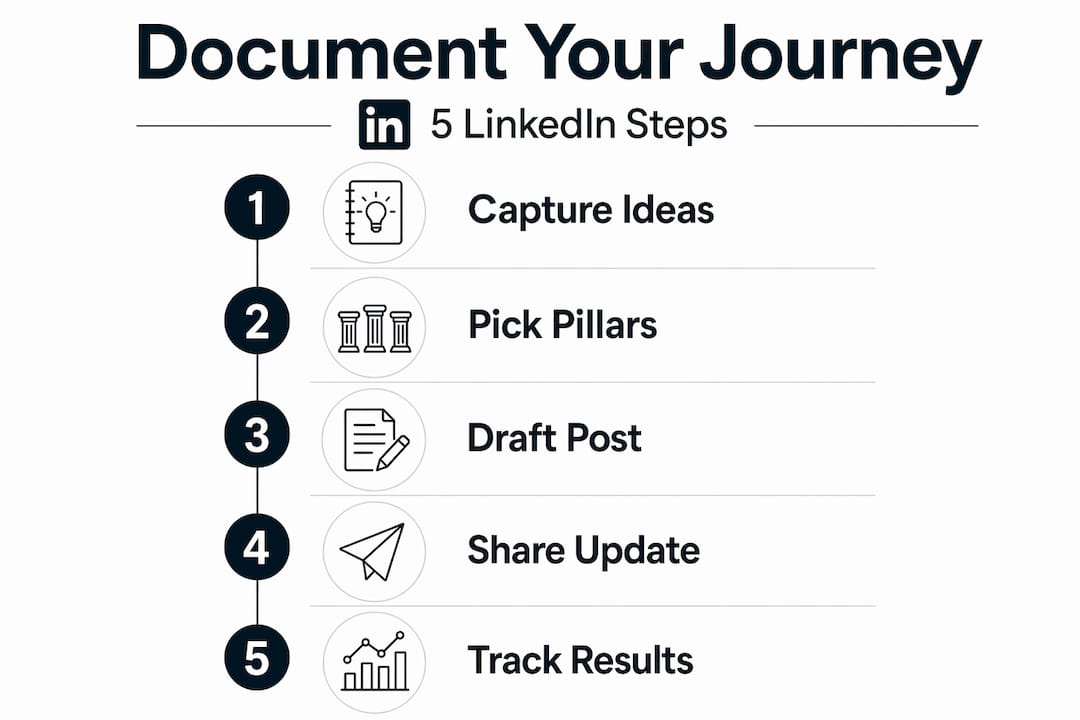
Having your pillars defined is not enough. You need a repeatable workflow that takes a raw idea and turns it into a published post without burning hours on every single update. Here is the process that works:
- Capture the moment. As soon as something noteworthy happens, write a one-line note. Do not try to craft a post in the moment. Just record the raw experience.
- Plan the angle. Within 24 hours, decide which pillar this moment fits and what the core lesson or insight is. Ask yourself: what would my audience do differently after reading this?
- Draft the post. Write a strong first line that does not start with “I” and does not summarize what you are about to say. Lead with tension, a surprising fact, or a direct question. Use short paragraphs. Three lines maximum per block.
- Add a call to action. Every post should end with a prompt. Ask a question, invite a reaction, or request a specific response. “What would you have done?” works better than “Like and share if you agree.”
- Publish and respond. Post during your audience’s active hours, typically Tuesday through Thursday between 8 and 10 a.m. Then stay online for 15 to 30 minutes to respond to every comment that comes in. Early engagement velocity affects how far LinkedIn distributes your post.
- Log the performance. After 48 hours, note the reach, comments, and profile visits. This data shapes your next post.
One of the most powerful moves you can make is turning real mistakes into content. A pivot that cost you two months, a product decision that flopped, a co-founder disagreement you navigated. These are not embarrassing. They are the content your audience actually wants to read. Avoiding press-release style narratives and leaning into authenticity and specificity is what 2026 creator strategy consistently recommends.
Personal posts generate 8x more engagement than company pages. That gap is not marginal. It is the difference between a post that reaches 200 people and one that reaches 1,600. Your face, your name, and your real story carry weight that a company logo simply cannot.
Best practices to layer in:
- Open with a hook that creates a gap the reader needs to close
- Use white space aggressively. Short lines are easier to read on mobile.
- Tag relevant people only when they are genuinely part of the story
- Avoid hashtag stuffing. Two to three relevant hashtags are enough.
- Use LinkedIn writing tips to refine your hook and structure before publishing
Optimize and measure with AI-driven tools
Once you have the basics of posting down, the next step is scaling your output without sacrificing quality or authenticity. This is where AI-driven tools change the game for founders who are already stretched thin.
Here is a numbered process for integrating AI into your LinkedIn workflow:
- Feed your AI tool real context. The best AI generators work from your actual data, not generic prompts. Connect your work tools so the AI can pull from real decisions, real metrics, and real moments.
- Draft with AI, edit with your voice. Use AI to generate a first draft quickly. Then read it aloud. Anything that does not sound like you gets rewritten.
- Format for LinkedIn specifically. AI tools built for LinkedIn understand hook structure, line breaks, and call-to-action placement. Generic writing tools do not.
- Schedule at optimal times. Use scheduling features to publish when your audience is most active without having to be online manually.
- Review analytics weekly. Look at which pillars are performing, which hooks are getting clicks, and which posts are driving profile visits. Adjust your content mix accordingly.
“A full-funnel strategy achieves 6x higher lead conversion rates.” This is the benchmark that B2B startups on LinkedIn are chasing, and it requires matching your content to every stage of the funnel, from awareness posts that reach cold audiences to tactical advice that converts warm followers into leads.
| Workflow element | Manual approach | AI-driven approach |
|---|---|---|
| Idea generation | Brainstorming sessions | Pulled from real work data automatically |
| Drafting | 45 to 90 minutes per post | 10 to 15 minutes with AI draft |
| Formatting | Manual line breaks and edits | Auto-formatted for LinkedIn |
| Scheduling | Manual publish or basic scheduler | Smart scheduling based on engagement data |
| Analytics review | Spreadsheet tracking | Automated dashboard with trend insights |
AI-driven LinkedIn post generators now handle formatting, hook writing, and scheduling in ways that used to require a dedicated content team. For founders, this means you can maintain a consistent presence without hiring. The LinkedIn-HubSpot startup benchmark data makes clear that startups using full-funnel content allocation see measurably better conversion performance.
Pro Tip: Set a recurring 20-minute block every Monday morning to review last week’s analytics. Look for your top-performing post and ask what made it work. Was it the topic, the hook, or the format? Then replicate that element in your next piece.
Avoid classic mistakes and maximize results
Even founders with great content instincts fall into traps that limit their reach and erode trust over time. Knowing what to avoid is just as important as knowing what to do.
Common mistakes that kill LinkedIn momentum:
- Only posting wins. Audiences can tell when a feed is curated to look perfect. Sharing failures and setbacks is not weakness. It is what makes people trust you.
- Ignoring comments. A post with 20 comments that go unanswered signals that you are broadcasting, not connecting. That kills future reach.
- Overusing templates. “I started with nothing. Now I have X. Here is what I learned.” This format was powerful once. Now it reads as lazy. Specificity beats structure every time.
- Posting without a call to action. Every post needs a direction. If you do not ask for a response, you will not get one.
- Chasing vanity metrics. Impressions feel good but do not tell you much. Profile visits, connection requests, and DMs are the signals that matter.
“Treat LinkedIn as an engagement loop: prompt a specific response, reply quickly, and let comments extend distribution signals.” This framing from executive LinkedIn content strategy reframes the platform entirely. You are not just publishing. You are starting conversations that the algorithm rewards with broader reach.
The engagement loop works like this: your post goes live, early commenters respond, you reply within the first 30 minutes, their networks see the activity, and the post gets pushed to a wider audience. Every reply you write is a free distribution boost.
Pro Tip: Schedule 15 minutes at the end of each workday to respond to all LinkedIn engagement from the past 24 hours. Treat it like email. Consistency here compounds your reach over weeks and months.
Our perspective: Where most ‘startup journey’ content gets it wrong
Here is the uncomfortable truth. Most startup content on LinkedIn is not authentic. It is performed authenticity. Founders write posts that sound vulnerable but are actually carefully crafted to look relatable while still presenting a winning narrative. The audience feels it. Engagement drops. Trust erodes.
The highest-performing founders we have seen do something different. They post before they know the outcome. They share the decision they are wrestling with right now, not the one they already resolved. They ask their audience for input before they have the answer. That is real vulnerability, and it drives real engagement because it makes the audience part of the story.
Formulaic inspirational posts backfire because they signal that the founder is performing rather than sharing. “I failed 100 times before I succeeded” is not a story. It is a template. What works is: “We lost our lead investor two weeks before close. Here is the exact conversation that changed the outcome.” That is a story. That is specific. That is shareable.
The other thing high-performing founders do is iterate based on signals, not ego. If a post underperforms, they do not assume the audience is wrong. They look at the hook, the format, and the call to action. They test a different angle next week. This is a discipline, not a talent.
Building authentic personal branding on LinkedIn is not about being the most polished voice in your industry. It is about being the most honest one. Imperfection, when it is specific and purposeful, is a competitive advantage that no template can replicate.
Take your LinkedIn journey further with Resonate
Applying everything in this guide manually takes real time and discipline. Most founders have the ideas but not the bandwidth to turn them into a consistent, high-quality LinkedIn presence week after week.
Resonate is built specifically for this problem. The platform connects to your actual work tools, including Notion, Slack, GitHub, and HubSpot, and pulls in real context to surface post ideas that reflect what you are actually doing. It trains on your writing patterns to generate drafts that sound like you, not like a generic AI output. It schedules safely with guardrails that protect your account, and it amplifies reach through community boosts right after publication. If you are ready to stop guessing and start building a LinkedIn presence that compounds, the Resonate AI LinkedIn generator is the practical next step.
Frequently asked questions
Why should founders post about their startup journey on LinkedIn instead of just using company pages?
Personal founder posts generate 8x more engagement than company pages, which means greater visibility, faster trust-building, and more direct conversations with potential customers, investors, and partners.
What type of content works best for documenting a startup journey?
Authentic, specific experiences framed as lessons, such as real failures, pivots, and key decisions, consistently attract more engagement than generic motivational posts or polished milestone announcements.
How can AI tools optimize LinkedIn posting for startup founders?
AI-driven LinkedIn generators handle drafting, formatting, and scheduling while optimizing hooks and calls to action, which frees founders to focus on the ideas and insights that only they can provide.
What’s the biggest mistake to avoid when sharing startup updates on LinkedIn?
Ignoring comments is the single most damaging habit. The engagement loop of prompting responses and replying quickly is what extends your post’s distribution and builds the audience trust that generic posts never can.
Recommended

Content Writer @ Resonate
Charlotte explores LinkedIn content, personal branding, AI writing, and founder-led marketing at Resonate. She believes the best content comes from real experience, not generic advice, and writes practical insights to help founders turn what they already know into content that people want to read.
Write LinkedIn content that sounds like you
with Resonate's AI Voice Engine