LinkedIn Content for Early-Stage Startups That Works
LinkedIn Content for Early-Stage Startups That Works

Most early-stage founders post on LinkedIn and hear nothing back. No comments, no DMs, no investor interest. The problem is rarely the product. It’s that LinkedIn content for early-stage startups gets treated as an afterthought, something you do when you have time. That approach leaves real opportunities on the table. This guide gives you a founder-focused content system built for the realities of a lean team, a thin following, and a runway that demands results. You’ll walk away with a clear framework covering setup, execution, measurement, and common mistakes to avoid.
Key takeaways
| Point | Details |
|---|---|
| Founder profiles drive results | Optimize your personal LinkedIn profile first; it will outperform your company page by a wide margin. |
| Text posts beat polished brand content | Authentic founder-led posts generate far more engagement than curated company announcements. |
| Track inbound signals, not vanity metrics | Qualified DMs and follower job titles matter more than likes when validating your content strategy. |
| LinkedIn Groups accelerate discovery | Active participation in relevant groups puts your content in front of investors and partners organically. |
| Batch content to stay consistent | Repurposing and scheduling posts in advance lets you show up reliably without burning out. |
What early-stage startups need before creating LinkedIn content
Before you write a single post, you need the foundation in place. Without it, good content still goes nowhere.
Profile optimization comes first
Your LinkedIn profile is the landing page investors, customers, and partners check the moment they see your content. The headline should communicate what you do and for whom. Not your title. Not “Founder at XYZ.” Something like “Building AI-powered contract review for solo attorneys.” The summary should answer three questions in plain language: what problem you solve, who you solve it for, and why you’re the person solving it. LinkedIn profile signals like company size, keywords, and founding date also affect how your startup shows up in searches, so treat them as discoverability levers, not administrative boxes to check.
Your company page should follow the same logic. Keep it consistent with your founder profile and include enough detail for a warm lead to validate you quickly. For early-stage startups, the company page is rarely the primary engagement vehicle. Think of it as supporting evidence.
Define your audience before posting anything
LinkedIn marketing for startups only works when you know exactly who you’re trying to reach. Early-stage founders typically need to attract three audiences simultaneously: potential customers, early investors, and future hires. These groups respond to different content triggers, so you need to know which one is your primary focus at any given time.
Define your ideal customer profile with specificity. Industry, company size, job title, and the specific pain they feel. Then ask whether those people are actually on LinkedIn and whether they are active. For B2B SaaS founders, the answer is almost always yes. For consumer-focused startups, the audience may be thinner.
Pro Tip: Before writing any posts, search LinkedIn for your ideal customer profile using keyword filters and look at what content they engage with. That tells you more about format and tone than any playbook.
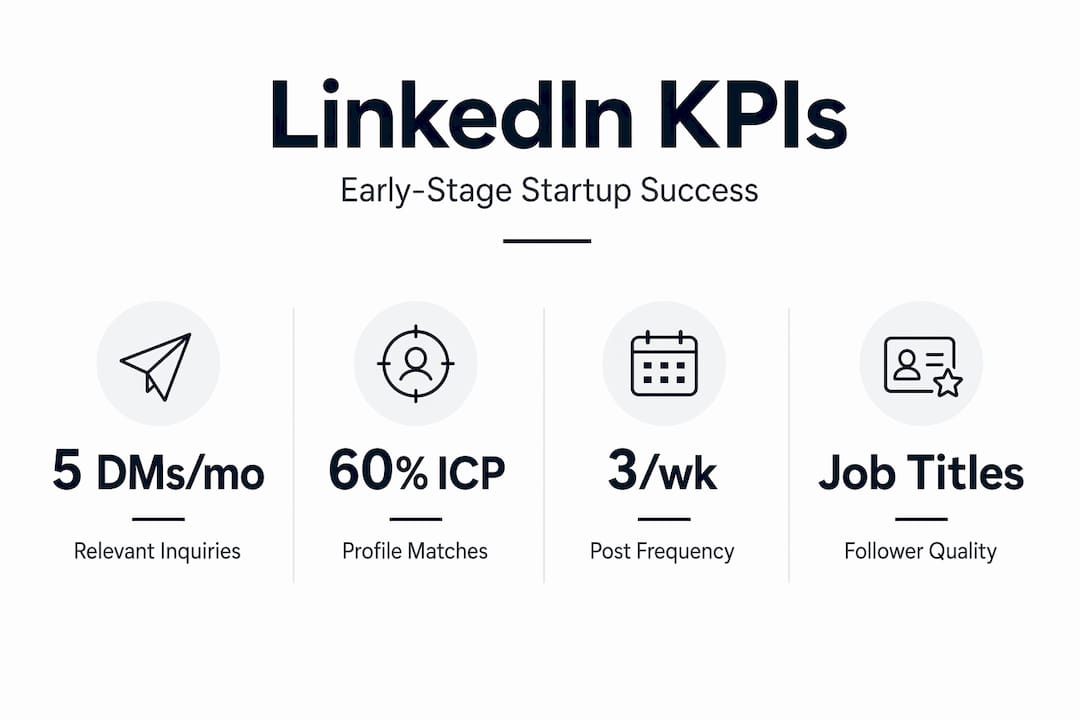
Set measurable goals before you start. Not “grow our following,” but “get five inbound DMs per month from seed-stage investors” or “generate two qualified demo requests per week from LinkedIn.” Specific goals let you evaluate whether your content strategy is actually working.
Building a content strategy execution system
Once the foundation is solid, execution is where most founders either build momentum or stall out. The key is a repeatable system, not occasional inspiration.

The content formats that actually move the needle
Personal posts vastly outperform company page content on LinkedIn, generating roughly 9 times more engagement. That single fact should drive your entire content strategy for early startups. Post from your founder profile first. Every time.
The formats that work best for early-stage founders are:
- Text-only posts with a strong first line. LinkedIn truncates posts after two or three lines before the “see more” click. Your opening sentence needs to create enough tension or curiosity to earn that click.
- Carousel posts (document format). Slide-style posts get saved and shared more than any other format. A “10 things I learned building our first product” carousel consistently outperforms a polished product announcement.
- Short-form video. Video content on LinkedIn reaches 3 to 5 times more people than text posts. If you can shoot a 60-second founder update from your desk, do it. AI-assisted tools can help convert written posts into video for startups that don’t have production resources yet.
Here’s how these formats compare across common early-stage goals:
| Format | Engagement potential | Resource required | Best for |
|---|---|---|---|
| Text-only post | High | Very low | Thought leadership, founder stories |
| Carousel (document) | Very high | Medium | Frameworks, lessons, tips |
| Short-form video | Highest reach | Medium to high | Trust-building, authenticity |
| Company page post | Low | Low | Announcements, social proof |
Cadence, batching, and keeping your sanity
Consistency beats frequency on LinkedIn. Posting three times per week with genuine perspective outperforms posting daily with filler. That said, keeping up with even a modest schedule is hard when you’re also running a company. Batching solves this.
Block two hours once a week to write five to seven posts. Schedule them out across the next two weeks. When a relevant conversation happens at your startup, capture the raw idea immediately. That raw material becomes next week’s post. Repurposing is your friend: a Slack message explaining a product decision can become a LinkedIn post. A customer discovery call insight can become a thread.
- Capture ideas daily. Keep a running note for post-worthy moments: customer reactions, team decisions, hard lessons.
- Write in batches. Set a weekly block for actual drafting. Treat it like a meeting you cannot skip.
- Schedule posts in advance. Use tools that let you queue content so you’re not relying on willpower at 8am.
- Engage immediately after posting. Reply to every comment within the first hour. The algorithm rewards early conversation activity.
- Review performance weekly. Look at what sparked conversation versus what was ignored and adjust your themes accordingly.
Pro Tip: Posting frequency and limits affect your content’s reach more than most founders realize. Understand what LinkedIn’s algorithm rewards before committing to a posting schedule.
LinkedIn Groups deserve more attention than they get in most content strategy guides. Active participation in relevant groups creates credibility loops and puts your content directly in front of investors who are already engaged in sector-specific conversations. Don’t just post links to your own content in groups. Ask questions, add context to others’ discussions, and treat the group feed as a separate engagement venue from your main feed.
Common mistakes that kill early-stage LinkedIn content
Knowing what to avoid is just as valuable as knowing what to do. These are the most common traps founders fall into.
- Chasing cold outreach over warm discovery. Investor discovery happens primarily through mutual connections, targeted searches, and group activity. Cold messaging converts poorly. Content that draws people to you converts far better.
- Measuring the wrong things. Follower count and post likes feel good but tell you almost nothing useful. The signals that matter are qualified inbound DMs, the job titles of new followers, and whether the right types of companies are engaging with your posts.
- Over-polishing to the point of sterility. Startup branding on LinkedIn does not mean every post needs to look like a press release. Founder visibility before product-market fit relies on authenticity and qualitative feedback loops. A slightly rough post that sounds like a real person beats a glossy announcement every time.
- Posting in a vacuum. Content designed for conversation performs better than content designed for broadcast. Write posts that invite responses. Ask a genuine question. Share a counterintuitive take and let the comment section do the work.
Pro Tip: When you notice a spike in qualified inbound DMs, reverse-engineer what triggered it. That post format, topic, or framing is likely your highest-signal content type. Run experiments around it.
One underappreciated mistake is spreading your effort across too many platforms too early. Concentration on a single channel with consistent founder visibility produces better early traction than diluted activity across LinkedIn, Twitter, and a blog simultaneously. Pick LinkedIn, go deep, and expand later.
Measuring success and knowing when to scale
Measurement without context is noise. Here’s a practical framework for early-stage startups to interpret their LinkedIn data honestly.
| Metric | What it tells you | Target threshold |
|---|---|---|
| Inbound DMs per month | Whether content is attracting relevant conversations | 3 to 5 qualified DMs monthly |
| Follower job titles (ICP match) | Whether you’re reaching the right audience | 60% or more match your ICP |
| Engagement rate per post | Whether content resonates with current followers | 3% or higher on personal posts |
| Comment-to-like ratio | Whether content sparks conversation vs. passive scrolling | 1 comment per 5 likes or better |
Inbound DMs and follower job titles are your most important early metrics. If the people engaging with your content are not the people you’re trying to reach, the strategy needs to shift before you scale the volume.
Long-term, consistent LinkedIn presence compounds. Founders who build a recognizable voice on LinkedIn before they raise a Series A are easier to validate during investor due diligence. Talent referrals come through shared content. Networking and audience-building create warm pipeline that no ad budget can replicate.
Pro Tip: Once your inbound DM rate and ICP match percentage both hit healthy levels, that’s the signal to increase posting frequency or add a second content format, not before. Scale what’s working, not what feels like hustle.
Indicators that you’re ready to scale include a consistent inbound conversation rate for 60 or more days, follower growth that skews toward your ICP, and content engagement that produces referrals or introductions. At that point, you can add more volume, experiment with brand visibility tactics, and consider expanding your team’s involvement in content creation.
My honest take on LinkedIn content for early startups
I’ve watched founders spend months building beautiful brand pages while their personal profiles collect dust. It’s one of the most predictable mistakes in early-stage marketing. The data is not subtle. Your personal profile will outperform your company page by such a large margin that treating the two as equals is genuinely wasteful.
What I’ve found actually works at the early stage is radically simple: post from the founder’s account, make it sound like a real person wrote it, and show up for the comments. Not viral posts. Not polished campaigns. Conversation. The startups I’ve seen gain genuine LinkedIn traction did it by treating their feed like a professional dinner party, contributing something interesting, asking questions, and following up when someone responded.
The other thing most guides miss is the role of LinkedIn Groups. Groups feel old-fashioned, but they’re where engaged, sector-specific audiences actually gather. Making content comment-ready and dropping it into a relevant group discussion is more effective than broadcasting into the void and hoping the algorithm delivers it to the right people.
Consistency is the most underrated advantage you have as an early-stage founder. You are not competing with major brands for attention. You’re competing with other founders who post sporadically and give up. Show up every week, say something worth reading, and engage with the people who respond. That compounds in ways that are hard to see in month one but obvious by month six.
- Tom
How Resonate helps you build LinkedIn content faster
If the hardest part of your LinkedIn strategy is simply finding the time to produce posts that sound like you, rather than like a press release, Resonate was built for that problem.
Resonate connects to the tools your team already uses, including Notion, Slack, and HubSpot, and pulls real content from your actual work to surface post ideas grounded in what’s actually happening at your company. The platform trains on your writing style so every generated post sounds like the founder wrote it, not like an AI filled in a template. You can batch a week’s worth of posts in one session, schedule them safely within LinkedIn’s limits, and get community boosts that amplify reach right after publication. For a lean startup team, that’s the difference between LinkedIn being a burden and being a consistent growth channel.
If you’re ready to make founder-led LinkedIn content part of your weekly routine without it consuming your week, start with the Resonate LinkedIn content generator and see how it fits your workflow.
FAQ
What type of LinkedIn posts work best for early-stage startups?
Text-only posts and document carousels from the founder’s personal profile consistently outperform company page content, generating up to 9 times more engagement according to LinkedIn algorithm data for 2026.
How often should an early-stage startup post on LinkedIn?
Three times per week from the founder’s profile is a sustainable and effective starting cadence. Consistency over a longer period matters more than posting volume in any single week.
How do investors find startups on LinkedIn?
Investors primarily discover startups through mutual connections, group participation, and targeted searches rather than cold outreach. Creating content that invites conversation in relevant LinkedIn Groups significantly increases founder visibility with investors.
What metrics should early-stage startups track on LinkedIn?
Prioritize inbound DMs from relevant contacts and the job titles of new followers over vanity metrics like total likes or follower count. These signals tell you whether your content is reaching the right audience.
When should a startup scale its LinkedIn content volume?
Scale when inbound DMs are consistent and your follower base skews heavily toward your ideal customer profile, typically after 60 or more days of steady results at your current posting frequency.
Recommended

Content Writer @ Resonate
Charlotte explores LinkedIn content, personal branding, AI writing, and founder-led marketing at Resonate. She believes the best content comes from real experience, not generic advice, and writes practical insights to help founders turn what they already know into content that people want to read.
Write LinkedIn content that sounds like you
with Resonate's AI Voice Engine