LinkedIn Hook Writing Best Practices for More Reach
LinkedIn Hook Writing Best Practices for More Reach

Your LinkedIn post lives or dies in the first two lines. Before anyone reads your insight, your story, or your hard-earned lesson, they have to decide whether to click “…see more.” That single decision is the most important event in LinkedIn post engagement, and it hinges entirely on your hook. LinkedIn hook writing best practices exist precisely because most professionals write their opening lines like press releases. This article walks you through the criteria, the archetypes, the comparison data, and the practical workflow to write hooks that stop the scroll and earn the read.
Key takeaways
| Point | Details |
|---|---|
| Hooks control post reach | The “…see more” click is the primary conversion event that determines how far your post travels on LinkedIn. |
| Short beats clever | Keep hooks under 10 to 12 words so they display fully on mobile before truncation. |
| Rotate your hook types | Cycling between contrarian, story, data, and curiosity hooks prevents audience fatigue and keeps your feed presence fresh. |
| Write the post first | Extract your strongest sentence from the finished post rather than forcing a hook before you know what you want to say. |
| Test and track early | Monitoring engagement in the first 60 minutes after posting tells you whether a hook is working before the algorithm moves on. |
LinkedIn hook writing best practices: the core criteria
Every great LinkedIn hook satisfies a small set of non-negotiable conditions. Miss one, and even your best content disappears into the feed.
Length comes first. Hooks over 12 words risk being cut off on mobile before the “…see more” button appears, which means readers never get the invitation to click. Eight to twelve words is your window. Shorter is almost always better.
Standalone strength matters. A hook should work as its own sentence. It should not trail off, require context from the second line, or hint vaguely at something. Strong hooks promise a payoff and earn reader trust by being specific and complete. If you removed everything after the first line, would anyone feel compelled to ask what comes next? That is the test.

Emotion or curiosity must be present. A hook that triggers neither feeling is just a sentence. The best openers generate curiosity, emotion, or name a real problem the reader recognizes immediately. That recognition is what produces the click.
Tone has to feel human. Corporate language kills hooks faster than any other mistake. Personality-driven hooks outperform press release language because people are scanning for other people, not brands. You can be professional and still sound like yourself.
Pro Tip: Write ten candidate hooks for every post. Delete the first five. The first five are almost always what everyone else would write. The next five are where your actual voice shows up.
The five hook archetypes that drive engagement on LinkedIn
Knowing the psychological triggers behind each hook type makes writing attention-grabbing hooks faster and more deliberate.
1. Contrarian hooks
These open with a belief reversal. “Most LinkedIn advice is making you less visible” or “Cold outreach is not dead. Your cold outreach is dead.” Contrarian hooks prompt debates and draw comments because they challenge something the reader already holds. The LinkedIn algorithm weighs comments heavily, which means more debate equals more distribution.
2. Curiosity gap hooks
These create an open loop the brain wants to close. “The email subject line that got me a 78% open rate” or “Three things I stopped doing after my first 10,000 LinkedIn followers.” The reader cannot know the answer without clicking. Curiosity gap hooks are particularly effective for list posts and case studies.
3. Data-driven hooks
Specific numbers build authority fast. “I analyzed 200 LinkedIn profiles. Here is what separates the top 1%.” The specificity signals that real research happened, which matters to B2B audiences who are trained to be skeptical. Avoid round numbers. “5 things” feels templated. “I tested 47 subject lines” feels lived-in.
4. Story-driven hooks
A single concrete scene pulls readers in. “I walked out of a board meeting and deleted my LinkedIn account. Two weeks later I rebuilt it from scratch.” Story hooks work because the brain processes narrative differently than information. Readers do not evaluate a story opening. They simply follow it. This is one of the most reliable tools for crafting compelling LinkedIn content.
5. List or framework hooks
These set clear expectations. “Four reasons your LinkedIn posts are not being read. None of them are your writing.” The reader knows the format, trusts the structure, and believes they will learn something discrete and applicable. This hook type also benefits from paired curiosity, since you name the topic but withhold the list until the click.
Rotating between hook types over time is not just good variety. It actively protects your reach. When your audience starts to predict your opening style, they stop reading carefully and engagement drops.
Comparing hook types by context and effectiveness
Different hooks serve different goals. This table gives you a quick reference for matching hook type to content and audience.
| Hook type | Engagement potential | Best context | Key strength | Watch out for |
|---|---|---|---|---|
| Contrarian | Very high | Opinion posts, industry takes | Sparks comments and debate | Can feel manufactured if not genuinely believed |
| Curiosity gap | High | Case studies, lessons learned | Creates irresistible open loops | Vague hooks that promise but under-deliver |
| Data-driven | High | B2B content, research posts | Signals authority and specificity | Round numbers undermine credibility |
| Story-driven | High | Personal experience, career moments | Emotional engagement and narrative pull | Long setups that bury the tension |
| List or framework | Medium to high | How-to posts, explainers | Clear expectations and easy commitment | Overuse makes hooks feel templated |
The LinkedIn algorithm rewards posts that earn “see more” clicks because that metric signals genuine reader interest. Hooks that generate controversy perform especially well because comments are weighted more than likes in feed distribution. Data hooks tend to build longer-term trust in professional and B2B contexts, where authority matters more than emotion. Story hooks perform best when the situation is immediately relatable to your specific audience.
Pro Tip: Before picking a hook type, ask: what do I want readers to do after reading? Comment? Click through? Share? Match the hook to that goal, not just to what feels natural to write.
Practical workflow for writing and testing your hooks
These are the habits that separate consistent LinkedIn performers from occasional viral posts.
Write the post first. Extracting the most compelling sentence from a finished post almost always produces a stronger hook than writing the hook before you know what you want to say. Read through what you wrote. Find the sharpest, most specific, most surprising line. That is your hook.
Build a swipe file. Collecting and classifying hooks by psychological mechanism gives you a reference library that sparks ideas without becoming a copy-paste crutch. Every time you stop scrolling on LinkedIn, note the hook and label what made it work. Curiosity? Specificity? Contrast? Over time this library becomes one of your most practical writing tools. The Resonate blog offers additional frameworks for building this kind of systematic content practice.
Test with variation. A/B testing hooks by posting the same core content with different opening lines across separate days is how you move from guessing to knowing what resonates with your audience. No two audiences are identical. What wins for a growth marketer may tank for a software engineer.
Track the first 60 minutes. Early engagement signals tell the algorithm whether to distribute your post more widely. If a hook is not generating clicks and comments in that window, the post’s organic reach will likely plateau. You do not need to obsess over it. Just know the window and review your numbers before moving on.
Edit for simplicity, not complexity. Every time you revise a hook, ask whether you can say the same thing in fewer words with more specificity. “I was wrong about remote work” beats “My perspective on remote work has changed significantly over the past year.”
Pro Tip: Read your hook out loud. If it sounds like something from a company newsletter, rewrite it. Your hook should sound like something you would say to a colleague over coffee.
Common mistakes that kill your hook before the first read
Even professionals who know the basics still make these errors regularly. They are worth naming plainly.
Opening with pleasantries or greetings. “Happy Monday, LinkedIn!” and “Excited to share that…” waste your hook space completely. Nobody clicks “…see more” to find out what you are excited about.
Using jargon and buzzwords. Words like “synergy,” “disruptive,” “thought leadership,” and “moving the needle” signal to readers that what follows will be equally generic. Drop them.
Asking obvious questions. “Are you struggling to get engagement on LinkedIn?” answers itself. It also tells the reader you have nothing surprising to offer. Strong questions are specific and slightly uncomfortable. “Are you writing for your audience or for your manager?” is a question worth answering.
Repeating the same hook structure. If every post starts with “I failed at X. Here is what I learned,” your audience learns to tune it out. Vary your hook types across posts to keep your presence in the feed feeling fresh and worth reading.
Being vague to seem mysterious. Incomplete hooks that hint at something without delivering any tension create frustration, not curiosity. Readers close the loop by scrolling past.
Authenticity is not just a buzzword here. It is a practical competitive advantage. Professional hooks that balance credibility with personal voice outperform corporate language consistently. You do not have to share your deepest vulnerabilities. You just have to sound like a real person who has actually done the thing you are writing about.
My honest take on hooks and what most professionals miss
I have watched professionals spend two hours crafting a thoughtful post and thirty seconds writing the first line. That imbalance is the single biggest reason good ideas go unread on LinkedIn.
Here is what I have learned from watching effective LinkedIn hooks in action: the hook is not a marketing problem. It is a clarity problem. When someone cannot write a compelling opening, it usually means they have not yet figured out the most interesting thing they want to say. The hook is the moment of reckoning.
What I find genuinely under-discussed is the relationship between hook quality and posting frequency. If you post three times a week with mediocre hooks, you are training your audience to ignore your first line. One post a week with a hook that actually earns attention builds a stronger association over time. Quality of opening signals quality of content, and that reputation compounds. You can also explore how posting frequency affects reach if you want to think about this more systematically.
The professionals I have seen grow fastest on LinkedIn are the ones who treat hooks the way copywriters treat headlines. They write ten, delete most, and test the survivors. They keep a running file of what worked. They study the hooks that stopped them while scrolling and ask why. That systematic attention is what separates creators who grow from creators who wonder why they are not growing.
- Tom
Write hooks that actually sound like you with Resonate
Knowing the best practices for LinkedIn intros is one thing. Applying them consistently, post after post, while maintaining your actual voice is where most people stall.
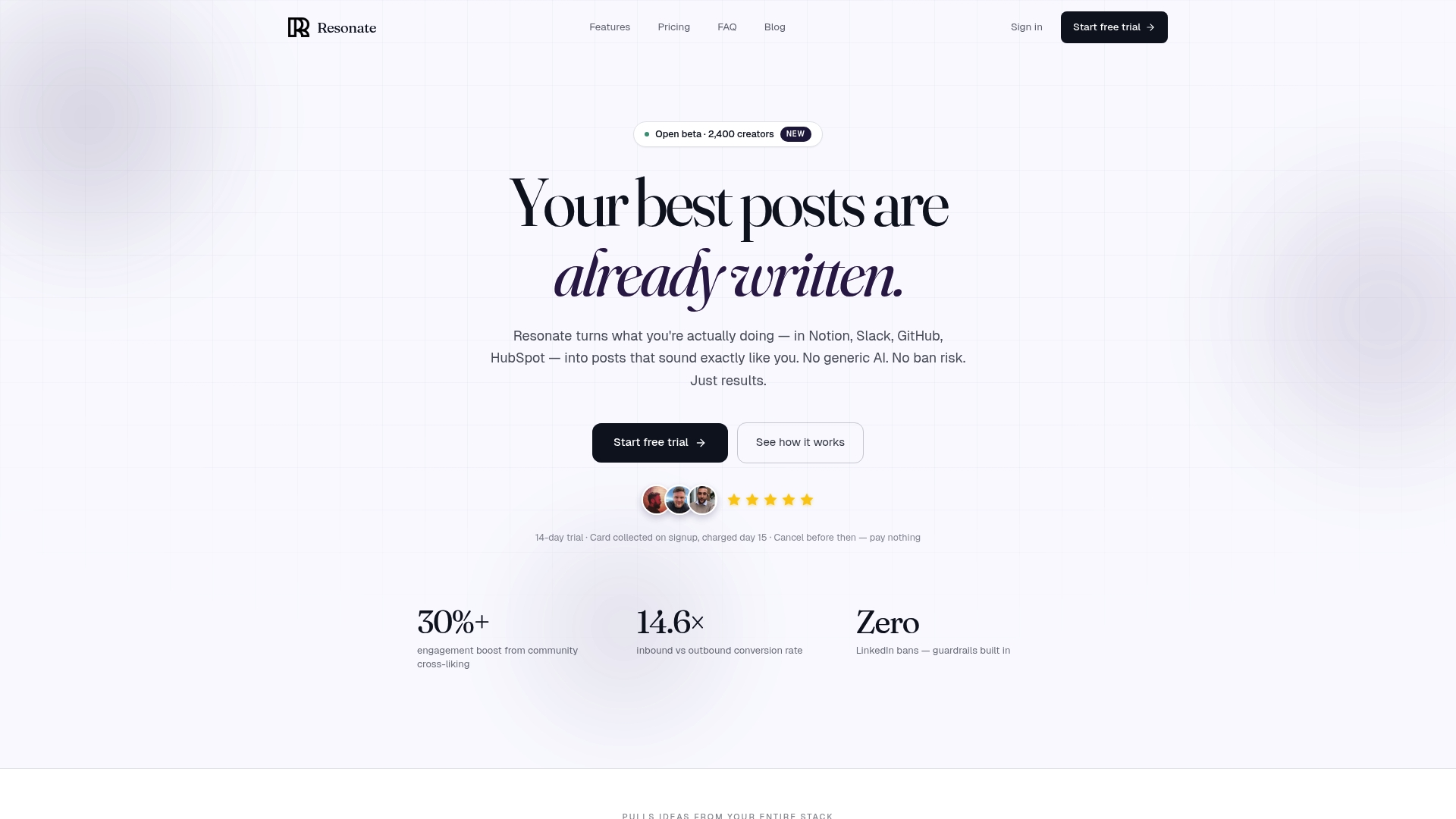
Resonate is built specifically for this problem. The platform trains on your individual writing style and pulls from your real work across tools like Notion, Slack, and HubSpot to surface post ideas grounded in what you actually do. Its AI critique agents review your hooks against engagement criteria, and its built-in analytics track what resonates with your specific audience over time. For professionals who want to test and refine their LinkedIn content approach without losing the human voice that makes posts worth reading, Resonate gives you the structure to do it at scale without sounding like a template.
FAQ
What makes a LinkedIn hook effective?
An effective LinkedIn hook is short (under 12 words), creates curiosity or emotion, and works as a standalone sentence. The goal is to earn the “…see more” click, which is the primary driver of post reach.
How long should a LinkedIn hook be?
Keep your hook to 8 to 12 words. Anything longer risks being truncated on mobile before the “see more” button appears, which reduces the chance of a reader clicking through.
Which hook type gets the most engagement?
Contrarian and curiosity gap hooks tend to generate the highest engagement because they trigger comments and debates, which the LinkedIn algorithm uses as a signal to distribute posts more widely.
How do I test whether my LinkedIn hooks are working?
Post the same content with varied hooks on different days and track engagement in the first 60 minutes. Early comments and clicks are the clearest signal of hook effectiveness.
Should I write my hook before or after the rest of the post?
Write the full post first, then extract the most specific or surprising sentence to use as your hook. This approach produces stronger openers than forcing a hook before you know what you want to say.
Recommended

Content Writer @ Resonate
Charlotte explores LinkedIn content, personal branding, AI writing, and founder-led marketing at Resonate. She believes the best content comes from real experience, not generic advice, and writes practical insights to help founders turn what they already know into content that people want to read.
Write LinkedIn content that sounds like you
with Resonate's AI Voice Engine