LinkedIn Networking Content Strategy That Gets Results
LinkedIn Networking Content Strategy That Gets Results

Most professionals post on LinkedIn regularly and see almost nothing in return. No new clients, no meaningful conversations, no real relationships. The problem usually isn’t effort. It’s that posting without a deliberate linkedin networking content strategy is like handing out business cards at an empty conference. This guide walks you through building a content plan that works from the ground up: who you’re speaking to, what you’re saying, how you’re showing up consistently, and how you’re turning visibility into real business conversations.
Key takeaways
| Point | Details |
|---|---|
| Quality beats quantity | Targeted networks of 2,000 - 5,000 connections generate more inbound leads than large, unfocused followings. |
| Content pillars focus your effort | Define 3 - 4 pillars that balance expertise, personal perspective, and audience pain points to attract the right people. |
| The 4-1-1 framework sustains momentum | Post four value-driven pieces for every soft promo and one direct call to action to stay visible without burning out your audience. |
| Golden hour engagement is critical | Responding to comments within the first 60 minutes after publishing significantly amplifies your post’s reach. |
| Visibility alone isn’t networking | Converting public interactions into private, structured conversations is where real business relationships are built. |
Your LinkedIn networking content strategy starts here
LinkedIn’s algorithm has changed significantly, and the tactics that worked three years ago mostly don’t anymore. The platform now rewards content that earns genuine attention, not just surface-level clicks. Specifically, dwell time and saves are now primary distribution signals. Likes and shares, which once felt like the whole game, are secondary at best.
What this means practically: a post that earns 200 likes from passive scrollers is worth far less than a post that earns 40 thoughtful comments and gets saved by people who intend to act on it. LinkedIn is reading behavior, not just interaction counts.
“Prioritizing dwell time and saves reflects a platform-wide trend favoring deeper engagement for building real authority.” - Teneo
There’s also the authenticity factor. Posts with 30% human input outperform fully AI-generated content by 150% in organic performance. The algorithm can detect when content reads like it was written by a template rather than a person. And so can your readers.
This is the environment you’re operating in. A large random network is not an asset in this context. Targeted connections of 2,000 - 5,000 consistently generate more inbound leads than accounts with 20,000 followers who don’t know what you stand for.
Building your content pillars and audience profile
Before writing a single post, you need to know exactly who you’re writing for and what space you want to own. This isn’t abstract planning. It’s the foundation that makes everything else work.
Start with your ideal reader. Get specific: job title, industry, company size, and the specific frustration they’re trying to solve. A “business owner” is not specific enough. “A 40-person SaaS company’s VP of Sales trying to shorten their sales cycle” is a real target.
From there, build a content positioning statement. Something like: “I help B2B sales leaders close faster by sharing what I’ve learned about buyer psychology and deal structure.” This statement does two things. It tells your audience immediately whether you’re relevant to them. It also trains LinkedIn’s algorithm to distribute your content to the right people by creating semantic relevance and targeted distribution.
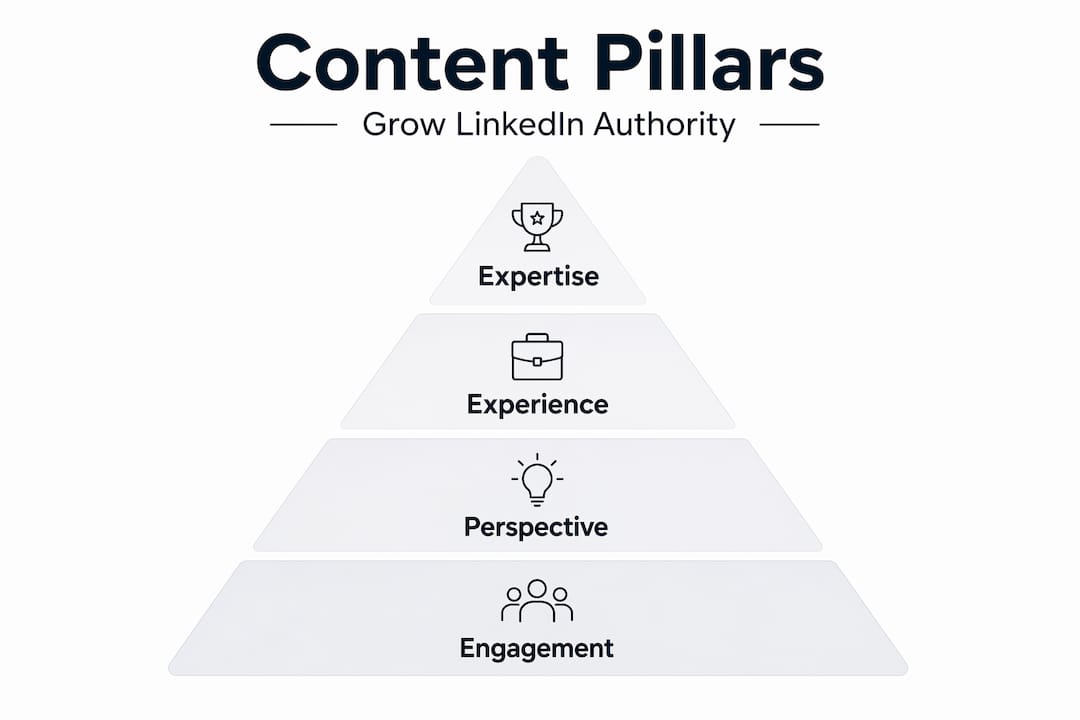
Once your positioning is clear, build your content pillars. Aim for three to four that cover different angles:
- Expertise posts share what you know: frameworks, processes, hard-won lessons.
- Experience posts share what you’ve lived through: wins, failures, surprises.
- Perspective posts share your point of view: contrarian takes, predictions, hot takes.
- Connection posts invite participation: questions, polls, discussions.
Here’s a quick comparison of how these pillars differ in purpose and expected outcome:
| Pillar | Primary goal | Engagement type |
|---|---|---|
| Expertise | Build authority | Saves, shares |
| Experience | Build relatability | Comments, DMs |
| Perspective | Build differentiation | Debate, follows |
| Connection | Build community | Replies, reach |
Rotating across these pillars keeps your feed from feeling repetitive and helps you attract different types of valuable connections with each post.
Executing your content plan with consistency
Strategy without execution is just a document. Here’s how to put it into practice without burning out by week three.

The optimal posting frequency is 3 - 5 times per week, paired with a 4-1-1 content mix. For every six posts, four should deliver pure value (no ask), one can mention your work softly, and one can include a direct call to action. This ratio keeps your audience engaged rather than feeling sold to.
Your post’s first line is everything. LinkedIn collapses text after two to three lines. If your opening line doesn’t create a reason to click “see more,” you’ve already lost most of your audience. Specific, curious, or slightly provocative openers outperform polished summaries every time. “Here’s why most LinkedIn profiles repel the right clients” will outperform “Today I want to share some LinkedIn tips.”
When it comes to format, vary it deliberately. Carousel posts tend to earn high saves. Short videos earn dwell time. Polls invite fast participation and signal your audience’s priorities back to you. Text-only posts with strong storytelling perform surprisingly well when the writing earns attention on its own. The mix matters more than any single format.
Pro Tip: Batch-creating content by separating ideation from drafting saves 60 - 70% of the time you’d spend writing ad-hoc. Block two hours per week for ideas and one hour for drafts. You’ll be more consistent and less stressed.
Your engagement routine matters as much as your posting schedule. Comment thoughtfully on five to ten posts before you publish your own. This warms up your account’s activity signal and puts your name in front of potential connections. After you publish, respond to early comments within the first 60 minutes. This is the golden hour. Strong early engagement within that window triggers broader platform-wide distribution. Miss it, and even a great post plateaus early.
Meaningful comments with 15 or more words that genuinely add to a conversation are among the highest-value signals LinkedIn tracks. Leave those kinds of comments on other people’s posts. Earn them on yours.
Moving from visibility to real relationships
Here’s where most content marketing on LinkedIn breaks down. Professionals spend months building an audience and then wonder why it hasn’t translated into business. The answer is almost always that they stopped at visibility and never moved into conversation.
Connection count is a vanity metric by itself. What matters is how many of those connections you’ve actually talked to. Most opportunities on LinkedIn arise not from posts being seen but from turning interactions into personalized, direct follow-ups.
Here’s a practical sequence to move people from public engagement to private conversation:
- Identify contacts who comment on your posts repeatedly or whose content aligns with your work.
- Engage with their content meaningfully for one to two weeks before reaching out.
- Send a connection request that references something specific: a post they wrote, a comment they left, or a shared professional challenge.
- After connecting, open the conversation around their work or a mutual interest. Not your pitch.
- When the conversation is warm, propose a specific next step: a 20-minute call, a resource you can share, or a question you genuinely want their take on.
Pro Tip: Think of LinkedIn as the top of the funnel that leads to owned channels. Once a relationship develops, invite people into your email list or private community where the real depth of connection happens. You don’t own your LinkedIn audience. You rent it.
LinkedIn Groups and collaborative posts (inviting others to co-create content) are underused relationship-building tools. Tagging someone thoughtfully in a post you know they’d find useful is a conversation starter that doesn’t feel cold.
Measuring and refining your strategy
You can’t improve what you don’t track, but you also can’t learn anything useful if you’re watching the wrong numbers. Here’s a table of the metrics that actually tell you whether your linkedin networking content strategy is working:
| Metric | What it tells you |
|---|---|
| Profile views per week | Whether your content is driving curiosity about who you are |
| Search appearances | Whether you’re showing up in your niche’s relevant searches |
| Inbound DMs | Whether your content is prompting people to reach out |
| Post saves | Whether your content is delivering lasting perceived value |
| Engagement rate | Whether your existing audience finds your content worth stopping for |
Follower count is not on this list. It’s a lagging indicator and tells you very little about whether real networking in marketing is happening.
Review these numbers weekly, not daily. Daily tracking creates noise. Weekly patterns reveal signal. When a post earns significantly more saves or DMs than usual, note the topic, the format, and the hook. That’s data pointing you toward what your audience actually values.
Adjust your content pillars every 60 to 90 days based on what you find. If your perspective posts consistently outperform your expertise posts, lean into your point of view. If a particular topic drives inbound messages, that’s a content pillar worth expanding. The strategy should evolve with your audience’s responses, not stay frozen in your original plan.
Avoid the trap of posting more when results plateau. More volume rarely fixes a positioning or relevance problem. Before increasing frequency, ask whether your content is genuinely solving a real problem for a specific person. If the answer is unclear, go back to your audience profile and sharpen it.
My honest take on LinkedIn content and real networking
I’ve watched professionals spend enormous amounts of time and energy chasing follower counts on LinkedIn and end up frustrated. In my experience, rapid follower growth is genuinely one of the most misleading signals you can optimize for. It feels like momentum. It usually isn’t.
What I’ve learned is that the professionals who build the strongest LinkedIn networks aren’t always the ones posting every day. They’re the ones who show up with a clear point of view, engage like real humans, and follow up with the people who actually respond. That deliberate pattern, repeated over six to twelve months, compounds in a way that quick growth hacks simply don’t.
The thing I’d push back on most is the idea that you need to create more content to network better. You don’t. You need to create more purposeful content and spend the time you save on actual conversations. Sustainable content creation comes from focusing on specific audience questions, not from posting more. Quantity without that focus is just noise, and LinkedIn’s algorithm is increasingly good at detecting the difference.
Patience is the actual competitive advantage here. Most people quit their strategy after six weeks. The ones who stay consistent and keep refining almost always win.
- Tom
How Resonate helps you execute this strategy
Building a consistent LinkedIn content strategy is hard to maintain alone, especially when you’re also running a business or managing a team.
Resonate is built specifically for this problem. The platform trains on your voice and writing style so the content it generates sounds like you, not like a template. It connects with your existing work tools to surface real post ideas from your actual work, supports the 4-1-1 content mix with scheduling and publishing tools, and includes community boost features that amplify reach during that critical golden hour window. The AI-powered content generator handles the repetitive parts of your content workflow so you can focus your time on the conversations that actually build relationships. If you’re serious about turning LinkedIn into a consistent source of real business connections, explore what Resonate’s tools can do for your strategy at the Resonate blog.
FAQ
What is a LinkedIn networking content strategy?
A LinkedIn networking content strategy is a deliberate plan for creating and sharing content that attracts specific professional connections and converts visibility into real business relationships, rather than simply accumulating followers.
How often should you post on LinkedIn for networking?
Posting 3 - 5 times per week using a 4-1-1 content mix (four value posts, one soft promo, one direct call to action) is the optimal frequency for maintaining visibility without overwhelming your audience.
What content works best for LinkedIn networking?
Posts that earn saves, long comments, and dwell time perform best. Carousel posts, opinion-driven text posts, and experience stories tend to generate the most meaningful engagement and inbound conversations.
How do you turn LinkedIn connections into business relationships?
Engage with the same people consistently before reaching out, then send personalized connection requests referencing specific interactions. Follow up in direct messages with a genuine question or offer, not a pitch. Most LinkedIn opportunities come from private follow-up conversations, not public posts.
How do you measure success on LinkedIn beyond follower count?
Track profile views, search appearances, post saves, inbound DMs, and engagement rate. These metrics show whether your content is driving real curiosity and conversations, which are the actual outcomes a strong LinkedIn networking strategy should produce.
Recommended

Content Writer @ Resonate
Charlotte explores LinkedIn content, personal branding, AI writing, and founder-led marketing at Resonate. She believes the best content comes from real experience, not generic advice, and writes practical insights to help founders turn what they already know into content that people want to read.
Write LinkedIn content that sounds like you
with Resonate's AI Voice Engine