LinkedIn Visibility Benefits Startups: 2026 Growth Guide
LinkedIn Visibility Benefits Startups: 2026 Growth Guide

LinkedIn visibility is the single most valuable free asset a startup founder controls in 2026. LinkedIn generates 80% of all B2B social media leads, and founders who post actively see 33% more leads than those who stay silent. Deals also close 22% faster when buyers already recognize a founder through LinkedIn content. For startups without a legacy brand or institutional credibility, that recognition gap is the difference between a warm conversation and a cold rejection.
1. LinkedIn visibility benefits startups by building instant credibility
LinkedIn visibility is the practice of consistently showing up in search results, feeds, and conversations on the platform so that the right people find you before you find them. For startups, this matters more than for established companies because founders carry the brand. A prospect researching your company will check your LinkedIn profile before they check your website. If your profile is thin or your feed is empty, you lose the deal before the first call.
The credibility gap is real, and LinkedIn closes it faster than any other channel. Founder personal brands compensate for institutional credibility in early-stage startups, making the founder’s public voice the primary trust signal for investors and partners. That means your LinkedIn presence is not a nice-to-have. It is your pitch deck’s opening slide.

2. Optimizing your LinkedIn profile boosts discovery and trust
A fully optimized LinkedIn profile is 40x more likely to receive recruiter or partner interest than an incomplete one. Profiles with professional headshots get 14x more views. These are not marginal improvements. They represent the difference between being found and being invisible.
The most effective profile optimization treats your page as a landing page, not a résumé. Recruiters spend 40% of their time reviewing the About section, so that section must speak directly to the problems your buyers, investors, or recruits are trying to solve. A chronological list of job titles does not do that. A clear statement of what you build, who you help, and what results you deliver does.
Key profile elements to address:
- Headline: Include the specific problem you solve, not just your title. “CEO at Acme” tells no one anything. “Helping logistics teams cut delivery costs by 30%” earns a click.
- About section: Write in first person. Address your reader’s pain, then explain your solution. End with a clear call to action.
- Featured section: Pin your best post, a case study, or a press mention. This is prime real estate most founders leave blank.
- Experience entries: Lead with outcomes, not duties. “Grew ARR from $0 to $2M in 18 months” beats “Responsible for sales strategy.”
Profile audit and updates take about 60 minutes. Visibility improvements appear within 48 - 72 hours. That is the fastest ROI in startup marketing.
Pro Tip: Run a keyword audit on your headline and About section. Search LinkedIn for your ideal customer’s job title and note the language they use in their own profiles. Mirror that language in yours to appear in their searches.
3. Consistent, authentic content accelerates startup growth on LinkedIn
Posting 10 or more times per year yields 33% more leads than posting less. That is a low bar, and most founders still miss it. The founders who win on LinkedIn post consistently and write from personal experience rather than recycling generic industry takes.
Posts with personal stories drive 38% higher engagement than promotional updates. The algorithm rewards depth signals like dwell time and saves. A post that makes someone stop, read, and save gets amplified. A post that announces a product update gets ignored.
The compounding effect is significant. Consistent posting over 60 days yields 78% higher content distribution compared to sporadic posting. Most founders quit before the 60-day mark because early posts get little traction. That is a mistake. LinkedIn authority builds like compound interest. The first month feels flat. The third month feels different.
A practical content framework for founders:
- “How I” posts: Share a specific decision you made and what happened. These generate 3x more saves than listicles.
- Failure posts: Describe something that did not work and what you learned. Vulnerability increases engagement and trust simultaneously.
- Behind-the-scenes posts: Show the real work. A photo from a customer visit or a screenshot of a product milestone outperforms polished marketing copy.
- Opinion posts: Take a clear position on an industry trend. Neutral content gets neutral engagement.
- Customer story posts: Share a specific result a customer achieved. Name them if they agree. Specificity builds credibility.
Pro Tip: Write your posts the night before and schedule them for 7 - 9 AM on Tuesday, Wednesday, or Thursday. Then block 30 minutes after posting to reply to every comment. Engaging within the first 60 minutes doubles your post’s impressions.
4. Why personal profiles outperform company pages for startup reach
Personal posts generate up to 8x more engagement than company pages on LinkedIn. Personal profiles reach 8 - 15% of followers organically. Company pages reach 2 - 5%. Company page organic reach dropped 60 - 66% since 2024. Those numbers make the decision simple.
Company pages still serve a purpose. They are the right place for job postings, official announcements, and static company information. Investors and recruits will check your company page to verify legitimacy. But they will not discover you through it. Discovery happens through personal content.
The practical implication for startups is clear. Founders should lead the content strategy personally. Employees who post about their work amplify reach further. A company page that reposts founder content gets some secondary distribution. But the founder’s personal feed is where the audience actually forms.
LinkedIn content is also a primary source surfaced by AI search tools when prospects research founders and companies. That means your LinkedIn posts now appear in ChatGPT and Perplexity answers when someone searches your name or your startup’s category. Active content creation is no longer just a social media tactic. It is a search strategy.
5. LinkedIn visibility accelerates recruitment, investment, and partnerships
The business outcomes of strong LinkedIn visibility are concrete and measurable. An optimized profile is 40x more likely to attract recruiter interest, which matters enormously for startups competing against larger companies for top talent. Candidates research founders before accepting offers. A visible, credible founder profile tips the decision.
The investment and partnership outcomes are equally strong:
- Deal size: Deals with executive LinkedIn influence show 3.7x larger deal sizes than deals without it. Buyers who trust a founder spend more.
- Win rates: Executive LinkedIn presence correlates with 11% higher win rates in competitive sales situations.
- Lead conversion: Inbound leads from personal LinkedIn content convert at 14.6%, compared to 1.7% for cold outbound leads. That is an 8x difference in conversion efficiency.
- Sales cycle speed: Buyers familiar with a founder through LinkedIn content close 22% faster. Familiarity removes friction.
The “LinkedIn-First GTM” approach formalizes this dynamic. Founders publish content consistently to build familiarity, then follow up with direct outreach. Prospects who already recognize the founder respond at significantly higher rates because the cold call is no longer cold. This shortens sales cycles and improves the quality of every conversation.
Pro Tip: Before sending a connection request to a target investor or partner, comment meaningfully on two or three of their posts over two weeks. When your request arrives, they already know your name.
6. How LinkedIn content builds long-term startup brand authority
LinkedIn authority compounds over time, but the timeline surprises most founders. Building a notable inbound pipeline typically requires 3 - 6 months of consistent, high-quality posting. Founders who quit after four weeks never see the return. Those who stay consistent past the 90-day mark report a qualitative shift in the quality of inbound conversations.
The mechanism is straightforward. Early posts build a small audience. That audience engages, which signals to the algorithm that the content is worth distributing further. Each post reaches a slightly larger group. Over months, the founder becomes associated with a specific topic in their network’s mind. When a relevant opportunity arises, that founder is the first name that comes up.
Startup branding on LinkedIn also benefits from the dual approach of content publishing and outbound connection requests. Publishing alone builds awareness. Outbound connection requests alone feel cold. Combined, they create a recognition loop where prospects see your content before you reach out, making every touchpoint warmer and more effective.
Key Takeaways
LinkedIn visibility drives startup growth through profile optimization, consistent personal content, and founder-led engagement that compounds over months.
| Point | Details |
|---|---|
| Profile optimization pays fast | A fully optimized profile is 40x more likely to attract recruiter or partner interest, with results visible in 48 - 72 hours. |
| Personal content beats company pages | Personal posts reach 8 - 15% of followers versus 2 - 5% for company pages, making founder content the primary growth channel. |
| Consistency unlocks distribution | Posting consistently over 60 days increases content distribution by 78%, but most founders quit before reaching that threshold. |
| Inbound leads convert far better | Personal LinkedIn content converts at 14.6% versus 1.7% for cold outreach, making visibility a direct revenue driver. |
| Authority builds over 3 - 6 months | Meaningful inbound pipelines typically develop after 3 - 6 months of consistent posting, not weeks. |
What I’ve learned about LinkedIn as a startup founder
The most common mistake I see founders make is treating LinkedIn like a press release channel. They post product announcements, funding news, and award wins. Those posts get polite likes from employees and crickers from everyone else. The posts that actually build a pipeline are the ones that make you slightly uncomfortable to publish.
The vulnerability piece is not a soft concept. It is an algorithm signal. A post about a deal you lost and what it taught you will outperform a product launch post every time. Buyers and investors are not looking for perfection. They are looking for self-awareness and judgment. Those qualities show up in honest content, not polished marketing.
The other thing I would tell any founder is to ignore the first 60 days of data. Early posts will feel like shouting into a void. That feeling is normal and temporary. The founders who build real LinkedIn authority are the ones who treat the first 90 days as practice, not performance. They post, they learn what resonates, and they adjust. By month four, the compounding effect becomes visible. By month six, inbound opportunities start arriving without any outbound effort.
The practical advice is simple. Pick two or three content formats that feel natural to you. Commit to posting three times per week for 90 days. Engage genuinely with every comment within the first hour. Do not automate your engagement. The algorithm detects it, and your audience definitely does.
- Tom
How Resonate helps founders stay consistent on LinkedIn
Staying consistent on LinkedIn is the hardest part for busy founders. Content ideas run dry. Writing takes time. Posting schedules slip. Resonate solves this by generating personalized LinkedIn content that matches your actual voice, not a generic AI template.
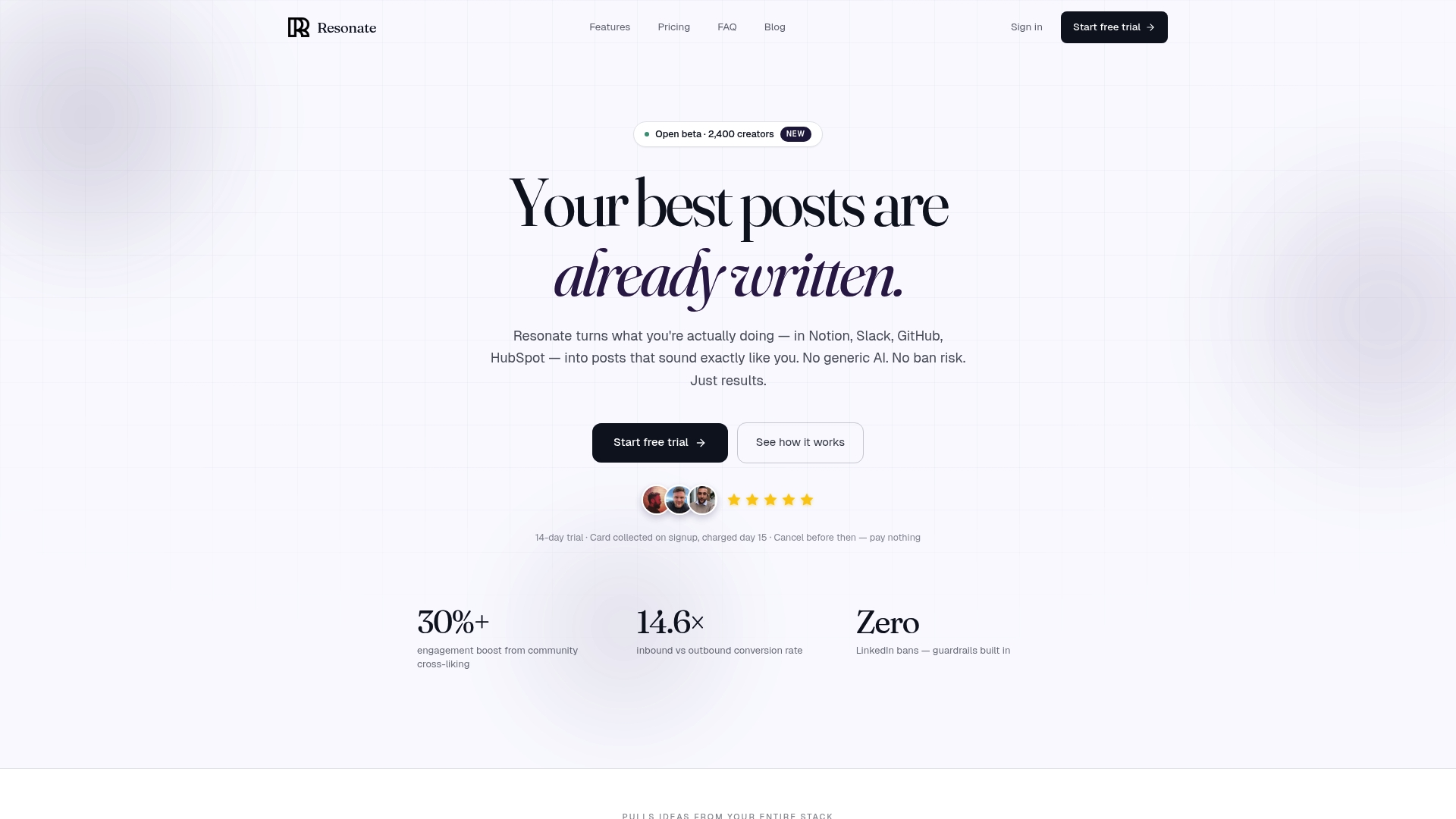
Resonate connects to tools you already use, including Notion, Slack, and HubSpot, to surface post ideas from your real work. It trains on your writing patterns so every post sounds like you wrote it. Built-in safety guardrails prevent the account bans that come from aggressive automation. For founders who want to maintain a consistent posting schedule without spending hours writing each week, Resonate handles the workflow from idea to publish.
FAQ
How often should startup founders post on LinkedIn?
Posting at least 10 times per year generates 33% more leads than posting less, but three times per week is the cadence that builds meaningful authority within 60 - 90 days.
Do LinkedIn company pages work for startup visibility?
Company pages are useful for job postings and official information, but their organic reach dropped 60 - 66% since 2024. Founder personal profiles reach 8 - 15% of followers versus 2 - 5% for company pages, making personal content the stronger channel.
How long does it take to see results from LinkedIn content?
Profile optimization produces visibility improvements within 48 - 72 hours. Building a meaningful inbound pipeline from consistent content typically takes 3 - 6 months of regular posting.
What type of LinkedIn content works best for founders?
Posts with personal stories generate 38% higher engagement than promotional updates. “How I” posts and honest failure posts consistently outperform product announcements and generic industry commentary.
How does LinkedIn visibility help with fundraising?
Deals with executive LinkedIn influence show 11% higher win rates and 3.7x larger deal sizes. Investors research founders on LinkedIn before meetings, making an active, credible profile a direct factor in fundraising outcomes.
Recommended
- Resonate Blog - LinkedIn Content, Voice, and Growth
- LinkedIn Content vs LinkedIn Outreach: Which Drives More B2B Leads in 2026? · Resonate
- LinkedIn Engagement Automation: The Risks No One Talks About in 2026 · Resonate
- Resonate for Agencies & Ghostwriters
See how Resonate's LinkedIn content generator handles this end to end - from voice training on your real writing to ban-safe scheduling via the official LinkedIn API.

Content Writer @ Resonate
Charlotte explores LinkedIn content, personal branding, AI writing, and founder-led marketing at Resonate. She believes the best content comes from real experience, not generic advice, and writes practical insights to help founders turn what they already know into content that people want to read.
Write LinkedIn content that sounds like you
with Resonate's AI Voice Engine