The Role of Content Hooks in LinkedIn Posts That Win
The Role of Content Hooks in LinkedIn Posts That Win

Most LinkedIn posts die in silence. Not because the content is bad, but because nobody clicks “see more.” The role of content hooks in LinkedIn posts is the difference between a post that travels across feeds and one that gets buried within minutes. With LinkedIn’s 2026 algorithm rewarding genuine engagement over vanity metrics, your first line is no longer just an opener. It’s the entire audition. Get it right, and the algorithm amplifies you. Get it wrong, and even your best ideas go unseen.
Key Takeaways
| Point | Details |
|---|---|
| Hooks control visibility | Your first line determines whether readers click “see more,” directly affecting algorithmic reach. |
| Algorithm rewards real engagement | Comments and saves outweigh likes, so hooks must invite substantive responses, not simple reactions. |
| Mobile preview sets the limit | Hooks must deliver impact within roughly 140 characters before the “see more” cutoff hides your content. |
| Hook and content must align | Mismatched openings and post bodies erode audience trust and reduce long-term engagement. |
| Write the hook first | Starting with your hook shapes the entire post architecture and keeps your message focused. |
The role of content hooks in LinkedIn posts and the 2026 algorithm
LinkedIn in 2026 is not the platform it was three years ago. The algorithm has shifted decisively away from rewarding reach-seeking behavior and toward prioritizing what it calls “meaningful engagement.” That means comments, saves, and shares carry far more weight than passive likes or impressions.
Here is why this matters for your hook: the hook is the mechanism that determines whether a reader stays or scrolls. A post that gets skipped generates zero engagement signals. A post where someone clicks “see more,” reads to the end, and leaves a thoughtful comment sends powerful ranking signals back to LinkedIn. According to best practices for 2026, posts with open-ended questions paired with strong hooks generate significantly more comments, which are the key ranking signals for feed distribution.
Timing makes this even sharper. Engagement velocity in the first 60 to 90 minutes after posting heavily influences how widely LinkedIn distributes your content. This means your hook has to work fast. If the opening line does not compel the right people to read and respond within that window, the post rarely recovers.
There is also a penalty side to understand. LinkedIn actively suppresses engagement bait posts that ask for simple reactions. Explicit prompts like “Comment YES if you agree” do not just feel cheap; they reduce reach. The algorithm in 2026 recognizes recycled templates and generic content as low-value signals. So a hook that feels formulaic will not just fail to excite readers. It may actively suppress your distribution.
The practical takeaway here is that your hook needs to do two things simultaneously. It needs to stop the scroll and it needs to signal to the algorithm that real conversation is about to happen.
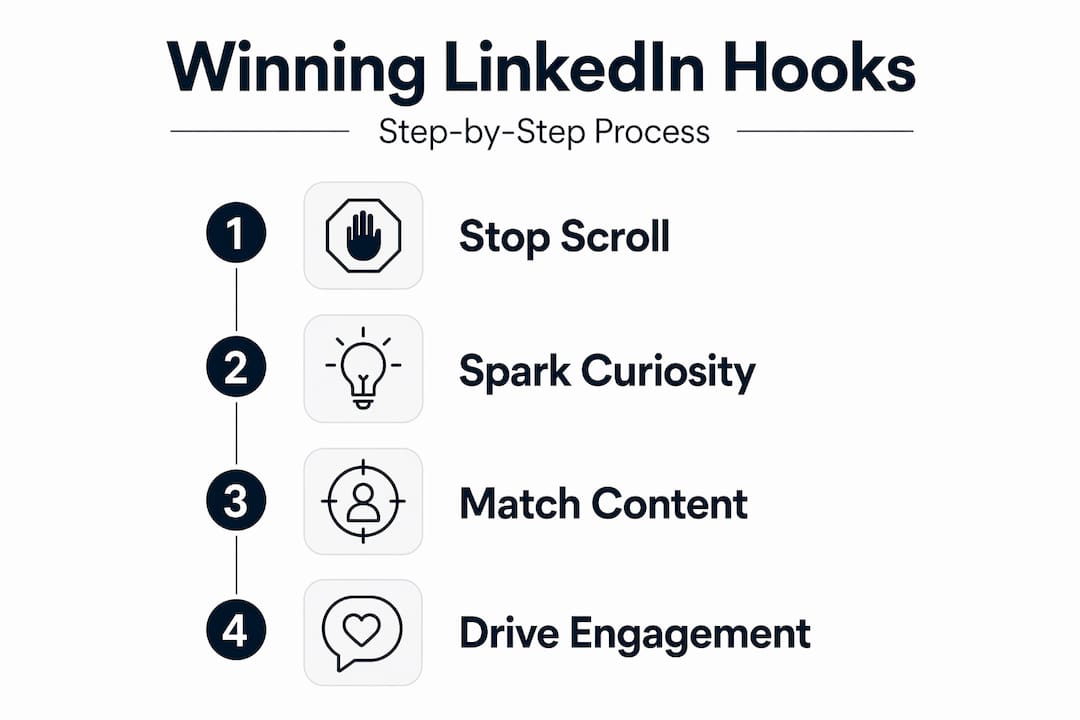
What makes a content hook actually work
There is a rigid technical reality every content creator on LinkedIn must respect: the mobile preview cuts off after approximately 140 characters before hiding the rest behind “see more.” Practitioners who understand this draft five to ten hook variations to find the one that fits this constraint and still lands with emotional impact.
Within that tight window, certain hook patterns consistently outperform generic openers. The most effective types include:
- Contrarian statements. Challenge a widely held belief in your industry. “Posting every day killed my LinkedIn growth” forces a double-take from anyone who has been told consistency is everything.
- Curiosity gaps. Introduce a concept or outcome without explaining it immediately. “There’s a reason your best posts get fewer replies than your average ones” plants a question the reader has to answer.
- Vulnerability or confession. Share a real failure, reversal, or uncomfortable truth. The research-backed example “I deleted three years of LinkedIn content last week. Engagement went up.” works because it feels unmistakably human, not polished or corporate.
- Pattern interrupts. Begin with something structurally unexpected. An extremely short sentence. A number without context. A question that sounds almost too simple.
Generic openers are the enemy. Phrases like “I’m excited to share,” “In today’s competitive environment,” or “Here’s what I learned” are so familiar they have become invisible. LinkedIn’s algorithm in 2026 flags recycled content patterns. Readers have trained themselves to skip them before the second word registers.
Pro Tip: Write your hook before writing the rest of the post. A hook written as an afterthought almost always misses the emotional tension that makes people click. When you start with the hook, the entire post structure builds around delivering on that specific promise.
This principle is well-supported. Content creators who plan hooks first report that the full post architecture aligns more naturally, preventing the rambling and tonal mismatch that kills engagement partway through a read.

How to align post content with your hook
A great hook that leads nowhere is actually worse than a mediocre hook. When readers click “see more” expecting a specific insight and find something generic, they learn not to trust you. Mismatched hooks and content train audiences over time to treat your opening lines as noise, which is one of the hardest engagement problems to recover from.
The post body needs to deliver the “so what” that your hook implied. If your hook is “I lost a six-figure client because of a single LinkedIn post,” the body must explain exactly what happened and what you learned. Vague lessons or pivots to promotional content break the contract with the reader.
A few structural approaches that complement strong hooks:
- Storytelling with a clear arc. Set up the tension in the hook, walk through what happened or what you discovered, and resolve it with a specific, non-obvious takeaway. Readers stay because they want the resolution.
- Frameworks and lists that deliver. If your hook promises a system or a breakdown, the body must provide exactly that. Numbered steps, clear categories, and concrete examples show you know the territory.
- Open-ended questions at the close. After delivering real value, invite conversation with a question that does not have a one-word answer. “What’s the riskiest assumption your team is currently making about content?” pulls in comments far better than “What do you think?”
Pro Tip: Read your hook and then ask yourself: “Would I feel cheated if the post didn’t deliver on this?” If the answer is yes, you have written a strong hook. Now the pressure is on the content to earn it.
Posts between 1,301 and 2,500 characters show median engagement rates of 2.61 to 2.67%, compared to just 2.10% for shorter posts. But that advantage only materializes when the hook is strong enough to make readers click through to the full length.
Practical tips for crafting and testing hooks consistently
Building a reliable hook-writing practice takes a specific kind of discipline. It is less about talent and more about process. Here is what works across different content types and industries:
- Write at least three hook variants for every post. Force yourself to try a contrarian angle, a curiosity gap, and a personal confession for the same content. You will almost always find one that feels sharper and more specific than the first version you drafted.
- Read your hook on your phone before posting. The mobile-first preview is not an abstraction. Paste your hook into a note app or draft it in the LinkedIn mobile app to see exactly where the cutoff lands and whether the visible text still generates curiosity.
- Use language your audience already uses. Mirror the words your readers use when they describe the problem you are addressing. If your audience says “I keep running out of content ideas,” your hook should not say “content ideation challenges persist.” The closer you get to their actual language, the faster they recognize themselves in your opening line.
- Track which hook types drive comments versus just clicks. Curiosity-gap hooks may drive high click-through rates but shallow engagement. Vulnerability hooks often drive fewer clicks but deeper, more personal comments. Both have their place depending on your goal for that specific post.
- Avoid AI-generated hooks that sound detached. Creators who outsource their personality entirely to AI lose audience credibility quickly because readers in 2026 are increasingly sensitive to robotic tones. Use AI to generate options, then rewrite in your own voice.
Visibility on LinkedIn in 2026 comes from precision and relevance, not from posting volume. Five posts with great hooks will outperform twenty with generic ones almost every time.
My honest take on hooks and what most people get wrong
I have watched hundreds of LinkedIn profiles up close over the years, and the same mistake shows up constantly. People treat the hook like decoration. They write the whole post, get to the top, type something vague, and call it done.
What I have found is that the hook is actually where the thinking happens. When you struggle to write a compelling first line, it usually means you have not yet figured out what is genuinely surprising or useful about what you are sharing. The hook forces clarity. If you cannot make the opening interesting in 140 characters, the post probably does not have a sharp enough point yet.
I have also seen the opposite failure: a brilliant hook attached to content that meanders. The creator gets credit for stopping the scroll but loses the reader by the third paragraph. That misfire is just as damaging long-term. Your audience remembers the letdown more than they remember the clever opener.
The thing I keep coming back to is that a clear point of view builds more authority than any single hook ever will. The best LinkedIn creators I have studied do not write clever openings for their own sake. They write hooks that are specific expressions of a consistent perspective. That is what makes their content recognizable and trustworthy over time.
Own your voice. Use AI as a drafting tool, not a ghostwriter. Your hook should sound like the most interesting sentence you would say in a real conversation, not the most polished thing a content template can generate.
- Tom
Write posts that actually get read, with Resonate
Knowing what makes a strong hook is one thing. Writing them consistently, in your own voice, for every post you publish is another challenge entirely. Resonate was built specifically for content creators and marketers who want their LinkedIn posts to reflect how they actually think and communicate. The platform’s AI-powered content generator learns your voice patterns, pulls context from your real work, and generates hook options that sound like you. Not like a content template. You can explore more approaches to authentic LinkedIn content on the Resonate blog, or go straight to Resonate to see how it works in practice.
FAQ
What is the role of content hooks in LinkedIn posts?
A content hook is the opening line that determines whether a reader clicks “see more” or scrolls past. It directly controls engagement velocity and algorithmic distribution.
How long should a LinkedIn hook be?
Hooks should fit within approximately 140 characters, the mobile preview cutoff before “see more” appears. Any curiosity you build needs to land within that visible space.
What types of hooks work best on LinkedIn in 2026?
Contrarian statements, curiosity gaps, vulnerability confessions, and pattern interrupts consistently outperform generic openers. The most effective hooks feel human and specific, not polished or templated.
Does LinkedIn penalize certain types of hooks?
Yes. LinkedIn suppresses posts that use engagement bait, such as asking readers to “Comment YES if you agree.” The algorithm also flags recycled content templates as low-value signals, reducing their reach.
How do I know if my hook and post content are aligned?
If a reader who clicks “see more” would feel the post delivered exactly on the opening promise, you have alignment. If the body pivots, stays vague, or goes generic, the hook and content are mismatched, which damages long-term audience trust.
Recommended

Content Writer @ Resonate
Charlotte explores LinkedIn content, personal branding, AI writing, and founder-led marketing at Resonate. She believes the best content comes from real experience, not generic advice, and writes practical insights to help founders turn what they already know into content that people want to read.
Write LinkedIn content that sounds like you
with Resonate's AI Voice Engine