The Role of LinkedIn Profile in Lead Generation
The Role of LinkedIn Profile in Lead Generation

Your LinkedIn profile is doing sales work right now, whether you’ve set it up for that purpose or not. Prospects are searching your name before they reply to your outreach. Decision-makers check your profile before agreeing to a call. The role of LinkedIn profile in lead generation is far bigger than most professionals realize because it acts as your always-on prospecting storefront, not just a digital resume. Get it right, and your profile pulls qualified leads toward you around the clock. Get it wrong, and you’re losing deals before the conversation even starts.
Key takeaways
| Point | Details |
|---|---|
| Profile is your storefront | Your LinkedIn profile functions as a landing page that either converts prospects or sends them elsewhere. |
| Completeness multiplies visibility | All-Star profiles are 40x more likely to receive opportunities than incomplete ones. |
| Headline is your ad copy | A keyword-rich, outcome-focused headline directly increases profile views and inbound interest. |
| SSI signals lead gen behavior | Your Social Selling Index reflects habits that correlate with real lead generation results over time. |
| Content sustains visibility | Consistent posting and engagement keep your profile ranking higher and build ongoing credibility. |
Role of LinkedIn profile in lead generation explained
Most professionals treat their LinkedIn profile like a filing cabinet: something you update when you change jobs and mostly ignore in between. That mindset costs you leads every single day.
LinkedIn functions as a search engine. When someone searches for a consultant, vendor, or expert in your space, LinkedIn’s algorithm decides whose profile surfaces first. The platform’s ranking logic rewards profiles that are complete, keyword-relevant, and actively engaged. A half-filled profile with a generic title does not compete.
The Social Selling Index measures four behavioral pillars: establishing your professional brand, finding the right people, engaging with insights, and building relationships. Professionals with high SSI scores create 45% more opportunities and are 51% more likely to reach quota. That is not a coincidence. SSI reflects the same habits that make a profile magnetic to leads.
Profile completeness is the baseline. All-Star profiles are 40x more likely to receive opportunities than profiles missing key sections. LinkedIn defines All-Star status by requiring a photo, headline, summary, current role with description, skills (minimum five), education, and at least 50 connections. Each section adds surface area for discovery and credibility.
Pro Tip: Check your current SSI score by visiting linkedin.com/sales/ssi while logged into your account. This free score tells you exactly which of the four behavioral pillars you need to improve first.
Here is a quick reference for what each profile component contributes to lead generation:
| Profile element | Lead generation impact |
|---|---|
| Headline | Search discoverability and first-impression conversion |
| About section | Value proposition clarity and call to action |
| Experience entries | Credibility building and proof of results |
| Skills and endorsements | Search ranking and social proof |
| Profile photo | Trust and click-through rate |
| Featured section | Showcasing offers, content, and case studies |
What makes a strong LinkedIn profile for leads
Profile visitors spend only 6 to 10 seconds scanning before deciding to engage or leave. That means your headline and About section carry most of the weight. Every word in those sections needs to earn its place.
Writing a headline that works as ad copy
Your headline is the most visible text on your profile outside of your name. LinkedIn gives you 220 characters. Most people use 40 of them with something like “Sales Manager at Acme Corp.” That is a missed opportunity.
Headline clarity and outcome framing dramatically improve profile engagement versus generic role titles. A headline that reads “I help SaaS companies cut customer acquisition costs by 30% | B2B Growth Consultant” tells a prospect exactly what you do and who you serve. It also contains the keywords those prospects are searching. The result is measurable: headline keyword optimization leads to 30% more profile views and up to 5x more recruiter and prospect messages.
Crafting an About section that converts
Think of your About section as a landing page. It should open with a hook that speaks directly to your ideal client’s problem. Then it should explain your solution, proof points, and next steps. End with a clear call to action: schedule a call, download a resource, or send a message.

Avoid writing your About section in third person. It feels distant. Write in first person, speak to one type of reader, and be specific about outcomes you deliver. Vague summaries full of words like “passionate” and “results-driven” communicate nothing.
Skills, photos, and the credibility stack
Profiles with at least five relevant skills are discovered 31x more often, and verified skills boost hiring and outreach chances by 30%. Do not list generic skills like “Microsoft Office.” List the specific capabilities your prospects are searching for: “B2B SaaS Sales,” “Demand Generation,” “Revenue Operations.”
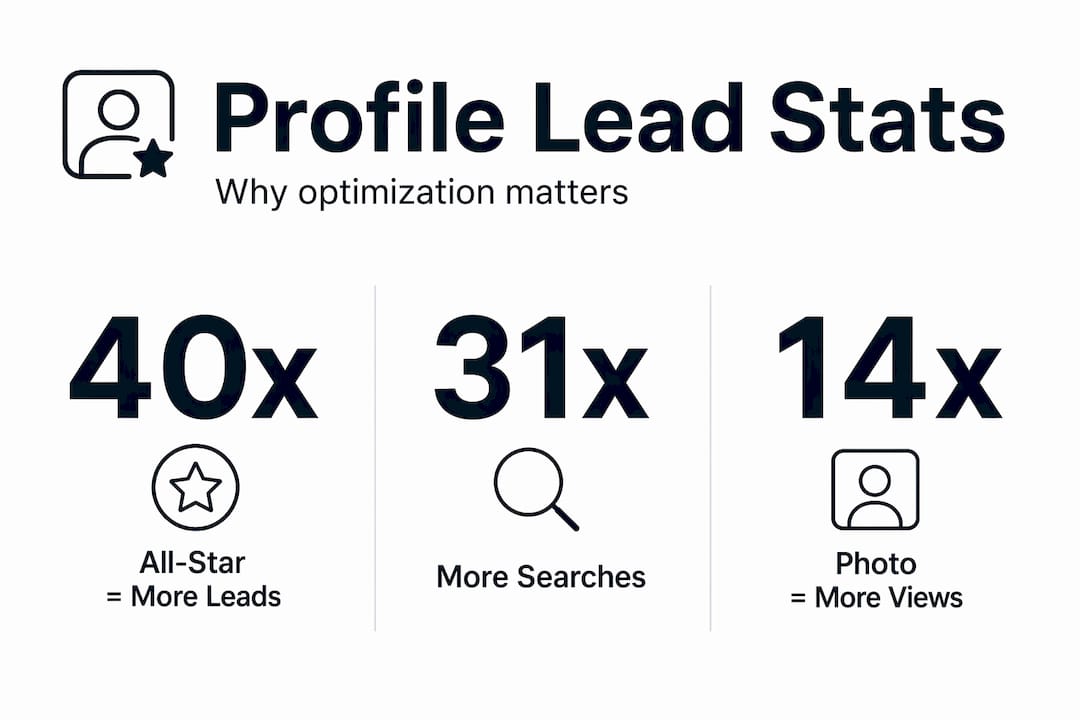
Your photo matters more than you probably think. Profiles with professional photos receive 14x more views. A clean, well-lit headshot where you are looking at the camera signals professionalism and approachability. Your background image is also prime real estate. Use it to reinforce your positioning with a tagline or visual that supports your headline.
Pro Tip: Use the Featured section to pin your best lead-generating content: a case study, a lead magnet, a testimonial video, or a landing page link. Most people leave this section empty, which means it costs them conversions every week.
How your profile supports outbound and inbound leads
An optimized profile does not just attract inbound interest. It also makes your outbound efforts dramatically more effective.
When you send a cold connection request, the prospect’s first action is to check your profile. If what they find does not match the message you sent, the trust gap kills the conversation before it starts. Profile alignment with messaging reduces friction and increases conversion from connection requests into qualified conversations.
Here is a practical sequence for harmonizing your profile with outbound lead generation:
- Define your target prospect clearly. Know their role, industry, and the specific problem you solve for them.
- Audit your headline and About section. Make sure both speak directly to that prospect’s world, not to your own career history.
- Align your outreach message with your profile. If your headline says “I help e-commerce brands scale paid acquisition,” your first message should reflect that same focus.
- Use your Featured section as a soft offer. Link to a resource that is relevant to the prospect so your profile does part of the selling before you say a word.
- Engage consistently with content. Commenting thoughtfully on posts in your niche keeps your name visible to prospects even when you are not actively reaching out.
LinkedIn’s own research supports using Sales Navigator alongside profile optimization to improve prospect targeting. Combining a refined profile with targeted search filters means your outreach lands with people who are already more likely to recognize you as credible.
Optimizing headline, About, and Featured sections first creates alignment that makes every downstream outreach message easier to write and more likely to convert. Think of it as building the store before running the ads.
Measuring and improving profile performance over time
Optimization is not a one-time event. Your LinkedIn profile needs to evolve as your audience, offer, and content strategy develop. The platform gives you signals to work with.
Start by monitoring your profile views weekly. A sudden drop often means your content activity has slowed. A spike typically follows a post that performed well or a period of active engagement. Both are useful data points.
- Track profile view trends weekly. Look for patterns: which days or weeks show higher views and what content activity preceded them.
- Review your SSI score monthly. Identify which of the four pillars is weakest and focus your activity there for 30 days before reassessing.
- Check the “People Also Viewed” sidebar. It tells you who LinkedIn considers your competitive peers, which reveals whether your positioning is landing correctly.
- Test headline variations. Change your headline, give it two weeks, and compare view and connection acceptance rates. Small wording changes produce measurable differences.
- Audit skills quarterly. Remove outdated skills and add terms that reflect how your industry currently describes the work you do.
Consistent posting and engagement improve profile rankings beyond static optimization. LinkedIn builds an expertise score based on your content history and the topics you engage with. Professionals who post regularly in a defined niche see their profiles surface more frequently in searches related to that niche. The compound effect over six to twelve months is significant.
Here is a concrete example of what iterative improvement looks like: A B2B consultant rewrites her headline from “Senior Consultant at XYZ Firm” to “I help mid-market manufacturers reduce procurement costs | Supply Chain Consultant.” Within 30 days, her profile views double. She adds a Featured section with a linked case study. Connection acceptance rates on her outbound messages climb from 22% to 41%. She updates her skills list to reflect current supply chain terminology. Six months later, inbound inquiry volume has tripled. None of that required paid advertising.
My honest take on why most profiles fail at lead generation
I’ve looked at hundreds of LinkedIn profiles from professionals who are genuinely good at what they do. The pattern is almost universal: the profile is built for a job search, not for generating leads. Everything on it talks about what the person has done rather than what they can do for the next client.
What I’ve found is that most people avoid rewriting their profile because it feels uncomfortable to be direct about the value they deliver. There is something vulnerable about saying “I help X type of company achieve Y result” in plain language. So instead, they hide behind job titles and corporate-sounding summaries. And then they wonder why their outreach feels like pushing a boulder uphill.
The uncomfortable truth is this: your profile is not for you. It is for your prospect. Every section should be written from the perspective of what a potential client wants to understand. Not your career timeline. Not your responsibilities. What results you produce, for whom, and what they should do next.
I’ve also seen professionals spend significant time crafting clever outreach sequences while their profile looks like it belongs on a job board from 2009. The sequence does not matter much if your profile destroys the credibility the message was building. Fix the profile first. Everything else gets easier.
The professionals who treat their LinkedIn profile as a living lead generation asset and update it with the same intention they bring to a sales deck are the ones whose pipelines stay full without burning out on cold outreach.
- Tom
How Resonate helps you turn your LinkedIn profile into a lead engine
If rewriting your headline, About section, and content strategy sounds like a lot to tackle at once, that is exactly the problem Resonate was built to solve.
Resonate is an AI-powered LinkedIn content platform that learns your voice, pulls in context from your actual work tools, and helps you publish content that sounds like you at your most articulate. Instead of staring at a blank editor trying to figure out what to post, you get post ideas surfaced from your own work, voice-calibrated drafts, and engagement predictions before you publish. Better content means your profile stays active, your expertise score climbs, and prospects see consistent proof that you know your field. Explore the LinkedIn content tools at Resonate and see how a smarter posting strategy translates directly into more conversations with the right people.
FAQ
What is the role of LinkedIn profile in lead generation?
Your LinkedIn profile acts as a landing page that either converts profile visitors into leads or loses them within seconds. An optimized profile with a clear headline, strong About section, and relevant skills attracts inbound interest and supports outbound outreach by building instant credibility.
How complete does a LinkedIn profile need to be for lead generation?
LinkedIn defines All-Star status with specific sections including photo, headline, summary, current role, skills, education, and at least 50 connections. All-Star profiles are 40x more likely to receive opportunities, making full completion the baseline for serious lead generation.
What makes a headline effective for generating leads on LinkedIn?
An effective headline names your prospect’s outcome, identifies who you serve, and includes keywords those prospects search. Keyword-optimized headlines generate 30% more profile views compared to generic job titles.
How does LinkedIn content affect profile lead generation?
Consistent posting builds LinkedIn’s expertise score for your profile, which improves how often your profile appears in relevant searches. Professionals who post regularly in a defined niche see compounding visibility benefits that static profile optimization alone cannot produce.
What is the Social Selling Index and does it affect lead generation?
The Social Selling Index measures four behavioral habits on LinkedIn: brand building, prospect finding, insight engagement, and relationship building. High SSI leaders create 45% more opportunities than low scorers, making it a useful behavioral benchmark even though it is not a direct sales metric.
Recommended

Content Writer @ Resonate
Charlotte explores LinkedIn content, personal branding, AI writing, and founder-led marketing at Resonate. She believes the best content comes from real experience, not generic advice, and writes practical insights to help founders turn what they already know into content that people want to read.
Write LinkedIn content that sounds like you
with Resonate's AI Voice Engine