What does dwell time mean on LinkedIn? A creator's guide
What does dwell time mean on LinkedIn? A creator’s guide

Most LinkedIn creators obsess over likes, comments, and follower counts. Those numbers feel real, trackable, and satisfying. But understanding what does dwell time mean LinkedIn is far more important than chasing any of those visible metrics. Dwell time is the hidden signal that actually tells LinkedIn’s algorithm whether your content is worth showing to more people. Get it wrong, and even your best posts disappear into the void. Get it right, and LinkedIn starts doing the distribution work for you.
Key Takeaways
| Point | Details |
|---|---|
| Dwell time definition | Dwell time measures how long users engage with your LinkedIn post both on feed and after clicking to read more. |
| Primary ranking signal | LinkedIn’s algorithm prioritizes posts with longer dwell time to show content to wider audiences beyond your immediate network. |
| Hidden engagement | Many users consume content silently, so dwell time captures genuine interest better than likes and comments alone. |
| Optimization focus | Effective dwell time optimization involves strong hooks, clear formatting, and carousel posts delivering micro-value per slide. |
| Shift mindset | Focus on creating authentic, story-driven posts that earn sustained attention rather than chasing quick likes or comments. |
What dwell time means on LinkedIn and why it matters
Dwell time on LinkedIn means the total duration a user spends engaging with your post, both while it is visible in their feed during scrolling and after they click “See more” to read the full content. It is not one single measurement. It is two distinct phases working together to tell LinkedIn how much genuine interest your post generated.
Think of it this way. Someone scrolls their feed, pauses on your post for 15 seconds, reads the preview, clicks “See more,” and spends another 45 seconds reading the rest. LinkedIn records all of that. That combined attention is your dwell time for that interaction.
Here is what makes dwell time on LinkedIn particularly powerful as an engagement signal:
- It captures silent readers, the large portion of your audience that consumes content without ever tapping the like button or leaving a comment
- It reflects actual reading behavior, not a reflexive double-tap
- It rewards posts that make someone genuinely stop and think, not just posts that trigger a quick reaction
- It cannot easily be gamed by asking “like this post if you agree” because attention is involuntary
LinkedIn uses dwell time as a direct engagement and quality signal to determine feed ranking and wider distribution. The logic is simple: longer attention means the content delivered real value. Likes can be accidental. Reading cannot. This is why user engagement strategies that focus on depth over breadth tend to produce better long-term results on the platform.
Understanding dwell time shifts how you think about every post you write. The goal is no longer to trigger a reaction. The goal is to earn time.
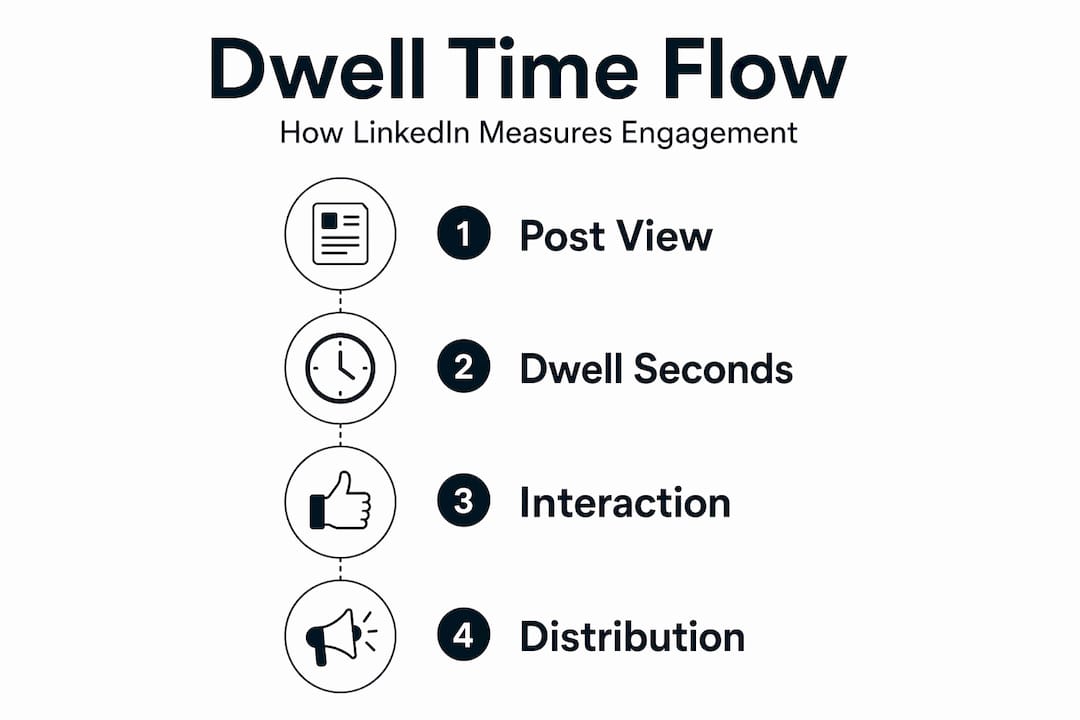

How LinkedIn measures dwell time and its impact on distribution
Understanding how LinkedIn measures dwell time helps explain why certain content reaches far beyond your immediate network.
LinkedIn does not use a fixed number of seconds to define “long dwell.” Instead, the algorithm applies a binary “Long Dwell” classifier that labels each post based on whether its dwell time exceeds a percentile threshold relative to similar content types and audiences. A 30-second read on a text post might qualify as long dwell. The same 30 seconds on a multi-slide carousel might not. Context drives the classification.
Here is how the dwell time impact plays out in practice across the distribution cycle:
- Post published. LinkedIn shows your content to a small initial group from your first-degree connections.
- First 60 to 90 minutes. This window is critical. The algorithm collects dwell data from that initial audience to decide whether to expand distribution.
- Long Dwell classification triggers. If enough viewers dwell long enough relative to your content type, the algorithm expands reach to second and third-degree connections.
- Posts under 3 seconds of average dwell receive limited distribution regardless of how many likes they collect.
- Posts averaging over 60 seconds of dwell have genuine viral reach potential, even with modest visible engagement.
The practical implication is significant. Posts with strong dwell time can earn meaningfully more distribution than posts that get scrolled past in under three seconds, even when the fast-scroll post has more likes. This is why you occasionally see a post from someone with 2,000 followers outperform a post from someone with 50,000. The algorithm does not care about your audience size nearly as much as it cares about how long people stay.
The early window matters most for content ranking strategies. Publishing when your core audience is actively online gives you the best shot at generating strong dwell data quickly enough to trigger broader distribution.
Common misconceptions and hidden nuances about dwell time on LinkedIn
With misconceptions cleared, let’s explore actionable ways you can optimize your content to improve dwell time effectively.
The biggest misconception is treating visible engagement as a reliable proxy for content quality. It is not. Dwell time captures hidden attention because many members read thoroughly without leaving any reaction, and that silent reading still signals content relevance to LinkedIn’s algorithm. A post with 12 comments but 800 silent readers who averaged 45 seconds each is performing far better algorithmically than a post with 80 likes and a 4-second average dwell.
Here is where most creators go wrong when thinking about dwell time metrics on LinkedIn:
- Confusing impressions with attention. A high impression count just means your post appeared in feeds. It says nothing about how long anyone stopped.
- Assuming all formats work the same. Long dwell thresholds differ by post type. Text posts, carousels, videos, and documents each have different baseline attention curves.
- Thinking there is a universal target. There is no single number of seconds that guarantees success. The classifier is relative, not absolute.
- Ignoring “See more” click rate. This is one of the best proxy signals available for estimating dwell time since LinkedIn does not publish dedicated dwell time metrics in its public analytics dashboard.
You can build a reasonably accurate picture of your dwell performance by watching three things: your “See more” click rate on truncated posts, the depth and specificity of comments (surface-level comments suggest fast reads, detailed responses suggest longer engagement), and boosting social proof signals that correlate with time spent.
Pro Tip: If your post gets strong reach but shallow or no comments, test a different hook or break your content into a carousel. You may be getting impressions but losing people before they hit “See more.”
The dwell time definition also extends to what happens after the click. A post that compels someone to click through and then delivers weak content will produce a short post-click dwell. LinkedIn registers that as a failed engagement. Strong hooks that lead to weak substance actually hurt you.
How to optimize your LinkedIn content for higher dwell time and reach
Now that you know how to optimize content for dwell time, let’s take a unique perspective on why focusing on genuine attention beats chasing superficial engagement.
Higher dwell time starts before you write a single sentence. It starts with knowing exactly who you are writing for and what specific problem or insight you are delivering. Vague content earns vague attention spans.
The content optimization framework for dwell time:
- Lead with a scroll-stopping first line. Your opening sentence determines whether someone pauses or keeps scrolling. Make a bold claim, share a counterintuitive number, or open mid-story. “I lost a $40,000 client because of a LinkedIn post” is more compelling than “Here are some tips about LinkedIn.”
- Use structure to reduce reading fatigue. Short paragraphs, occasional line breaks, and bold callouts make content feel readable at a glance. Dense walls of text signal effort before value, and people scroll away.
- Design carousels as standalone micro-assets. Carousel posts earn strong dwell time because users engage slide by slide. Each slide should carry a headline and a complete idea, not just a fragment of a larger thought.
- Add short videos with subtitles. Most LinkedIn users watch without sound. Subtitles keep them engaged and increase the time they spend with your content even without audio.
- Avoid engagement bait. “Comment YES if you agree” tactics may spike comments briefly, but they do not increase dwell time and LinkedIn actively discounts this type of behavior.
Here is a comparison of common post formats and their typical dwell time potential:
| Format | Dwell time potential | Best use case |
|---|---|---|
| Plain text post | Medium | Personal stories, opinions, quick insights |
| Carousel (PDF) | High | Step-by-step guides, lists, visual frameworks |
| Short video with subtitles | High | Tutorials, behind-the-scenes, reactions |
| External link post | Low | Traffic driving (limited distribution) |
| Long-form article | Medium | Thought leadership, detailed research |
Pro Tip: Dwell time optimization is less about guessing seconds and more about improving your content funnel: stop the scroll, convert the impression to a “See more” click, and sustain attention through structured, specific content. Treat each post like a three-stage funnel, not a one-shot broadcast.
The timing of your post matters far less than most people think. Content quality drives dwell. Publishing time drives initial exposure opportunity. These are not the same variable.
Why focusing on dwell time changes the LinkedIn content game
Here is an uncomfortable truth most LinkedIn advice ignores: the platform’s algorithm in 2026 does not care whether people engage with your post. It cares whether people stop scrolling when they see it. Engagement is just a proxy for attention. And proxies can be faked. Attention cannot.
This reframes the entire content conversation. The creators winning on LinkedIn right now are not the ones with the cleverest hashtag strategies or the ones posting three times a day. They are the ones whose content makes people genuinely pause. Vulnerability works because it is unexpected. Specificity works because it feels earned. A story about a real failure with a real number and a real lesson produces 60-second dwell almost automatically.
Generic LinkedIn advice pushes creators toward templates, trending formats, and engagement triggers. All of that is noise if the underlying content does not hold attention. Worse, the algorithm has become increasingly good at identifying low-quality engagement patterns and throttling reach accordingly. Chasing likes is not just ineffective in 2026. It is actively counterproductive.
The deeper shift is this: when you optimize for dwell time, you are forced to think like a reader, not a broadcaster. You ask “would I stop and read this?” not “will this get engagement?” That question produces better writing, better ideas, and ultimately a better audience. High dwell scores attract followers who actually read. Those followers generate strong dwell on your next post. The effect compounds.
Building this kind of content-driven growth takes longer than a viral hack. But it produces an audience that responds when you post, shows up consistently, and treats your content as worth their time. That is the only LinkedIn following worth having.
Boost your LinkedIn dwell time with smart content tools
Understanding dwell time is one thing. Consistently producing content that earns it is another challenge entirely.
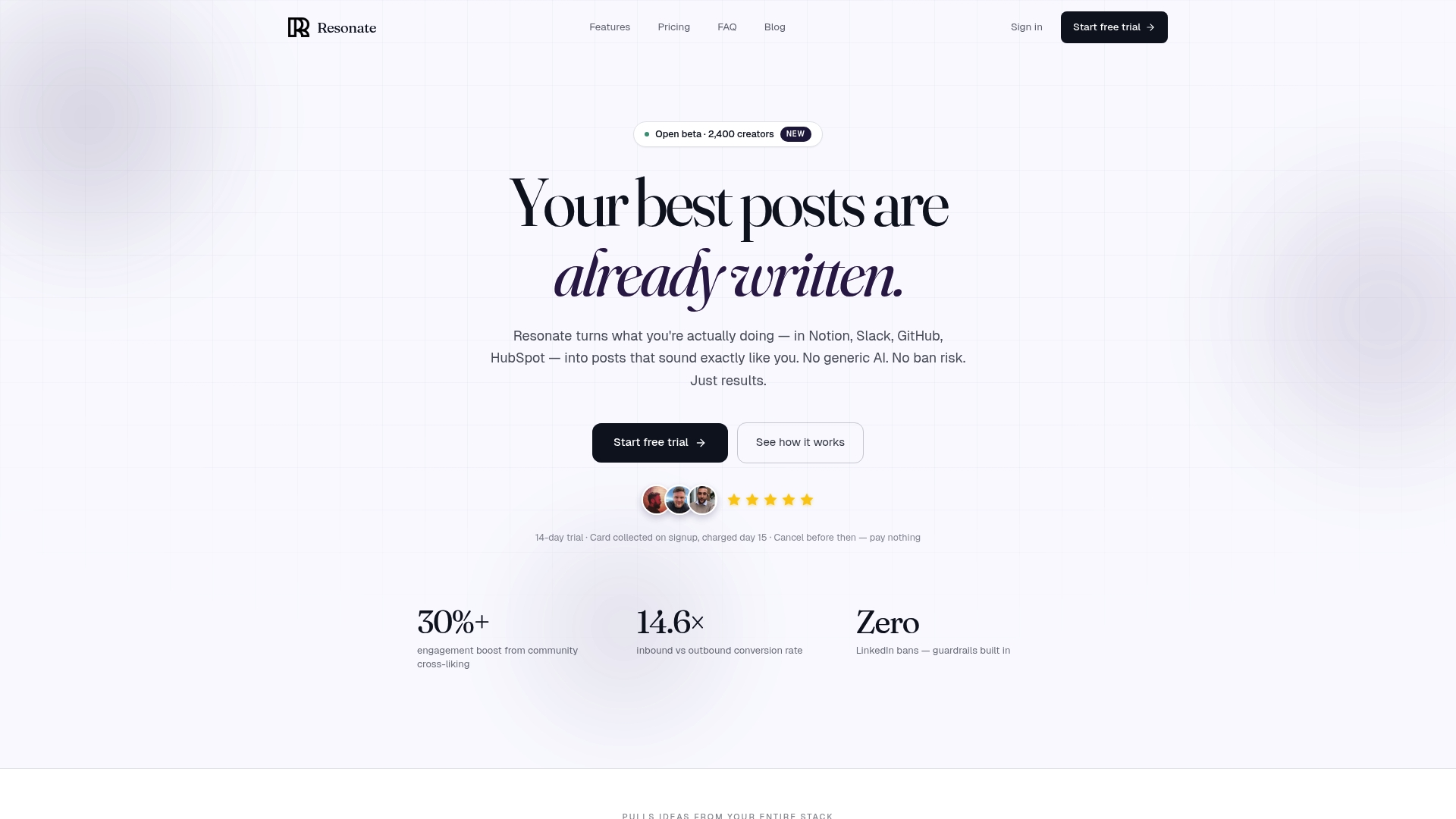
That is exactly the problem Resonate was built to solve. The Resonate LinkedIn content generator trains on your actual voice and pulls context from the tools you already use, such as Notion, Slack, and HubSpot, to surface post ideas grounded in your real work. Every post it helps you create is built with the attention funnel in mind: strong opening hooks, clean formatting, and authentic storytelling that holds readers long enough to trigger LinkedIn’s Long Dwell classifier. Explore the Resonate blog for more hands-on guidance on making every post count. Stop posting into the void and start creating content that earns time.
Frequently asked questions
What does dwell time mean on LinkedIn?
Dwell time on LinkedIn is the total duration a user spends engaging with your post, including the time it is visible during scrolling and the time spent after clicking to view the full content. Both phases count toward the signal LinkedIn uses for feed ranking.
Why is dwell time important for LinkedIn content reach?
Because LinkedIn’s algorithm uses dwell time as a primary quality signal to decide how broadly to distribute your post, prioritizing content that holds genuine attention over content that simply collects fast, reflexive reactions.
Can I see dwell time metrics in LinkedIn analytics?
No. LinkedIn does not publish a dedicated dwell time metric in its analytics dashboard, so creators typically infer dwell performance by tracking “See more” click rates and the depth of comments they receive.
How can I improve dwell time on my LinkedIn posts?
Focus on writing a compelling opening line to stop the scroll, format your post for easy reading with short paragraphs, use carousels where each slide delivers standalone value, and prioritize authentic storytelling over engagement bait. Practical dwell time optimization is about building a content funnel, not hitting a specific second count.
Does posting time or hashtags affect dwell time significantly?
Minimally. Posting time affects reach by under 5%, and excessive hashtag use can actually reduce reach because LinkedIn appears to penalize algorithmic gaming. Content quality and relevance are the dominant factors in dwell time performance.
Recommended
Content Writer @ Resonate
Charlotte explores LinkedIn content, personal branding, AI writing, and founder-led marketing at Resonate. She believes the best content comes from real experience, not generic advice, and writes practical insights to help founders turn what they already know into content that people want to read.
Write LinkedIn content that sounds like you
with Resonate's AI Voice Engine