Why gated content affects your LinkedIn reach
Why gated content affects your LinkedIn reach

You’ve built a solid ebook, wrapped it behind a form, and shared the link on LinkedIn. Leads trickle in. Feels like a win. But here’s the part most creators miss entirely: that very decision to gate your content is quietly throttling your LinkedIn reach, sometimes dramatically. Understanding why gated content affects LinkedIn reach is not just a technicality. It is the difference between a content strategy that builds audience and one that keeps harvesting the same small pool of contacts while your visibility flatlines.
Key Takeaways
| Point | Details |
|---|---|
| Gated content limits visibility | Blocking core insights behind forms reduces LinkedIn reach by making content invisible to AI and search engines. |
| Delayed engagement weakens signals | Users often consume gated content days after download, weakening initial engagement that drives algorithmic distribution. |
| Balance gating with open content | Mix open insights with gated premium assets to maximize both reach and qualified lead capture. |
| Avoid gating basic info | Immediate access to pricing or fundamental educational content builds trust and improves awareness-stage engagement. |
| Measure consumption timing | Track both downloads and actual reading delays to align marketing and sales efforts effectively. |
What is gated content and how does it work on LinkedIn?
Gated content requires users to submit information, typically a name and email, before accessing materials like ebooks, research reports, webinars, or whitepapers. As Salesforce explains, gated content creates friction by adding a form step before access, which limits visibility to search engines and casual readers alike.
On LinkedIn specifically, this mechanic plays out in a few important ways:
- Platform algorithm behavior: LinkedIn’s feed algorithm prioritizes content that generates early, rapid engagement. When you post a link to a gated asset, fewer people click through and even fewer share or comment, which sends weak signals to the algorithm.
- AI and search engine exclusion: Crawlers from search engines and AI discovery tools cannot access the content behind forms. The insights locked inside your report are invisible to any system trying to surface or cite your work.
- Audience psychology: LinkedIn users scroll fast. A form adds cognitive and behavioral friction that most people simply abandon, especially on mobile.
- Lead quality illusion: You may collect form fills, but those contacts often have little immediate intent. The lead list looks healthy; your actual reach shrinks.
Understanding the mechanics helps you see that gating is not neutral. It actively works against the way LinkedIn surfaces and distributes content. For deeper reading on how LinkedIn’s content ecosystem operates, the LinkedIn content insights blog covers platform-specific strategy regularly.
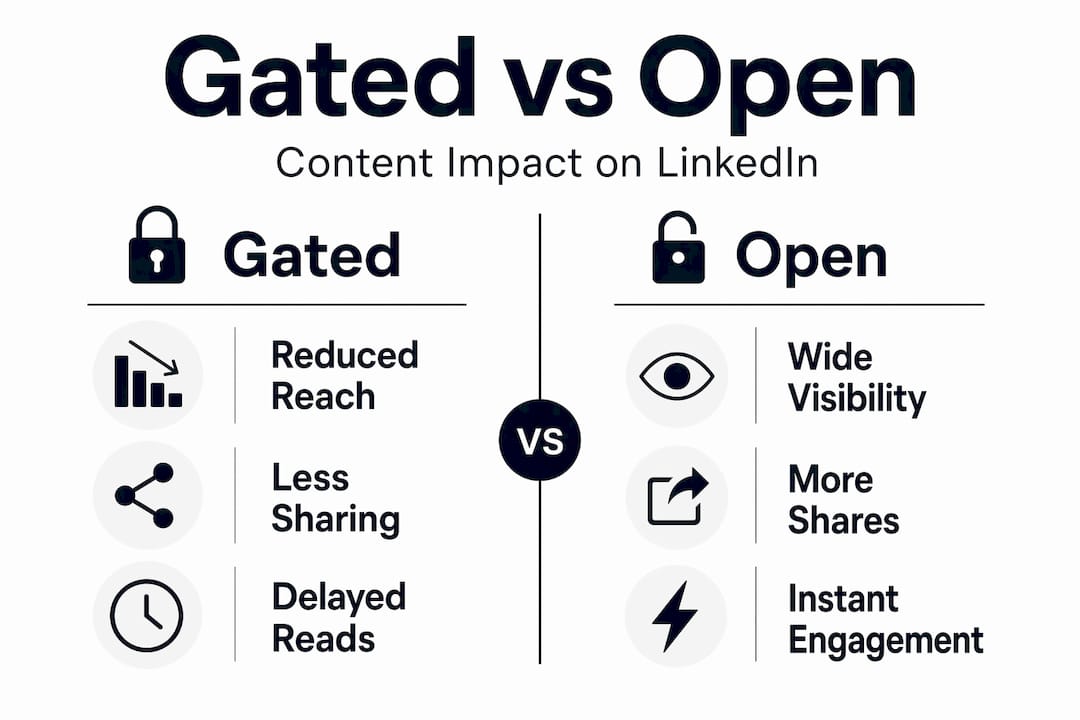
Why gated content reduces LinkedIn reach: the visibility and engagement impact
Now that we understand what gated content is, let’s explore exactly why it limits your LinkedIn reach and engagement at every level of the distribution chain.
The first layer is discovery. As Hallam Agency’s research confirms, gated content’s core insight becomes invisible to discovery systems, leading directly to suppressed distribution. AI-powered search tools, LinkedIn’s own semantic indexing, and third-party crawlers all hit a wall at your form. Your best thinking never gets cited, never gets referenced, and never generates the backlink or mention momentum that feeds organic reach.
The second layer is timing. This one is counterintuitive and important. A significant data study found that gated content downloads fell and actual consumption was delayed by nearly a week, directly weakening the near-term engagement signals that LinkedIn’s algorithm depends on.
LinkedIn’s algorithm rewards content that earns rapid engagement in the first few hours after posting. Gated content, by design, breaks that feedback loop. The download happens eventually. The reading happens later. The comment or share, if it ever comes, arrives days after your post has already been buried.
Here is what that looks like in practice:
- A user downloads your report on Tuesday morning after seeing your post.
- They open it Thursday night.
- They might share a takeaway Friday, but your original LinkedIn post is now four days old and invisible in most feeds.
- The algorithm never registered those engagement signals as meaningful momentum.
Friction compounds this problem. Casual readers, people who might have shared your insight with their own networks, abandon the form entirely. You lose the amplifiers. You lose the sharing layer. AI-driven visibility strategies increasingly depend on content that can be read, indexed, and cited at the moment of discovery. Gated content opts out of that entire ecosystem.
For creators building authority on LinkedIn, this is not a minor inefficiency. It is a structural barrier to growth. More analysis on this topic is available through the LinkedIn content insights blog.

Balancing qualification and distribution: strategic gating models for better reach
Understanding the reach limitation impact clarifies why balancing gating with open content is critical for LinkedIn success.
The core tradeoff is real. Gated content’s fundamental tension is qualification versus distribution. You cannot fully maximize both with a single binary choice. But you can get close with a smarter model.
The answer most high-performing creators arrive at is hybrid gating. Research confirms that hybrid gating approaches combining a free preview with a gated deeper asset increase conversion rates while also restoring AI and search engine visibility. You earn the discovery. You still capture the lead.
Here is a comparison of the three main approaches:
| Approach | Visibility | Lead quality | Engagement signals | Best for |
|---|---|---|---|---|
| Full gating | Very low | High intent | Weak (delayed) | Late-stage, proprietary research |
| Hybrid gating | Moderate to high | Medium to high | Strong (preview drives early engagement) | Mid-funnel guides, reports |
| Ungated | Maximum | Lower (no form) | Strongest | Awareness, authority building |
The practical framework comes down to funnel stage:
- Awareness stage: Publish everything openly. You want reach, not forms.
- Consideration stage: Use hybrid gating. Share the insight; gate the full template, dataset, or tool.
- Decision stage: Gate freely. Someone asking for your pricing guide or case study pack is already close to a decision.
Pro Tip: Before you gate any piece of content, ask whether a competitor has published the same insight ungated. If they have, gating yours just hands them the traffic, the citations, and the authority.
For more on matching content type to funnel stage, explore 2026 marketing funnel strategies that address how gating fits modern lead generation. More perspective is available on the content gating strategy blog.
Best practices to maximize LinkedIn reach while using gated content effectively
With a strategy for when and what to gate, let’s review concrete practices you can use to boost your LinkedIn reach today.
- Keep awareness-stage content fully open. Educational posts, frameworks, opinions, and short-form insights should live as native LinkedIn content or ungated blog posts. These are your discovery assets.
- Reserve gating for genuinely premium materials. Templates, original research with proprietary data, toolkits, and certification-level courses justify a form. Basic tips and industry overviews do not.
- Publish the core insight openly first. Post the main finding from your report as a LinkedIn native post or carousel. This drives early engagement signals before you ever mention the gated download.
- Use non-aggressive calls to action. Invite further engagement with language like “I wrote a full breakdown if you want it” rather than dropping a form link abruptly. Curiosity converts better than friction.
- Align sales follow-up with actual consumption timing. Given the evidence that content buyers expect immediate access and that gating basic insights breaks trust, your follow-up sequence should not assume someone read your report the day they downloaded it. Build in a buffer.
- Post native LinkedIn content with immediate value. A post that delivers a complete insight in 300 words generates real-time likes, comments, and shares. That momentum feeds the algorithm and grows your reach in the window that matters most.
Pro Tip: Create a standalone LinkedIn post that contains the single most surprising finding from your gated report. That post works as a distribution engine that pulls qualified readers into the gated asset without the cold form-fill approach.
For more tactics on this, the LinkedIn content optimization blog offers platform-specific guidance.
Measuring impact and adjusting your gated content approach on LinkedIn
Knowing how to apply best practices, it is essential to measure real impact and adjust your gated content tactics accordingly.
Most LinkedIn marketers conflate downloads with success. The numbers look good. The pipeline does not move. Here is how to read the data more accurately:
- Track engagement metrics and download numbers separately. Likes, comments, shares, and click-throughs are real-time signals. Downloads are lagging indicators. Never treat them as equivalent.
- Watch for the consumption gap. Research shows that marketers should not evaluate reach solely on download spikes since actual consumption can be delayed by a week or more. Your post performance window closes long before the report gets read.
- Measure signal quality, not just quantity. One comment from a senior buyer asking a specific question is worth more than 50 silent downloads from people who never open the file.
- Test gated versus ungated versions. Run the same content both ways over time and compare not just downloads but downstream pipeline impact, follow-on engagement, and brand mention frequency.
Here is a practical reference for common timing patterns and recommended follow-up adjustments:
| Gated content type | Typical download-to-read delay | Recommended follow-up timing |
|---|---|---|
| Short ebook (under 20 pages) | 1 to 3 days | Follow up on day 4 |
| Full research report | 5 to 10 days | Follow up on day 8 |
| Webinar recording | 2 to 5 days | Follow up on day 5 |
| Template or toolkit | Same day to 2 days | Follow up on day 2 |
Adjust your gating decisions based on these patterns. If a content type consistently shows delayed consumption and weak pipeline conversion, that is a signal to ungated it or move to a hybrid model. More on measuring content performance is available at the content performance measurement blog.
Why treating gated content as a strategic lever unlocks LinkedIn growth potential
Here is the uncomfortable truth that most marketing advice avoids saying directly: default gating is lazy strategy. It is the content equivalent of asking someone for their number before introducing yourself. You might occasionally get what you want, but you lose far more than you gain.
The creators building real authority on LinkedIn in 2026 have figured out something important. Reach precedes qualification. You cannot qualify leads from people who never discovered you in the first place. When you gate your best thinking immediately, you shrink your discovery pool. You opt out of AI citation. You signal to the algorithm that your content produces low engagement. And you hand your ungated competitors the organic visibility that compounds over months and years.
The smarter play is to earn gating. Publish your core insights openly. Get cited by AI tools. Build the social proof that comes from real shares and real comments. Then, once you have established that a piece of content resonates, gate the premium extension: the deeper data, the custom template, the advanced framework. At that point, the form does not feel like a barrier. It feels like a reasonable next step.
There is also a measurement trap worth naming. Too many marketers over-credit download conversions and under-credit the slow-burn authority that open content builds. A post that generates 200 comments and zero form fills might drive more pipeline over six months than a gated piece with 400 downloads and no social engagement. The algorithm, the AI discovery systems, and your future audience all respond to visible engagement, not silent downloads.
The creators worth following on LinkedIn treat gated content as one specific tool for one specific moment, not a default setting for everything they produce. That distinction is what separates accounts that grow from accounts that plateau. More perspective on building a content strategy with this mindset lives on the content strategy perspective.
Improve your LinkedIn content reach with Resonate’s AI-powered tools
Understanding why gated content affects your reach is one thing. Building a content workflow that acts on that understanding daily is another challenge entirely.
Resonate is built specifically for LinkedIn creators and marketers who want to post with precision, not guesswork. The platform trains on your individual writing style and connects with tools you already use, like Notion, Slack, and HubSpot, to surface post ideas grounded in your actual work. Resonate’s AI agents critique your content before it goes live, predict engagement, and amplify new posts immediately through community boosts that generate the early signals LinkedIn’s algorithm rewards most. You can balance open-reach content with strategic gating decisions, all within a single workflow that keeps your voice authentic and your account safe.
Frequently asked questions
What exactly is gated content on LinkedIn?
Gated content on LinkedIn requires users to fill out a form before accessing materials like ebooks or reports, creating a friction step that captures leads but limits casual reach and search engine visibility.
How does gated content affect LinkedIn’s algorithm and reach?
LinkedIn’s algorithm favors immediate engagement signals, and gated content delays consumption by nearly a week on average, which weakens the near-term signals that drive broader distribution.
Can a hybrid gating strategy help improve LinkedIn reach?
Yes. Partial ungating improves conversion rates and AI visibility compared to full gating, because a free preview drives early engagement while the deeper asset still captures qualified leads behind a form.
When should I avoid gating content on LinkedIn?
Avoid gating awareness-stage content that shares basic insights or process knowledge, since gating basic insights breaks trust and reduces engagement from the casual readers who make up most of your potential audience.
How can I measure the true impact of gated content on my LinkedIn marketing?
Track engagement metrics and download numbers separately, and account for delayed consumption when evaluating results, since most readers engage with gated content days after downloading, which skews standard performance reporting.
Recommended

Content Writer @ Resonate
Charlotte explores LinkedIn content, personal branding, AI writing, and founder-led marketing at Resonate. She believes the best content comes from real experience, not generic advice, and writes practical insights to help founders turn what they already know into content that people want to read.
Write LinkedIn content that sounds like you
with Resonate's AI Voice Engine