Why LinkedIn Is the Top Freelancer Acquisition Channel
Why LinkedIn Is the Top Freelancer Acquisition Channel

Most freelancers spend months grinding through bidding platforms, cutting rates to win jobs that barely cover their costs. The exhausting cycle of competing on price is so normalized that it feels like the only option. But understanding why LinkedIn is the top freelancer acquisition channel changes that assumption completely. While bidding marketplaces reward whoever accepts the lowest fee, LinkedIn rewards expertise, credibility, and relationships. That shift alone is worth paying attention to. The freelancers consistently landing high-value, direct clients are not working harder on their Upwork proposals. They are showing up daily on LinkedIn.
Key takeaways
| Point | Details |
|---|---|
| LinkedIn leads in B2B acquisition | LinkedIn drives 75-85% of B2B social leads, making it unmatched for reaching decision-makers directly. |
| LinkedIn pays more per client | Clients sourced through LinkedIn pay 2-3x higher rates than those found on anonymous bidding platforms. |
| Outreach beats passive content early | Active outreach produces faster results, while content marketing on LinkedIn takes 6+ months to generate warm inbound leads. |
| Zero commission changes the math | On a $5,000/month retainer, Upwork costs $6,000/year in fees. LinkedIn costs nothing in commissions. |
| Profile must work as a portfolio | Shifting your LinkedIn profile from a resume to a business development engine is the single biggest strategic move you can make. |
Why LinkedIn dominates freelancer acquisition
LinkedIn’s size is impressive on paper. Over 1.3 billion registered members globally as of 2026, with four out of five active members involved in business decisions. But raw numbers do not explain why LinkedIn is the top freelancer acquisition channel. The real answer is who those members are and why they are on the platform.
Unlike social networks built around entertainment or personal connection, LinkedIn is a professional-intent platform. People log in because they are thinking about their careers, businesses, and problems that need solving. That mindset is gold for freelancers. You are not interrupting someone’s scroll through vacation photos. You are showing up in a context where the person is already thinking about work.
The targeting on LinkedIn reinforces this advantage. You can filter by job title, seniority level, company size, and industry with precision that most social platforms cannot offer. LinkedIn’s identity-led targeting outperforms creative-focused platforms like Meta for B2B lead generation because it connects on professional context, not algorithmic interest guesses. A marketing consultant can find the Head of Growth at a Series B SaaS company in three clicks.
Then there is the trust infrastructure. LinkedIn’s endorsement and recommendation system creates social proof that is hard to fake and difficult to replicate elsewhere. Expert endorsements on LinkedIn are 1.7x more effective at building B2B trust than self-published content alone. A freelancer with 12 client recommendations and a strong skills section carries far more credibility than the same person posting a portfolio website link in a cold email.
LinkedIn vs. bidding platforms: the real difference
Here is the comparison most freelancers need to see written plainly.
| Factor | Upwork | |
|---|---|---|
| Commission fees | 0% | 10% plus paid Connects |
| Client mindset | Problem-aware, budget-assigned | Searching for the lowest bid |
| Rate potential | Premium rates common | Race-to-the-bottom pricing pressure |
| Relationship model | Direct, ongoing relationships | Platform-mediated transactions |
| Client sourcing | You find them or they find you | Clients post jobs, you bid |
The commission math alone is staggering. On a $5,000/month retainer, Upwork costs $6,000/year in platform fees. LinkedIn costs zero. That is not a small difference. That is the equivalent of one full month of work you are handing over to a platform for the privilege of being discovered.
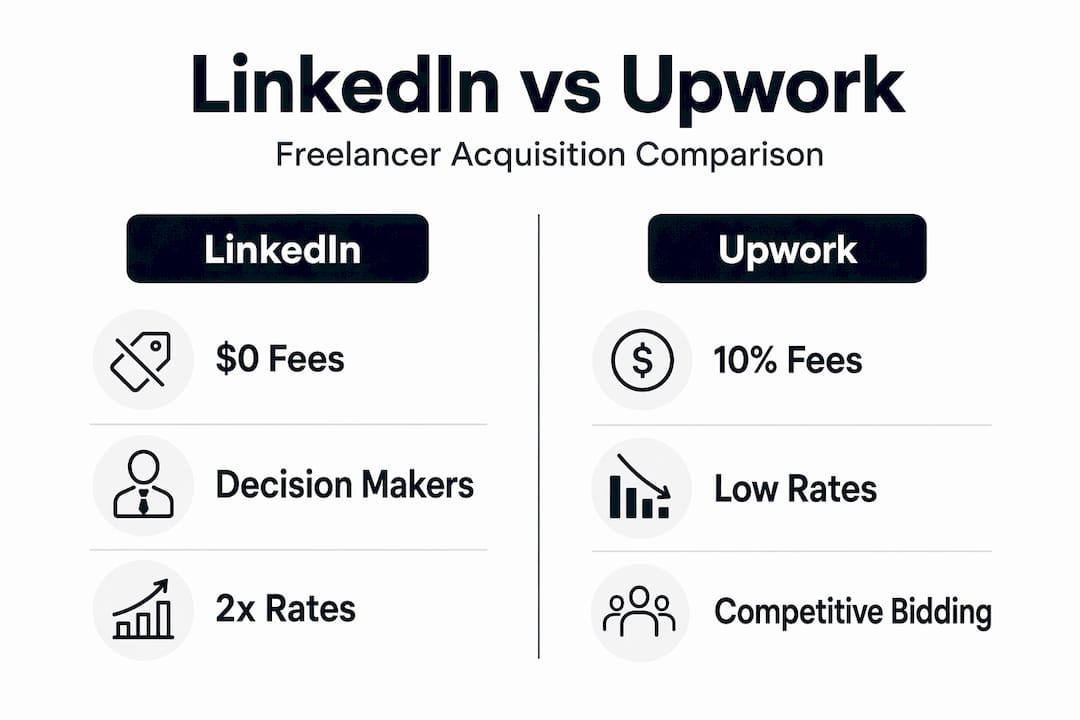
But the more important distinction is what the two platforms signal to clients. When a buyer finds you on a bidding marketplace, the frame is competitive. They have other proposals open. They are comparing prices. When a buyer reaches out to you on LinkedIn after reading your posts or seeing a recommendation, the frame is entirely different. You are already positioned as an expert before the first conversation. Clients from LinkedIn pay 2-3x higher rates than those from anonymous bidding platforms, and this is exactly why.
The strategic approach many experienced freelancers use is sequential. Successful freelancers use Upwork for initial credibility and then move to LinkedIn to bypass platform fees and build direct client relationships. Bidding platforms are a starting point, not a career strategy.
Pro Tip: Use your Upwork client history as social proof on your LinkedIn profile. Screenshots of strong reviews, project outcomes, and client names (where permitted) transfer credibility from one platform to the other and accelerate trust-building on LinkedIn.
Strategies that actually work on LinkedIn
Knowing LinkedIn is the better channel is only useful if you know how to work it. The freelancers who treat LinkedIn like a passive resume are leaving most of its value on the table.
The first and most important shift is moving from a resume to a portfolio mindset. Your LinkedIn profile should not read like a list of past jobs. It should read like a business development asset. Your headline should name the problem you solve, not your job title. Your About section should explain outcomes you have delivered for clients, not where you went to school. Your featured section should show work, case studies, and results. Buyers on LinkedIn are problem-minded with budgets already assigned. They need to see that you solve their specific problem, not that you are available.

The second shift is understanding the timeline difference between active outreach and content marketing. Active outreach produces quicker results than passive posting; content takes six or more months to generate warm inbound leads. This matters for how you allocate time.
A practical four-step weekly approach:
- Identify 10-15 ideal prospects by searching for your target job title and company type using LinkedIn’s search filters.
- Engage with their content before sending a connection request. Comment something genuinely useful on their posts. This collapses the stranger distance before any direct message.
- Send a short, context-specific connection note referencing their work or a shared topic. Never pitch in the first message.
- Post content twice per week that demonstrates how you solve a specific problem. Use real project examples, de-identified client scenarios, or takes on industry trends your prospects care about.
This combination of outreach and content is not about gaming an algorithm. It is about making yourself familiar, credible, and relevant to the exact people who have the problems you solve.
Pro Tip: When writing LinkedIn posts, lead with the problem before the solution. Most freelancers write “I helped a client increase conversions by 40%.” The better framing is “Most SaaS landing pages fail because they explain features instead of outcomes. Here’s how one change fixed that.” The second version attracts people who have that exact problem right now.
Limitations to know about LinkedIn
LinkedIn is not a complete solution on its own. Understanding where it falls short saves you from misplaced expectations.
The LinkedIn Services feature, which lets you list yourself as a service provider in a directory-style marketplace inside LinkedIn, sounds useful in theory. In practice, LinkedIn Services generates only 1-4 monthly inquiries for most freelancers. It lacks escrow, active client searches, and bidding infrastructure that actual marketplaces offer. Only about 8% of freelancers actively use LinkedIn Services, and roughly 3% generate meaningful income from it. Treat it as a small supplement, not a pipeline.
What LinkedIn does not provide:
- Contract and escrow tools. You need a separate tool to create agreements, handle payments, and protect yourself legally.
- Invoice and billing systems. LinkedIn has no billing layer. Freelancers need dedicated invoicing software.
- Lead management. Tracking conversations, follow-ups, and prospect stages requires a CRM or at minimum a spreadsheet system.
- Built-in dispute resolution. If a client disappears mid-project, LinkedIn offers no recourse.
The best-practice model is to use LinkedIn for brand building, networking, and prospect conversations, then move transactions to a dedicated platform that handles contracts and payments. This gives you zero commission exposure on client acquisition while keeping the transactional safety net that structured freelance platforms provide.
The importance of networking in marketing careers specifically makes LinkedIn indispensable as a relationship layer, even when other tools handle the operational side. Think of LinkedIn as your primary acquisition engine and other tools as your back-office support.
My take: LinkedIn is where careers actually compound
I have watched freelancers spend three or four years grinding on bidding platforms and never quite escape the ceiling of competing on price. When they finally commit to LinkedIn, the shift is not just in how they find clients. It is in how clients perceive them.
Here is what I have found to be true: treating LinkedIn like a job board is the single biggest mistake freelancers make. You are not there to apply. You are there to be found and to make that discovery feel inevitable. When a prospect has seen your posts for three months before ever speaking to you, they are not evaluating you against other candidates. They have already made a decision. That is what real relationship-first acquisition feels like.
What I keep coming back to is the compounding nature of LinkedIn activity. A post you write today might generate a client conversation six months from now. A recommendation you receive this quarter becomes the reason someone hires you next year without asking for a proposal. None of that happens on a bidding platform, because nothing accumulates. Every job there starts from zero. LinkedIn builds something that persists.
My honest advice: spend the first 30 days focused entirely on active outreach. Do not wait for your content to generate leads. Message people, engage in comments, build real conversations. Then layer in consistent content after month one. By month six, you will have a system that generates warm leads without starting every week from scratch.
- Tom
How Resonate helps you show up on LinkedIn consistently
Building a LinkedIn presence that actually attracts clients requires publishing consistently in a voice that sounds like you, not like generic AI output. That is exactly what Resonate was built for.
Resonate trains on your real writing style and work context, then generates LinkedIn content that reflects how you actually think and communicate. It connects with tools like Notion, Slack, and HubSpot to pull in real project context so your posts are grounded in specifics, not vague thought leadership. For freelancers moving from marketplace dependency to direct client acquisition, consistent LinkedIn content is the engine. Resonate makes sure you can run that engine without spending hours staring at a blank screen. Check out the Resonate blog for strategies on building a LinkedIn presence that converts.
FAQ
Why is LinkedIn the top channel for freelancer client acquisition?
LinkedIn connects freelancers directly with business decision-makers who have active budgets and defined problems. It drives 75-85% of B2B social leads and allows precise targeting by job title, seniority, and company type that no other social platform matches.
How much more can freelancers earn through LinkedIn vs. Upwork?
Clients sourced through LinkedIn typically pay 2-3x higher rates than clients from bidding platforms, and LinkedIn charges zero commission compared to Upwork’s 10% fee structure.
How long does it take to get clients from LinkedIn content?
Passive content marketing on LinkedIn takes 6 or more months to generate consistent warm leads. Active outreach to targeted prospects produces results much faster and should be your primary focus in the first few months.
Is LinkedIn Services worth using as a freelancer?
LinkedIn Services is a low-priority discovery tool that generates 1-4 monthly inquiries for most freelancers. It lacks the core features of real freelance marketplaces. Use it as a passive supplement, not your main acquisition method.
What should a freelancer’s LinkedIn profile include?
Your profile should function as a business development tool, not a resume. Lead with the problem you solve in your headline, show outcomes in your About section, and use the Featured section for case studies and real results. Recommendations from past clients build B2B trust more effectively than any self-written content.
Recommended

Content Writer @ Resonate
Charlotte explores LinkedIn content, personal branding, AI writing, and founder-led marketing at Resonate. She believes the best content comes from real experience, not generic advice, and writes practical insights to help founders turn what they already know into content that people want to read.
Write LinkedIn content that sounds like you
with Resonate's AI Voice Engine