Why the First Hour of Your LinkedIn Post Matters
Why the First Hour of Your LinkedIn Post Matters

Most LinkedIn creators spend hours crafting the perfect post, then walk away right after hitting publish. That’s the single biggest mistake you can make. Understanding why first hour matters on a LinkedIn post changes everything about how you approach content strategy. The platform’s algorithm makes critical decisions about your content’s reach within 60 minutes of posting. Nail that window and your post gets distributed to thousands. Miss it, and even your best writing may sit unseen. Here’s what actually happens during that hour, and how you can use it to your advantage.
Key Takeaways
| Point | Details |
|---|---|
| First hour drives reach | LinkedIn decides whether to amplify your post based on early engagement signals within 60 minutes. |
| Algorithm watches quality, not just quantity | Comment-to-like ratio and dwell time carry more weight than a flood of quick reactions. |
| Timing shifts to afternoons | Data from 4.8 million posts shows late afternoon and evening slots now outperform morning publishing. |
| Your response speed matters | Replying to comments within 15 to 30 minutes signals ongoing activity and boosts post visibility. |
| External links hurt reach | Putting outbound links inside your post body suppresses distribution. Place them in the first comment instead. |
Why first hour matters on every LinkedIn post
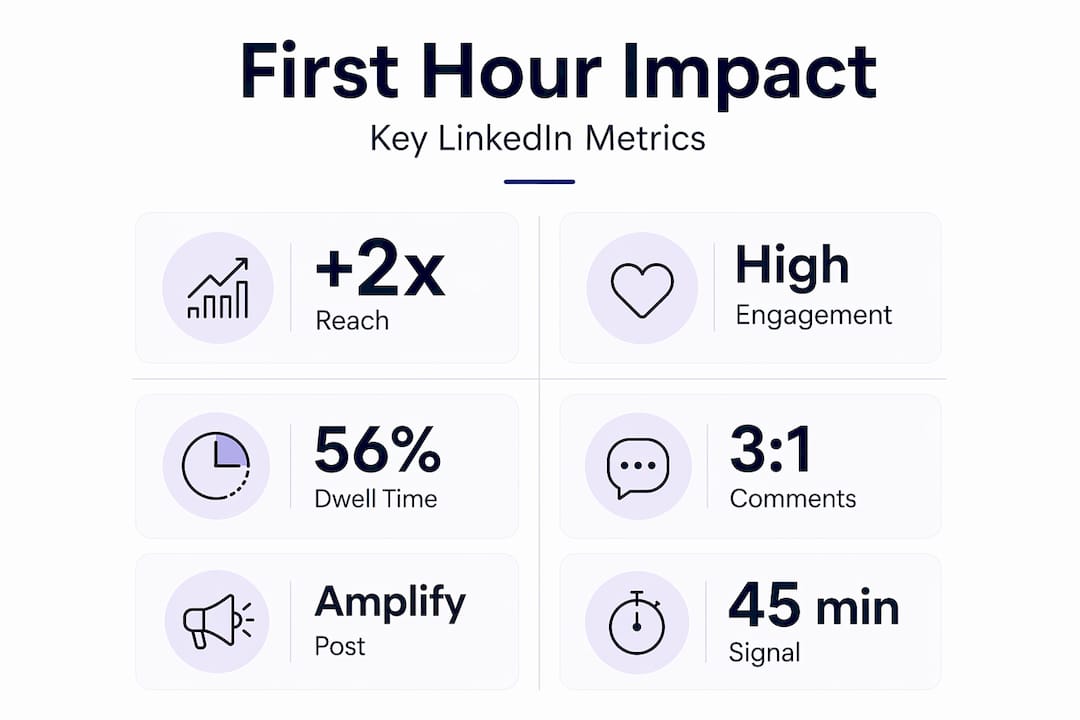
The reason the first hour carries so much weight comes down to how LinkedIn tests content before committing to it. LinkedIn runs a micro test exposing your post to a small slice of your network, typically under 10% of your connections and followers. What those early viewers do in the next 60 minutes tells the algorithm everything it needs to know about whether your content deserves a wider audience.
Think of it as an audition. The first hour acts as a real-time appraisal stage that dictates your post’s future success. If the initial test group engages meaningfully, LinkedIn interprets that as a signal of quality and pushes the post to a broader feed. If they scroll past it, the algorithm quietly buries it. There is no recovery from a weak start.
The metrics that matter most during this window are not what most people assume. Likes count, but they are the weakest signal. What the algorithm actually weights are:
- Dwell time: How long people actually stop and read your post before scrolling
- Comments: Especially substantive replies that suggest real conversation
- Comment-to-like ratio: A high ratio indicates that your content provoked thought, not just a reflex tap
- Shares: The strongest signal because they represent genuine endorsement
- Saves: A quieter but increasingly valued metric on LinkedIn’s feed
Posts with high dwell time and strong comment-to-like ratios consistently achieve wider reach than posts that collect fast likes and nothing else. A post with 10 thoughtful comments and 15 likes will almost always outperform a post with 80 likes and 2 comments.
Pro Tip: Write a post that ends with a specific, easy-to-answer question. Not “What do you think?” but “Which of these two approaches have you seen work better in your industry?” Specificity drives more comments per impression.
When to post for maximum first-hour engagement
You cannot separate timing from the importance of first hour engagement. If your audience is asleep or stuck in back-to-back meetings when you publish, the algorithm will run its micro test against an audience that simply isn’t there. The result is a weak first-hour signal through no fault of your content.

The data here has shifted significantly from conventional wisdom. Optimal LinkedIn posting times have moved toward late afternoon and evening hours on weekdays, specifically the 3 p.m. to 8 p.m. window. Wednesday at 4 p.m. and Friday between 3 and 4 p.m. are currently the top-performing slots across analyzed data sets.
| Day | Best posting window | Why it works |
|---|---|---|
| Wednesday | 4:00 p.m. local time | Mid-week, audience wrapping up work tasks |
| Friday | 3:00 to 4:00 p.m. | Pre-weekend wind-down, higher browsing activity |
| Tuesday | 10:00 a.m. to noon | Still valid for B2B audiences catching morning feeds |
| Thursday | 7:00 to 9:00 p.m. | Evening engagement is growing as users catch up after work |
The reason for this shift is behavioral. Posting when your audience is active triggers better early engagement because people are no longer primarily browsing LinkedIn during morning commutes or lunch breaks. They now check feeds during evening downtime, whether on the couch or during a post-work commute.
That said, timing amplifies good content. It does not rescue bad content. A perfectly timed mediocre post will still underperform a genuinely useful post published at a slightly off-peak hour.
Pro Tip: Test your posting time by checking your LinkedIn analytics for follower activity. The “Follower analytics” tab shows when your specific audience is most active, which matters more than any general benchmark.
How to generate strong engagement during the first hour
Knowing the importance of first hour engagement is one thing. Executing on it requires a specific set of behaviors in the minutes right after you publish.
Here’s what actually works, ordered by impact:
-
Respond to every comment within 15 to 30 minutes. Prompt responses to early comments boost post visibility because they signal ongoing conversation. The algorithm reads your reply as fresh activity on the post, which extends its distribution window. Even a two-sentence thoughtful response is enough.
-
Write a hook that stops the scroll. Your first line is visible before the “see more” cutoff. If it doesn’t create immediate curiosity or relevance, people scroll and your dwell time collapses. The most effective hooks state something surprising, make a bold claim, or open a loop that demands resolution.
-
Keep external links out of the post body. LinkedIn deprioritizes posts with outbound links built into the content. If you need to share a resource, drop it in the first comment and reference it in your post with a phrase like “Link in comments.” This one change can meaningfully improve first-hour reach.
-
Contact a small group of trusted peers before or right after posting. Reach out to three to five colleagues via direct message and let them know your post is live. Ask for honest reactions, not just likes. This gives the algorithm a warm, engaged initial test group rather than a cold one.
-
Share to one or two relevant LinkedIn Groups within the first 30 minutes. If your post is genuinely relevant to a group’s focus, the added exposure gives your micro test a broader pool to draw from. Do not spam groups. One or two targeted shares is enough.
You can find more strategies for maximizing first-hour reach in Resonate’s resource on why posting limits matter for creators.
Common mistakes that kill your first-hour momentum
Most creators already know they should engage quickly after posting. The problem is the subtle errors that undercut that effort.
Ignoring comments for the first hour and responding in bulk later. This is the most common mistake. Batch-responding three hours after posting does almost nothing for reach because the algorithm has already made its decision. Each comment you respond to within the first hour is a new activity signal. Each one you miss is a missed signal.
Treating all engagement as equal. Ten emoji reactions do not carry the weight of two substantive comments. Creators who celebrate surface-level engagement metrics often miss the fact that their posts are not gaining real traction. Watch your comment-to-like ratio more closely than your total like count.
Publishing during low-activity windows and expecting strategy to compensate. Responding fast to comments doesn’t help much if there are no comments to respond to. Posting at 6 a.m. on a Sunday or late on a Friday night puts you at a structural disadvantage from the start.
Letting the post go cold without a follow-up signal. Around the 45-minute mark, consider adding a follow-up comment on your own post. This could be an additional insight you left out, a reaction to early responses, or a question you want to direct at a specific commenter. Adding strategic follow-up comments during the first hour sustains momentum and keeps the activity clock running.
Chasing engagement at the cost of authenticity. Asking for likes directly, tagging people who have no connection to the topic, or posting inflammatory content to spark reactions all trigger short-term metrics at the cost of long-term audience trust. LinkedIn’s algorithm also monitors user engagement patterns for signals of artificial inflation, and your audience will eventually tune out content that feels manipulative.
Measuring what your first hour actually delivered
Understanding the impact of first hour performance requires looking at the right metrics, not just the vanity numbers.
| Metric | What it measures | Why it matters |
|---|---|---|
| Impressions in first hour | How far the algorithm distributed your post initially | Confirms whether the micro test generated traction |
| Engagement rate | Interactions divided by impressions | A low rate on high impressions means weak content resonance |
| Dwell time | Average time spent reading your post | High dwell time signals quality content to the algorithm |
| Comment-to-like ratio | Comments as a percentage of total reactions | The clearest indicator of meaningful, rather than passive, interaction |
If a post fails in the first hour, the algorithm limits subsequent visibility significantly. That means your first-hour metrics are not just a report card. They are a prediction. Posts that spike early tend to compound their reach over the following 24 to 48 hours. Posts that start slow almost never recover.
LinkedIn’s native analytics give you impression and engagement data with a reasonable lag. For real-time tracking during the first hour, Resonate’s LinkedIn content analytics provide faster feedback loops that let you act while the window is still open.
My take on what the data misses
I’ve spent years helping professionals think through their LinkedIn content strategies, and the one thing I keep seeing get overlooked is this: most people treat the first hour as a scheduling problem when it’s actually a presence problem.
You can post at the perfect time on the perfect day with a perfectly written hook, and still fail the micro test if you’re not actually there to respond. The creators I’ve seen double their post reach consistently are the ones who block 30 to 45 minutes after publishing. Not to monitor. To participate. They treat the comment section like a live conversation, not a notification feed.
I’ve also seen too many professionals get obsessed with timing to the exclusion of everything else. They move their post from Tuesday morning to Wednesday afternoon and wonder why it underperformed anyway. The answer is almost always in the content itself. The first line didn’t earn the scroll. The question at the end wasn’t specific enough. Timing amplifies what you already have. It doesn’t create what’s missing.
What I tell every client now is this: if you can’t be present for the first 30 minutes after posting, either schedule for a time when you can, or don’t post yet. The cost of an unattended post during its most critical window is real and it’s measurable.
- Tom
How Resonate helps you win the first hour
Getting your content and timing right consistently is the hard part. Resonate is built specifically to solve that problem.
Resonate’s LinkedIn content generator creates posts that sound like you, not a template. It trains on your actual writing style and work context, pulling from tools like Notion, Slack, and HubSpot to surface post ideas grounded in your real expertise. Every post it generates includes hooks calibrated to stop the scroll and structures proven to generate comments rather than passive likes.
Beyond content creation, Resonate’s community boost feature amplifies your post’s reach right at publication, giving the algorithm the warm initial audience it needs to run a meaningful micro test. When the first hour is your highest-leverage window, having a tool that prepares your content AND jumpstarts your engagement changes the math entirely. Start building your LinkedIn content strategy with Resonate today.
FAQ
Why does the first hour matter so much for LinkedIn posts?
LinkedIn runs an initial micro test exposing your post to under 10% of your network. The engagement quality during this window determines whether the algorithm distributes your content to a wider audience or limits its reach.
What’s the best time to post on LinkedIn for first-hour engagement?
Based on analysis of 4.8 million posts, Wednesday at 4 p.m. and Friday between 3 and 4 p.m. currently outperform other slots. Late afternoon and evening windows on weekdays have overtaken traditional morning posting times.
Should I include links in my LinkedIn posts?
Place external links in the first comment rather than inside the post body. LinkedIn deprioritizes posts with outbound links built into the content, which suppresses your first-hour reach before engagement can build.
How do I sustain momentum during the first hour?
Respond to comments within 15 to 30 minutes, and consider adding a follow-up comment of your own around the 45-minute mark. These actions signal continued activity to the algorithm and extend your post’s distribution window.
What metrics should I track after posting?
Watch your comment-to-like ratio and dwell time more than total likes. A high ratio indicates meaningful engagement, which carries far more algorithmic weight than a large number of quick reactions.
Recommended

Content Writer @ Resonate
Charlotte explores LinkedIn content, personal branding, AI writing, and founder-led marketing at Resonate. She believes the best content comes from real experience, not generic advice, and writes practical insights to help founders turn what they already know into content that people want to read.
Write LinkedIn content that sounds like you
with Resonate's AI Voice Engine