9 LinkedIn Post Formats That Convert Followers Into Leads for B2B Founders
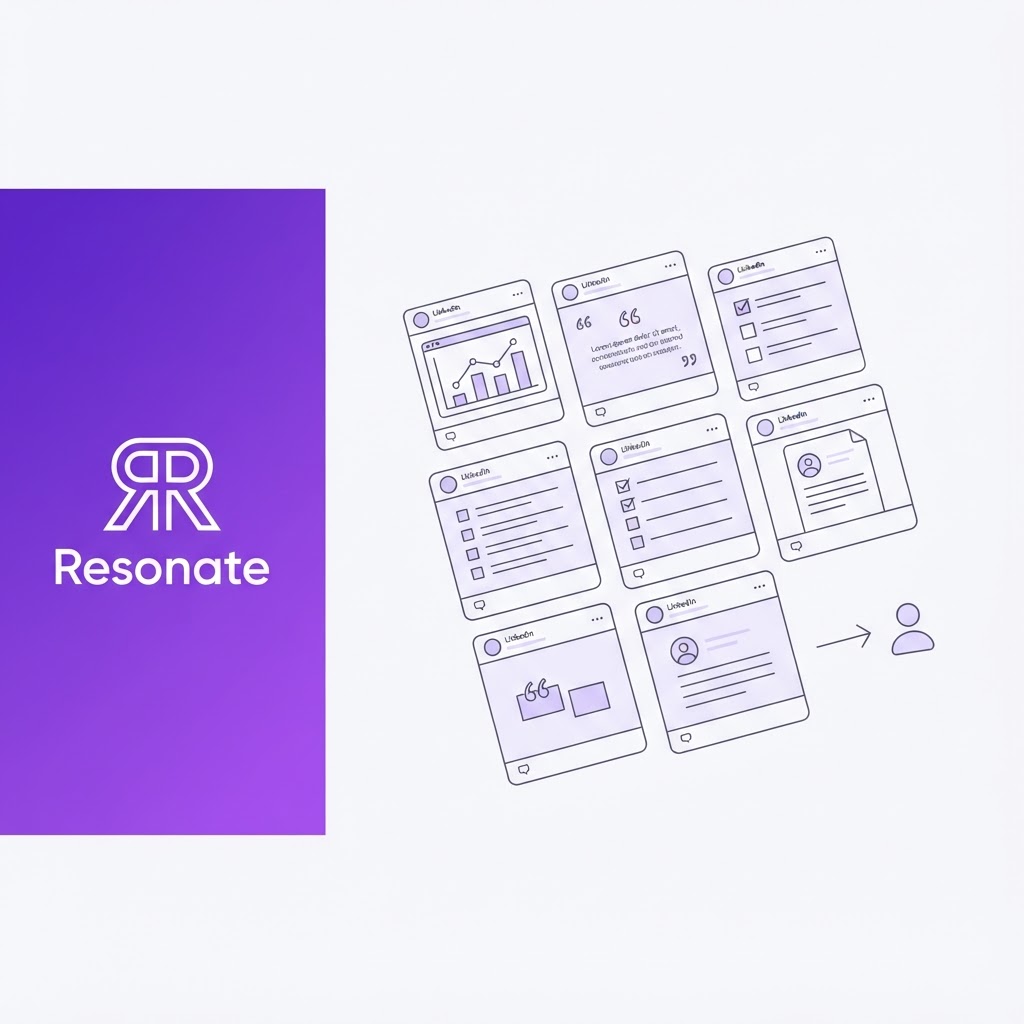
Most B2B founders do not have an idea problem. They have a post-selection problem.
They know they could publish a contrarian take, a customer insight, a framework, or a proof post. What they do not know is whether today's draft is specific enough for the right buyer, suited to the buyer's current stage, credible enough to publish, or connected to a useful next step.
That is why scoring every post before publishing can change results. A score does not predict virality. It creates a consistent decision process that helps you reject weak drafts, improve promising ones, and measure whether a post did more than collect impressions.
This matters because the most common LinkedIn advice covers what formats exist. It rarely explains how to choose a format for a particular buyer, produce it consistently, test it responsibly, or trace it to qualified pipeline. A better system does all four.
The nine LinkedIn post formats worth scoring
The following nine formats are useful starting points. Their ranking is not a universal performance leaderboard. It is a practical ranking by how much each format can contribute to a B2B founder's content system when the post has a clear audience, proof, and next action.
1. Customer insight post
A customer insight post names a pattern from real conversations, support requests, implementation work, or lost deals. It ranks first because it can connect the founder's expertise directly to a buyer's current problem, the same principle behind the role of testimonials in LinkedIn content.
Use it when you can explain what changed, who is affected, and what most teams misunderstand. Remove identifying details unless you have permission, but retain the operational specificity that makes the insight useful.
Before publishing, ask: would the target buyer recognise their own situation without recognising the customer?
2. Proof or result post
A proof post shows a measurable outcome from your company or a customer. The strongest version includes the starting condition, the intervention, the time period, and the limitation of the result.
Do not write "we increased revenue dramatically." Explain what changed and how it was measured. If the result is confidential, use an anonymised range or describe the operational improvement without implying a precision you cannot substantiate. This is the same discipline covered in why case study posts drive conversions that last rather than a single strong week.
A proof post should pass a simple test: could a sceptical buyer ask one follow-up question and receive an honest answer?
3. Framework post
A framework turns your method into a reusable model. It is especially valuable for complex B2B offers because it helps a buyer understand how you think before entering a sales conversation.
A useful framework has a defined problem, a small number of decisions, and an example. It should not be a list of generic principles with a branded name attached.
For a practical example of how to map content to buyer intent, see B2B LinkedIn content strategy.
4. How-to or tactical post
A how-to post shows a reader how to complete a specific task. Give away the method clearly enough that the reader can make progress without buying from you. The commercial value comes from demonstrating the quality of your thinking and revealing where expert help may be useful.
Score the post down if it uses a broad promise such as "how to grow faster" without naming the starting point, process, or expected outcome.
5. Build-in-public story
A build-in-public story shares a decision, result, experiment, or lesson from operating the company. It builds credibility because the evidence comes from work rather than positioning language, which is why documenting a startup's journey on LinkedIn tends to outperform polished announcements.
The post becomes stronger when it explains the decision context. "We changed our onboarding" is weak. "We removed three onboarding steps after seeing where new accounts stalled" gives the reader something to evaluate.
6. Mistake-and-lesson post
A mistake-and-lesson post earns trust when the mistake is real, the cost is clear, and the lesson changes future behaviour. Avoid the polished version in which the "mistake" conveniently proves that the company was right all along.
A strong lesson should be transferable. The reader should know what signal to watch for, what decision to change, or what assumption to test.
7. Contrarian take
A contrarian take challenges a common belief. It can earn attention quickly, but it should rank below evidence-led formats because disagreement alone does not create buyer confidence.
Use a contrarian post only when you can explain the conditions under which the popular advice fails. A claim such as "founders should stop posting educational content" is a hook, not an argument.
8. Industry-trend take
An industry-trend post interprets a development instead of merely repeating it. Explain what the change means for a specific buyer, what remains uncertain, and what decision the reader should reconsider. Platform shifts are a common trigger for this format - see how the LinkedIn algorithm has changed in 2026 for one example worth interpreting rather than just reporting.
The opportunity is not to be first to repeat the news. It is to be useful when the buyer asks, "what does this change mean for our business?"
9. Direct offer post
A direct offer post tells a defined audience how to take the next step. It is essential, but it should not carry the entire conversion burden. The other formats create the context that makes a direct offer relevant. Note also that a heavily gated offer can work against you - see why gated content affects your LinkedIn reach before deciding how much friction to put in front of the CTA.
Instead of "DM me if you need help," specify the problem, the fit, and the low-friction next step. For example: "if your sales team is generating conversations from LinkedIn but cannot tell which accounts are serious, I can share the attribution worksheet we use in our first audit."
There is no universal rule that an offer must appear exactly once in every eight or ten posts. Use the buyer's readiness, the strength of the offer, and the amount of proof available to determine frequency.
The pre-publish scorecard
Score each draft from 0 to 3 against seven criteria: audience specificity, problem clarity, proof strength, originality of the angle, voice fidelity, readability, and the usefulness of the next action. A score of 0 means the element is absent, 1 means it is vague, 2 means it is usable, and 3 means it is specific and defensible.
A draft can score a maximum of 21 points. Treat the score as a quality gate, not a prediction model:
- 18-21: publish after a final accuracy and compliance review.
- 14-17: revise the weakest two criteria before publishing.
- 10-13: rework the angle, audience, or format.
- 0-9: return the idea to the source material rather than polishing the draft.
The most important rule is to record the reason for the score. If a post receives 11 points because its proof and CTA are weak, you have a useful editorial decision. If it receives 18 points because the writer is optimistic, the number is decoration. Resonate's AI critique applies the same kind of dimension-level review automatically before a draft goes live.
Choose the format by job, not by habit
Use the scorecard with a simple format-by-stage decision rule: customer insights and trend interpretations for problem awareness, frameworks and how-to posts for evaluation, proof and mistake-and-lesson posts to reduce perceived risk, and direct offers only when a relevant next step genuinely exists.
This decision rule addresses a common gap in LinkedIn content advice: lists of formats do not tell a founder which format fits a particular buyer, sales motion, or funnel stage. A founder selling a high-consideration enterprise service should not use the same CTA or proof standard as a founder selling a self-serve product.
For a deeper execution model, see LinkedIn lead generation for B2B founders.
What scoring changes in the workflow
Scoring is most useful when it changes what happens before and after publication.
It forces a production system
A sustainable cadence requires more than a list of ideas. Decide where raw material comes from, who drafts it, who checks claims, who approves customer references, and how long each format takes.
A founder-only workflow may use one weekly call to capture customer patterns, decisions, and lessons. A founder-plus-writer workflow can turn that source material into drafts while preserving founder approval. A larger team can add design, editing, and compliance checks. The correct system is the one that can run without making the founder the bottleneck - see how to build a sustainable founder content workflow for what that looks like in practice.
It makes testing possible
Do not change the hook, format, CTA, audience, and publishing day at the same time. Start with a low-volume testing ladder: test two hooks on the same buyer problem, test proof-led versus opinion-led openings, test a low-friction CTA against a conversation CTA, and compare text with a document post only after the topic and audience are reasonably comparable.
Track qualified profile visits, target-account engagement, relevant replies, meetings, opportunity creation, and pipeline influence using a system such as Resonate's LinkedIn analytics. Likes and impressions can diagnose distribution, but they cannot prove commercial impact.
A single high-performing post is not a benchmark. Record the audience, topic, distribution, score, and outcome so you can distinguish a repeatable pattern from a lucky result.
It connects publishing to pipeline without overstating causality
A post may influence a buyer without receiving a click. Capture the post ID, target account, engagement role, profile visit, inbound message, meeting, opportunity stage, and self-reported source. Compare those signals with UTM-assisted traffic and CRM activity, an approach covered further in integrating CRM data with LinkedIn strategy.
Use language such as "influenced" or "was present in the buying journey" unless you have a credible control or time-series design that supports a stronger causal claim. This makes your LinkedIn content that converts analysis more trustworthy, not less persuasive, and it lines up with the broader pattern of how LinkedIn grows business pipeline.
It prevents avoidable publishing mistakes
Before publication, check that customer details are permitted, numerical claims are defensible, images have adequate contrast, videos have captions, documents are readable on mobile, and the CTA does not promise more than the offer delivers. If your format mix includes carousels or document posts, Resonate's carousel maker builds the mobile-readability checks into the format itself rather than leaving them for a manual pass.
The pages covering LinkedIn formats often mention whitespace, PDFs, visuals, or subtitles. A superior content system turns those suggestions into a repeatable preflight checklist.
It adapts to founder context
A pre-revenue founder should rely on customer interviews, market observations, product principles, and documented experiments rather than pretending to have mature case studies. A post-product-market-fit SaaS founder can add product usage patterns and outcome evidence. A services founder can use anonymised delivery lessons. A regulated or enterprise seller needs stricter approval and substantiation rules. This is one of several reasons a founder's LinkedIn approach should be built around their specific stage rather than a generic template.
The format can remain the same while the acceptable proof, cadence, CTA, and review process change.
Where Resonate fits
The scorecard does not replace judgment or founder voice. It makes both easier to apply consistently.
Resonate, as a LinkedIn content generator built for founders, can pull raw material from connected sources such as Notion, Slack, GitHub, and HubSpot - see how GitHub and Slack data fuel post ideas and the HubSpot integration for content teams - map that material to the nine formats, draft posts in the founder's own voice, and score them before publication. A build-in-public story may begin in GitHub. A customer insight may begin in a CRM note. A framework may begin in a strategy document.
The important distinction is that automation should reduce the distance between real work and publishable content. It should not manufacture proof, invent customer outcomes, or make every post sound like the same template.
Final takeaway
The competitive advantage is not knowing one more LinkedIn format. It is knowing why this post, for this buyer, at this stage, with this proof, and with this next action.
Rank the format. Score the draft. Test one variable at a time. Measure qualified outcomes. Then feed what you learn back into the next post. That turns LinkedIn from a swipe file into a repeatable B2B founder content system.
Frequently asked questions
Which LinkedIn post format is best for B2B founders?
There is no universal winner. Start with the buyer's job and stage. Use customer insights and trend interpretations to create problem awareness, frameworks and how-to posts to educate, proof posts to reduce risk, and direct offers when a relevant next step exists. Structuring these into repeatable content pillars makes the mix easier to sustain over time.
What score should a LinkedIn post reach before publishing?
Use 18 out of 21 as a practical publish threshold, but treat it as an editorial gate rather than a performance forecast. A high score cannot rescue a weak idea, an unsuitable audience, or an offer with no market fit.
Should every LinkedIn post include a CTA?
Every post should provide a useful next action, but that action does not always need to be a sales CTA. A reader may save a framework, answer a question, read a related guide, request a worksheet, or start a conversation. Match the CTA to the buyer's readiness.
How do B2B founders create enough content for nine formats?
Source content from real work instead of inventing ideas from a blank page. Review customer calls, product decisions, delivery notes, experiments, support questions, sales objections, and industry changes, the same extraction approach covered in how to surface post ideas from client work. Then score the strongest raw material before drafting.
Can content scoring guarantee more leads?
No. Scoring improves consistency and makes weak assumptions visible. It can increase the proportion of posts that are relevant, specific, credible, publishable, and connected to a next action. Lead volume still depends on audience quality, offer strength, sales execution, market conditions, and the buying cycle.

Content Writer @ Resonate
Charlotte explores LinkedIn content, personal branding, AI writing, and founder-led marketing at Resonate. She believes the best content comes from real experience, not generic advice, and writes practical insights to help founders turn what they already know into content that people want to read.
Write LinkedIn content that sounds like you
with Resonate's AI Voice Engine