How Scoring Every Post Before Publishing Changes Your Results
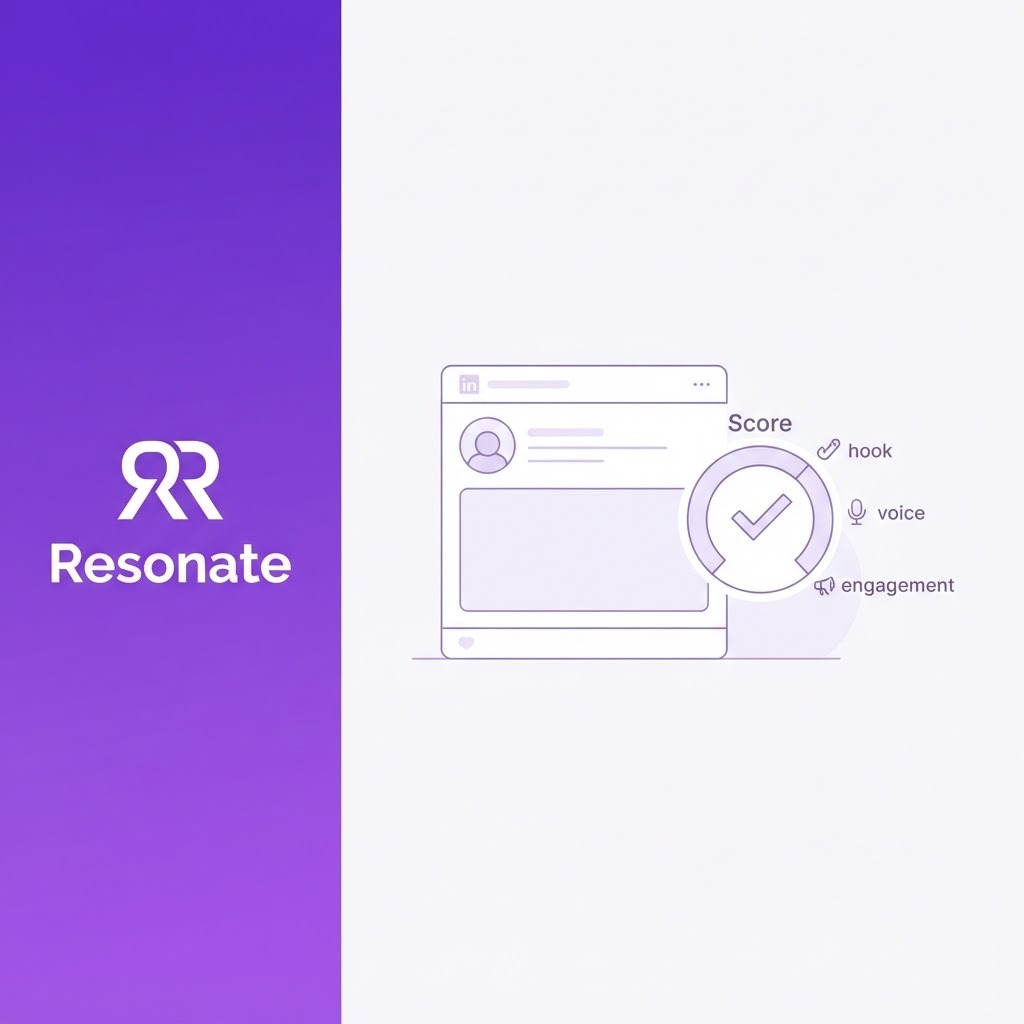
Quick answer: Scoring every LinkedIn post before publishing improves results by moving quality control from after publication to before publication. Weak drafts can be revised, rejected, or replaced while a change is still possible.
The original scoring sequence is:
- Hook scoring: does the opening earn attention and the "see more" click?
- Voice scoring: does the draft sound like the author rather than a generic template?
- Virality or engagement scoring: does the idea give the intended audience a credible reason to continue, respond, save, or share?
That sequence is useful, but a single score should not be treated as a guarantee of reach, comments, leads, or revenue. A responsible pre-publish system separates structural checks (hook visibility, readability, length, spacing, links, hashtags), editorial review (evidence, specificity, usefulness, originality, voice), predictive estimates (expected engagement relative to an account baseline), and safety gates (factuality, confidentiality, permission, originality, regulated-claim review).
The purpose of scoring is not to produce the biggest number. It is to make the next publishing decision better while the draft is still changeable. This is the same structural review that sits behind Resonate's AI critique.
What is LinkedIn post scoring?
LinkedIn post scoring is the evaluation of a draft before publication against defined criteria. The criteria may assess the writing structure, editorial quality, audience fit, or likely performance.
The distinction matters because these outputs are not equivalent. A deterministic rule can identify a dense paragraph. An editorial rubric can assess whether a lesson is useful. A predictive model can estimate possible engagement. None of those results proves that the post will create qualified business value.
The number is therefore less important than its meaning. Before trusting a score, ask:
- What exactly does the score measure?
- Which inputs and dimensions does it use?
- How were its weights and thresholds chosen?
- Is it calibrated to this account, audience, format, and objective?
- What uncertainty accompanies a prediction?
- What should the writer change first?
- Has the score been compared with real outcomes?
A score after publication is a post-mortem. A score before publication is decision support. It can help you sharpen the hook, clarify the audience, remove an unsupported claim, improve the sequence, preserve your voice, or skip a draft that is not ready.
How pre-publish scoring works
A practical scoring workflow evaluates a draft in a fixed order. It should begin with the purpose of the post, not with a generic engagement formula.
Step 1: Define the objective and audience
A post intended to build awareness should not receive the same evaluation as a post intended to generate a qualified meeting. A technical founder, recruiter, creator, executive, and company page all have different audiences and baselines. Record the intended reader and role, the problem the post addresses, the objective (awareness, education, conversation, authority, or demand), the format, the account baseline and relevant historical posts, and the desired next action.
This prevents a common mistake: calling a post "low quality" because it does not maximise a metric that was never its objective.
Step 2: Run the Hook agent
The Hook agent checks whether the opening communicates enough value or tension to earn continued attention. It can flag an opening that begins with context the reader does not yet care about, hides the point, or uses a generic statement. The mechanics behind this are covered in more depth in the role of content hooks in LinkedIn posts that win and why the first hour of your LinkedIn post matters for how the hook affects early distribution.
A useful hook review asks whether the first line identifies a problem, observation, tension, or promise; whether the intended reader can recognise why the post matters; whether the opening remains accurate after editing; whether it creates curiosity without an exaggerated claim; and whether it fits the rest of the post.
A hook is not automatically strong because it is provocative. A high-performing-looking opening that misrepresents the evidence can damage trust. The best revision preserves the truth while making the value visible earlier. If you want to test hook variations before running them through a full scoring pass, Resonate's free hook generator is a quick way to compare a few openings side by side.
Step 3: Run the Voice agent
The Voice agent checks whether the draft reflects the author's approved writing patterns, point of view, level of certainty, terminology, and personality.
Voice is not merely sentence length or vocabulary. It also includes what the author notices, believes, rejects, explains carefully, and refuses to claim. A fluent draft can still sound wrong if it adds an invented belief, exaggerates confidence, or uses generic AI phrasing, which is the exact failure mode covered in how to write LinkedIn posts without losing authenticity.
Resonate's voice learning and calibration workflow can support drafts based on approved writing and voice guidance. Human review remains necessary because only the author or an accountable editor can confirm that the post expresses the intended meaning.
Use a blind voice test when possible. Show a draft to the founder and a small group of target readers without revealing how it was produced. Ask whether it sounds attributable, accurate, and natural. Record disagreements as guidance for future drafts.
Step 4: Run the Virality or engagement agent
The Virality agent evaluates whether the post gives the intended reader a reason to continue, respond, save, or share. It may inspect the relationship between the hook, story, specificity, point of view, usefulness, and close.
"Virality" should be treated as a qualified engagement estimate, not a promise. A post can receive many comments because it is controversial without creating trust or business value. A technical explanation can receive fewer reactions but reach the right buyer and create a valuable conversation, the same distinction covered in why case study posts drive conversions that last longer than a broadly engaging but generic post.
A useful engagement review asks whether the idea is relevant to the intended audience, whether the post contains a concrete event, choice, or observation, whether there is a reason to respond beyond a forced question, whether the post provides enough value to save or share, whether the close matches the objective, and whether the likely outcome is measured against the account's own baseline.
When a tool returns a predicted score, request a range or confidence level when available. Exact reaction and impression forecasts imply more certainty than the evidence usually supports, and they can miss variables like dwell time, which shapes distribution independently of the score itself.
Step 5: Apply editorial and safety gates
A high engagement score cannot compensate for an unsupported statistic, invented customer result, confidential detail, privacy violation, copied material, or unsafe advice. Before publication, verify the source and denominator for every quantitative claim, customer and employee and partner permission, confidentiality and privacy boundaries, copyright and originality, regulated or high-stakes claims, AI-generated factual statements, required disclosure, and the correction path if an error is discovered.
Treat a critical safety failure as a veto rather than an average. A post with an excellent hook but an unverified claim should not pass because its overall score remains high. This is also where safe posting automation and Resonate's security practices matter - a well-scored post published through a risky automation setup still exposes the account.
Resonate's AI content critique can provide an additional review layer for clarity, structure, and reader response. It should complement, not replace, human fact-checking, permission review, legal review, or subject-matter approval.
Step 6: Prioritise revisions
Scoring is useful only when it leads to a better next action. Do not spend ten minutes changing hashtags while the audience and central claim remain unclear. Fix the audience and objective first, then the evidence, then the hook, then the argument and sequence, then the voice, and only then formatting details such as spacing and hashtags.
This revision waterfall makes scoring practical. It also prevents the tool from turning every problem into an equal-weight list of suggestions.
Why scoring beats publishing and hoping
Without pre-publish scoring, the feed becomes the only feedback loop. Every weak post consumes a publishing slot and produces noisy learning. The author may not know whether the problem was the idea, timing, audience, hook, format, account baseline, or distribution environment. A deeper look at how this compounds over a content system rather than a single post is in how AI critique improves content quality.
Pre-publish scoring changes the timing of feedback. The author can compare two openings, test a more specific example, remove a claim that cannot be supported, or decide that an idea needs more evidence before publishing.
The benefit is not certainty. It is controlled iteration. Over dozens of posts, a creator can record the original and final draft, the score and dimension-level feedback, the reason for accepting or rejecting each suggestion, the account baseline and audience, the format and timing and objective, the actual impressions, reactions, comments, saves, shares, clicks, and profile visits, and the qualified conversations, meetings, or opportunities that followed.
A score should earn trust by improving decisions against a baseline, not by displaying more signals.
How do you validate a score against real outcomes?
A useful validation study scores drafts before publication, records predictions, and compares them with observed outcomes after a defined reporting window. At minimum, compare the scorer with the account's recent median for similar posts, a human editor's assessment, a simple alternative draft, and comparable formats and objectives.
Report whether the score ranks stronger drafts correctly. If the tool predicts impressions or comments, report the error range rather than only the average. A model may be useful for choosing between two drafts even if it cannot forecast the exact number of comments.
Track performance by cohort. A score that works for a technical founder may not transfer to a recruiter or a company page. Use account-relative language such as "above the author's recent median" instead of assuming that one universal 0-100 benchmark works for everyone.
Measure business value, not only engagement
Engagement is an intermediate signal. The intended business outcome may be authority, qualified conversation, pipeline, hiring, referrals, or education.
Use UTMs for link traffic, CRM fields for source and influence, and self-reported attribution at forms or meetings. Distinguish sourced pipeline from influenced pipeline. A low-reaction post can still be valuable if it reaches the right buyer and creates a qualified conversation, the pattern behind how LinkedIn visibility drives more inbound leads.
Resonate's LinkedIn content analytics can help identify patterns across published content. Platform metrics should still be joined with audience quality and CRM outcomes before making a business claim, an approach also covered in integrating CRM data with LinkedIn strategy.
Does scoring make posts sound formulaic?
It can, if the score rewards surface compliance without evaluating voice, usefulness, or originality. Repeating the same hook, question, paragraph rhythm, and hashtag pattern may produce consistent formatting while reducing memorability and trust.
Good scoring should sharpen a post without flattening it. The tool can flag a buried hook, vague wording, unsupported certainty, or a flat ending. It should not force every idea into one template.
Test this directly. Compare a high-scoring formulaic version with a lower-scoring but more distinctive version using blind ratings for voice authenticity, memorability, insight, trust, reader usefulness, audience fit, and substantive response.
A rule should be broken deliberately when the reason is clear and the post remains accurate, readable, safe, and useful. The objective is not the highest possible score. The objective is the strongest post for the intended reader and outcome.
A practical pre-publish scoring workflow
- Write the brief. Define the audience, problem, objective, format, and desired action.
- Draft the post. Preserve the original idea and evidence before optimising the wording.
- Run structural checks. Review hook visibility, readability, length, spacing, links, hashtags, and formatting.
- Run Hook, Voice, and Virality reviews. Examine attention, authenticity, and qualified engagement potential separately.
- Check evidence and safety. Verify claims, permissions, privacy, originality, disclosure, and specialist review needs.
- Prioritise revisions. Fix the audience, evidence, hook, and argument before minor formatting issues.
- Compare versions. Record what changed and why.
- Approve and publish. Keep final responsibility with the author or designated reviewer.
- Measure outcomes. Compare performance with an account-relative baseline.
- Update the process. Keep useful feedback, but retire rules that repeatedly fail validation.
Use Resonate's AI LinkedIn writing workflow to reduce the time between a sound idea and a reviewable draft. The workflow should support human judgment rather than automate publication without approval.
Frequently asked questions
What is LinkedIn post scoring?
LinkedIn post scoring is the evaluation of a draft before publication against structural, editorial, audience, safety, or predictive criteria. A structural score can check formatting. An editorial score can assess usefulness and voice. A predictive score can estimate likely engagement. These outputs should not be treated as the same measurement.
How does Resonate score posts before publishing?
Resonate's scoring workflow reviews a draft through specialist perspectives for the hook, voice, and engagement or virality potential. The feedback is intended to identify what may weaken the draft and suggest specific changes before publication. The author should still verify factual accuracy, audience fit, confidentiality, permissions, and final voice.
Can you predict how a LinkedIn post will perform?
You cannot predict performance with certainty. A scoring system can provide a useful signal by comparing a draft with selected patterns or a relevant baseline. The result is more credible when the tool explains its inputs, validation data, uncertainty, limitations, and failure cases.
Does scoring every post guarantee better results?
No. Scoring improves the review and decision process, but it cannot guarantee reach, engagement, qualified conversations, or revenue. It may also produce worse content if the creator optimises for a generic formula and ignores audience fit, evidence, originality, or voice.
Should every post receive the same score threshold?
No. Thresholds should depend on the objective, account, audience, format, and risk level. A high-reach awareness post, a technical education post, and a lead-generation post should prioritise different dimensions. Critical safety failures should block publication regardless of the overall score.
How can I tell whether a score is trustworthy?
Ask what the score measures, how its weights were selected, whether it is calibrated to your account and audience, what data supports it, how uncertainty is reported, and whether it performs better than a simple baseline. Be cautious of claims such as "algorithm calibrated" or "98% accurate" without a definition, validation set, error analysis, and independent evidence.
How often should I score posts?
Score drafts consistently when you are testing a new format, objective, audience, or content system. For mature workflows, score enough posts to create a useful feedback loop without turning every sentence into an optimisation exercise. Measure qualified outcomes per founder or editor hour.
Final recommendation
Scoring every post before publishing can improve results because it catches preventable weaknesses while the draft is still changeable. Its value comes from better decisions, not from a magical number. Use scoring to make weak posts clearer, safer, and more useful. Do not use it to replace judgment, flatten the author's voice, or claim certainty about a feed that remains affected by audience behaviour, timing, context, and chance.

Content Writer @ Resonate
Charlotte explores LinkedIn content, personal branding, AI writing, and founder-led marketing at Resonate. She believes the best content comes from real experience, not generic advice, and writes practical insights to help founders turn what they already know into content that people want to read.
Write LinkedIn content that sounds like you
with Resonate's AI Voice Engine