What Notion, Slack, and GitHub Reveal About Your Best LinkedIn Content
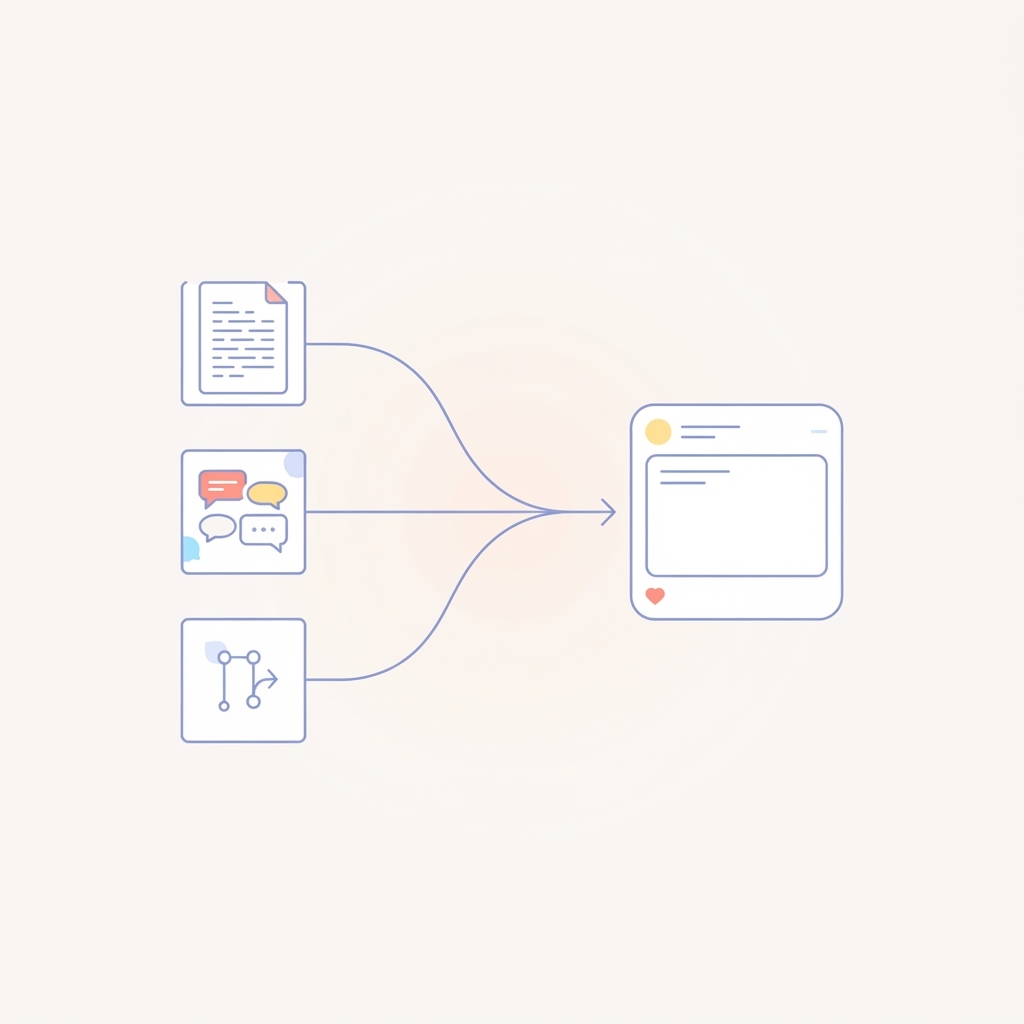
Founders rarely run out of experiences. They run out of visible source material. The best LinkedIn content ideas for founders usually already exist inside the tools where the work happens.
Quick answer: Notion reveals your thinking - strategy docs, specs, retrospectives expose frameworks and decisions. Slack reveals your reactions - debates, customer language, objections. GitHub reveals your execution - commits, pull requests, trade-offs, shipped work. That tells you where ideas live, not what should be published. A real system also defines the audience, verifies the claim, protects confidential information, preserves voice, chooses a format and connects the post to an objective.
Why founders run out of content ideas
A blank document makes content feel like invention. In reality founders generate potential content constantly: product decisions, customer conversations, hiring choices, technical trade-offs, failed experiments, market observations.
The problem is scatter. A decision may be documented in Notion, debated in Slack, implemented in GitHub and explained later on a customer call. If those sources are never connected, the founder has to remember and reconstruct the story by hand.
| Stage | Decision to make | Example output |
|---|---|---|
| Retrieve | What actually happened? | A pricing decision, debate, launch or code change |
| Identify the reader | Who needs this insight? | A technical buyer, founder, operator or developer |
| Interpret | Why might the reader care? | A reusable lesson, framework or trade-off |
| Verify | What supports the claim? | A document, transcript, metric or approved source |
| Protect | What cannot be shared? | Customer identity, internal data, security detail |
| Transform | What should the reader learn? | A clear hook, explanation, example and takeaway |
| Review | Is it accurate and in voice? | Founder, editor, expert, legal or security approval |
| Measure | Did it create useful response? | Qualified engagement, conversation, pipeline |
This sequence prevents the most common repurposing error: mistaking available information for publishable content.
1. Notion reveals your thinking
Notion usually holds the most considered version of a founder's reasoning - strategy documents, specifications, planning notes, decision records, retrospectives and research summaries. That makes it the strongest source for thought leadership.
| Notion source | Possible post | What the reader gains |
|---|---|---|
| Strategy document | "How we evaluate a market" | A reusable decision framework |
| Product specification | "Why we chose this trade-off" | Product choices linked to customer problems |
| Retrospective | "What we would do differently" | A bounded lesson backed by experience |
| Research note | "What the market misunderstands" | An evidence-led interpretation with stated limits |
| Planning decision | "How we prioritize" | Criteria, alternatives and consequences |
Never copy a Notion doc straight into a post - it was written for readers who already have the context. The external version needs a defined reader, a clear problem and a reason the decision matters beyond your company. One product doc can serve three audiences: a developer cares about the architecture trade-off, a buyer about implementation risk, another founder about the decision process. Pick one before drafting: "This post is for [role] facing [problem], and success means [qualified action]."
Make internal logic externally useful
- What problem existed?
- What alternatives were considered?
- What criteria mattered?
- What trade-off was accepted?
- What evidence supports the result?
- Where would the lesson not apply?
That last question prevents overclaiming. A decision that worked under your constraints is not a universal rule.
Classify the document before you use it
Access to a page is not permission to publish it. Notion may hold roadmaps, pricing, customer details, investor material or personal information.
| Risk level | Example | Publishing control |
|---|---|---|
| Low | General lesson from approved or public material | Standard editorial review |
| Moderate | Aggregated internal pattern | Anonymize and verify |
| High | Customer metric, contract, roadmap, employee information | Written permission and specialist review |
| Critical | Personal data, privileged material, credentials, active incident | Exclude unless formally authorized |
2. Slack reveals your reactions
Slack captures the real-time layer: debates, customer quotes, objections, quick judgments, unresolved questions. "We keep losing this deal for the same reason" is the beginning of a strong buyer-problem post. Its value is specificity - Slack holds the language people actually use, not the language a company later puts on its website.
| Slack source | Possible post | Safe transformation |
|---|---|---|
| Product debate | "The trade-off we chose and why" | Confirm the final decision, remove private context |
| Customer question | "The question buyers keep asking" | Get permission or generalize the language |
| Sales objection | "Why this solution gets rejected" | Verify the pattern without identifying the prospect |
| Team disagreement | "Two reasonable views on one decision" | Preserve nuance without exposing individuals |
| Quick founder reaction | "A belief I changed" | Add evidence; separate reaction from conclusion |
Candid does not mean publishable
Slack needs the strictest permission discipline of the three sources. Before using a Slack-derived idea, record the channel and date, the author and information owner, whether the information is confidential, whether a customer or employee is identifiable, whether permission is required, whether the claim was later verified, and whether the published version changes the meaning.
A private customer complaint can become a generalized pattern only once the company confirms the pattern is real and the story cannot be traced back. If the insight is useful but the source is sensitive, change the subject from who said it to what the company learned.
Prioritize ideas that meet three conditions: the pattern appears more than once or has strong evidence, the audience has a recognizable problem attached to it, and the lesson can be shared without exposing a person, customer or protected fact.
3. GitHub reveals your execution
GitHub records what was actually built and changed - commits, pull requests, issues, releases, tests, architecture decisions. For technical founders that is unusually credible evidence.
| GitHub source | Possible post | Reader-focused framing |
|---|---|---|
| Pull request | "The design trade-off behind this change" | Explain the user or business consequence |
| Issue discussion | "The problem that looked simple but was not" | Remove identifiers, verify the resolution |
| Release | "What we shipped and why" | Lead with customer value, not implementation |
| Failed test | "What the failure taught us" | Draw out the broader engineering lesson |
| Architecture change | "Why we replaced the old approach" | State constraints, alternatives, measurable result |
A commit message is rarely a finished post. And never publish repository activity as a performance claim without checking the metric, timeframe, denominator and comparison basis. "We made the system faster" is not precise. "Median response time fell from X to Y across Z requests during the measured period" is stronger - but only when the figures are accurate, approved and safe to publish.
Credibility without exposure Prefer design principles over credentials, trade-offs over proprietary architecture diagrams, user impact over private infrastructure, aggregated outcomes over customer-specific data, and reproducible reasoning over confidential code.
Connect the three into one story
The most valuable post often spans all three tools. Treat them as an evidence cluster, not three separate prompts.
| Tool | Contribution to the story |
|---|---|
| Notion | Why the team chose a direction |
| Slack | What people questioned and what customers cared about |
| GitHub | What was implemented and what changed in practice |
Say a team changes an architecture after a fast implementation created reliability problems. The Notion angle teaches a framework: we now evaluate architecture changes on failure isolation, operational complexity and reversibility. The Slack angle connects internal debate to buyer language: customers rarely ask whether the architecture is elegant, they ask what happens when it fails. The GitHub angle uses shipped work as evidence: the original code was not bad, the design optimized for the wrong constraint.
Pick the angle that matches your audience and objective. Do not publish all three just because three source records exist.
Build a safe retrieval system
Connect only systems the organisation is permitted to process, with least-privilege access, and exclude credentials, personal data, active incidents and privileged material. Review each tool's retention, deletion, subcontractor and model-training terms, and give every connected source an owner who can say what is retrieved, where it is stored, who can access it and how it is removed.
Then apply source-specific rules: from Notion take decision records, retrospectives, research and principles; from Slack take recurring customer language, resolved debates and verified patterns rather than every emotional reaction; from GitHub take shipped changes, meaningful trade-offs and user-impacting fixes rather than routine commits.
Deduplicate related events. One decision appearing in a doc, a thread and a pull request should become one cluster - otherwise an automated system produces three repetitive posts or merges separate events into an inaccurate story.
Attach a source receipt to every candidate: source document or commit, date and information owner, original evidence, intended audience and objective, the claim, sensitive details removed, permission status, required reviewer and final published version. It never appears in the post; it preserves provenance when the draft is edited or challenged later.
Score ideas before drafting
| Criterion | Review question |
|---|---|
| Relevance | Does a defined audience care about this problem? |
| Evidence | Can the claim be supported by the source? |
| Specificity | Is there a concrete event, choice or result? |
| Usefulness | Can the reader apply the lesson? |
| Originality | Does it add a point of view rather than a cliche? |
| Voice | Does it reflect the founder's real perspective? |
| Safety | Can it be shared without exposing protected information? |
| Objective | Is the desired outcome clear? |
An idea with high engagement potential but weak evidence or safety should be rejected or reframed. That is the difference between a retrieval system and a publishing system. Resonate is built for this workflow - its LinkedIn content generator pulls from connected work tools including Notion, Slack and GitHub, calibrates to your voice and critiques drafts before publication. Automated critique is one review layer, not a replacement for source verification, confidentiality review or founder approval.
Preserve the founder's voice
Voice is more than sentence length. It is what the founder notices, believes, rejects, explains carefully and refuses to claim. Test it through founder recognition of the meaning, reader recognition of the author, accuracy of personal experiences, preservation of uncertainty, absence of invented beliefs, and consistency across writers, editors and tools - the same discipline agencies need across multiple client accounts.
Use blind samples: ask target readers whether a post sounds attributable to the founder, then ask the founder whether the wording preserves the intended meaning. Record disagreements as guidance for future drafts.
Choose the format from the objective
| Source and objective | Suitable format | Primary measure |
|---|---|---|
| Notion framework for education | Text post, document or carousel | Saves, completion, useful replies |
| Slack customer pattern for conversation | Text story or question-led post | Substantive comments, qualified replies |
| GitHub trade-off for authority | Text explanation, diagram or short video | Target-role engagement, profile activity |
| Cross-source product launch | Case study or short video | Relevant conversations, proof consumption |
| Repeated pattern for demand | Checklist, guide or diagnostic | Qualified clicks, meetings, opportunities |
Protect cadence and founder time
Your work record will produce more ideas than you should publish, so the queue needs prioritization: source and date, audience, content pillar, risk level, evidence strength, estimated editing time, expiry date, related ideas and planned objective. Compare minimum-viable, batch, event-driven and high-frequency publishing on qualified outcomes per founder hour, quality scores, response time and comment burden. More retrieved drafts are not better content.
Connect content to business value
| Objective | Primary measure | Supporting measures |
|---|---|---|
| Awareness | Qualified reach | Relevant followers, profile visits |
| Education | Saves, completion, useful replies | Repeat visits, resource use |
| Authority | Target-role engagement, invitations | Referrals, speaking opportunities |
| Conversation | Qualified replies or messages | Meeting acceptance and fit |
| Demand | Qualified meetings or opportunities | Clicks, forms, account exposure |
| Sales influence | Pipeline or revenue influence | Stage progression, win rate |
Use UTMs for link traffic, CRM fields for source and influence, self-reported attribution at forms or meetings, and a defined reporting window. Separate sourced pipeline from influenced pipeline, and document uncertain attribution rather than presenting every conversation as revenue.
Final recommendation
Use Notion for thinking and frameworks, Slack for candid reactions and customer language, GitHub for execution evidence. Then add the editorial decisions most advice skips: retrieve from the right source, define the audience, preserve provenance, filter sensitive information, score the idea, draft in the real voice, review for accuracy and safety, choose the format, publish sustainably, measure qualified business value.
Your work is a rich content source, but it is not automatically public content. The best post may begin as a Notion decision, become clearer through a Slack debate, and gain credibility through a GitHub implementation - a connected workflow reveals that whole story without asking you to invent anything from a blank page.
Frequently asked questions
Where can founders find LinkedIn content ideas?
Start with the systems where work already happens. Notion holds strategy and reasoning, Slack holds conversations and customer language, GitHub holds implementation evidence and technical trade-offs. Customer calls, support tickets, CRM notes and voice notes also work. The goal is not to publish every activity, but to retrieve moments containing a specific lesson for a defined audience.
How do I turn Notion documents into LinkedIn posts?
Identify the decision, framework or retrospective in the document, then rewrite it for an external reader. Remove internal jargon and add the audience problem, the evidence, the trade-off, the limitation and the practical takeaway. Review the document for confidential information before publication.
How do I turn Slack messages into LinkedIn content safely?
Use Slack to identify patterns, language, questions and debates rather than copying private messages. Verify the claim is accurate, remove identifying details, obtain consent where necessary, and preserve the meaning of the original conversation. If the information is incomplete or sensitive, treat it as a private research signal rather than a public source.
How do I turn GitHub activity into LinkedIn posts?
Start with a meaningful change rather than a routine commit. Explain the user or business problem, the alternatives considered, the trade-off selected, the implementation and the result. Avoid publishing secrets, private repository information, customer details, security vulnerabilities or unverified performance claims.
Can AI turn Notion, Slack and GitHub into LinkedIn content?
AI can retrieve patterns, organize source material, generate drafts, critique structure and support a consistent workflow. It cannot independently decide whether a source is permissible, whether a claim is accurate, whether a customer has consented, or whether a draft represents the founder's real belief. Human review remains necessary.
How do I preserve my voice when AI uses my work?
Provide approved writing samples, source material, voice rules, terminology, boundaries and explicit feedback. Test drafts for meaning, factual self-recognition, reader recognition and unwanted style drift. A tool can reproduce surface patterns while still changing your level of certainty or inventing a conclusion.
Should every retrieved idea become a post?
No. Score ideas for audience relevance, evidence, usefulness, originality, voice, safety and business objective. Many ideas should stay internal, be combined with other sources, or wait until more evidence exists.
How often should founders publish source-derived content?
Use a cadence that matches your available source material, attention, audience expectations and business objective. Two or three high-quality posts per week is a reasonable starting point rather than a universal rule. Measure qualified outcomes per founder hour instead of maximizing retrieved drafts or posting volume.

Content Writer @ Resonate
Charlotte explores LinkedIn content, personal branding, AI writing, and founder-led marketing at Resonate. She believes the best content comes from real experience, not generic advice, and writes practical insights to help founders turn what they already know into content that people want to read.
Write LinkedIn content that sounds like you
with Resonate's AI Voice Engine