Why Case Study Posts Drive Conversions That Last
Why Case Study Posts Drive Conversions That Last

Case study posts are the highest-converting content format in B2B marketing because they replace abstract claims with specific, measurable proof that mirrors the buyer’s own situation. Unlike testimonials, which offer sentiment, case studies offer evidence. Landing pages with detailed case studies convert up to 70% better than those relying solely on testimonials. That gap exists because buyers do not just want to know a product works. They want to know it works for someone exactly like them. Understanding why case study posts drive conversions starts with recognizing that specificity, not polish, is what closes deals.
Why case study posts drive conversions better than any other format
Case studies convert because they collapse psychological distance between a skeptical buyer and a purchase decision. When a buyer reads about a company their size, in their industry, solving their exact problem, theory becomes proven necessity. Generic content cannot do that. A blog post can explain what your product does. A case study proves what it did, for whom, and by how much.
The numbers behind this are striking. 87% of B2B buyers demand specific metrics and outcomes in case studies. 79% require industry relevance, and 71% want company size comparability. These are not preferences. They are conversion triggers. Miss any one of them and the case study fails to move the buyer forward.

The MEDDIC framework, which stands for Metrics, Economic Buyer, Decision Criteria, Decision Process, Identify Pain, and Champion, gives marketers a proven structure for embedding these triggers. A 2022 Forrester study found that case studies lacking full MEDDIC elements have 63% lower conversion rates. That is not a marginal difference. It means a case study without explicit metrics, buyer context, and decision criteria is doing less than half the conversion work it could.
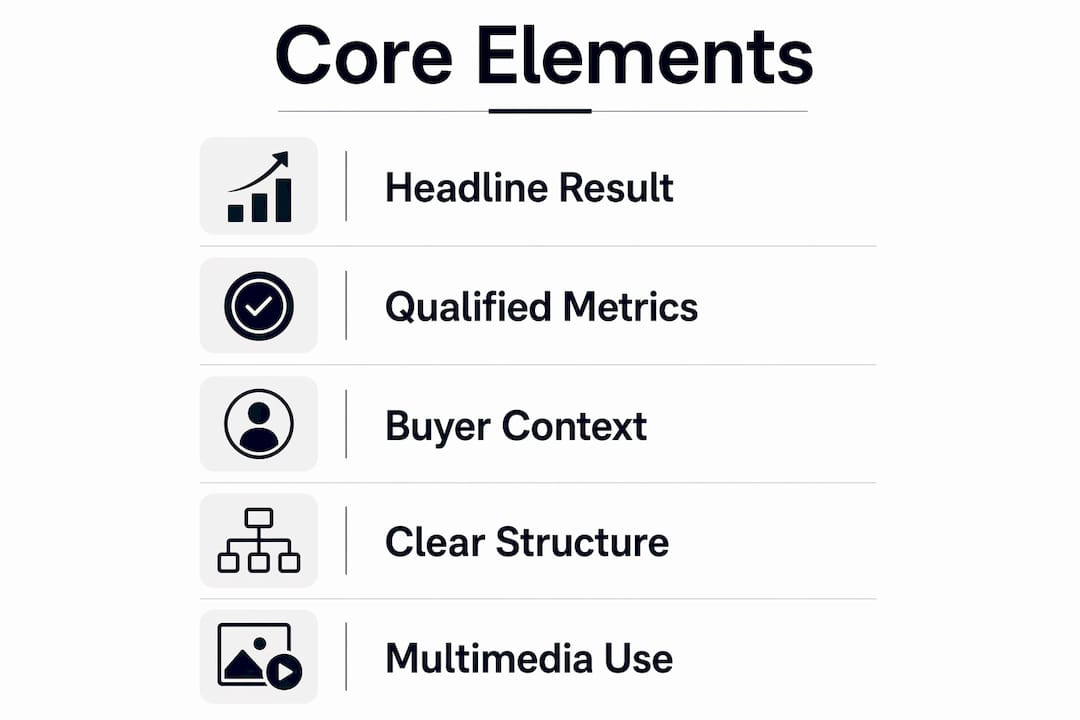
What are the core elements that make case study posts convert?
The STAR framework, which stands for Situation, Task, Action, and Result, is the most reliable structure for a converting case study. STAR-structured case studies convert three times better than unstructured ones. The reason is simple: buyers follow a logical path from recognizing a problem to justifying a solution. STAR mirrors that path exactly.
The core elements that separate converting case studies from forgettable ones include:
- Specific, quantified outcomes. “Reduced churn by 34% in 90 days” outperforms “improved retention significantly” every time.
- Industry and company size match. Buyers filter by relevance before they read a single word of body copy.
- Honest implementation narrative. Detailing what was hard, what required adjustment, and what the team had to learn builds far more credibility than a sanitized success story.
- ROI-focused framing. Time to value, cost savings, and revenue impact speak directly to economic buyers who control budget.
- Skimmable formatting. Pull quotes, result snapshots, bold metrics, and clear headers let busy decision-makers absorb the key proof points in under 60 seconds.
Pro Tip: Lead your case study headline with the result, not the customer name. “How [Company] Cut Onboarding Time by 52% in 8 Weeks” outperforms “[Company] Customer Story” in click-through rate and AI citation frequency.
Embedding MEDDIC-qualified metrics also compresses sales cycles by 21%. That matters because a case study is not just a marketing asset. It is a sales tool that answers the objections a prospect has not yet voiced.
How does multimedia and structure impact case study conversion rates?
Format is not cosmetic. It directly determines whether a case study gets read, shared, and acted on. B2B buyers are 4.8x more likely to request a demo after watching a case study video compared to reading text-only content. That multiplier reflects how video communicates emotion, credibility, and context simultaneously in a way that text alone cannot.
Mixed media formats, combining video, data visualizations, and written narrative, generate 5 - 7x more lead conversions than static text case studies. The before/after bar chart is particularly effective. 73% of viewers recall before/after visual metrics after 30 days. That recall rate matters because B2B sales cycles are long. A buyer who remembers your proof point three weeks later is far more likely to bring it into an internal buying conversation.
| Format type | Relative conversion impact |
|---|---|
| Text-only case study | Baseline |
| Text with data visualizations | Moderate lift |
| Video case study | 4.8x more demo requests |
| Mixed media (video + text + visuals) | 5 - 7x more lead conversions |
| STAR-structured narrative | 3x better than unstructured |
Pro Tip: If you cannot produce a full video case study, record a two-minute customer interview clip and embed it above the written version. Even a short video segment significantly increases time on page and form completions.
Distribution channel also shapes format choice. A LinkedIn post repurposed from a long-form case study performs best when it leads with the result metric, names the customer, and links to the full story. For repurposing case study content across formats, the key is preserving the specificity of the original while adapting length and structure to the platform.
What are common pitfalls marketers face when creating case study posts?
Most case studies underperform not because the underlying story is weak, but because execution errors strip out the elements buyers actually need. 83% of case studies fail to meet their conversion potential by burying the “aha moment.” The proof point that would trigger a buyer’s decision appears on page three instead of the headline.
The most damaging mistakes follow a predictable pattern:
- Vague outcomes. Generic case studies without concrete data convert roughly half as well as named, specific ones. “Improved efficiency” is not a conversion trigger. “Reduced manual reporting time from 12 hours to 45 minutes per week” is.
- Brand-centric storytelling. Case studies written to celebrate the vendor rather than document the buyer’s experience read as marketing material, not evidence. Buyers disengage immediately.
- Skipping implementation challenges. Trustworthiness comes from imperfections, not sanitized success stories. A case study that omits what went wrong during rollout signals that the story has been edited for optics.
- Ignoring buyer decision criteria. If the case study does not address how the customer evaluated alternatives and why they chose this solution, it misses the most persuasive part of the story.
- Poor distribution. Neglected case studies lose their revenue potential regardless of quality. A case study buried in a resources tab that sales never references is a wasted asset.
The last point deserves emphasis. Well-distributed case studies boost sales cycle efficiency by 28% versus those buyers find independently. Sales teams that share relevant case studies at the right stage close deals faster and with higher confidence. Distribution is not an afterthought. It is half the strategy.
How can marketers maximize the conversion impact of case study posts?
The gap between a case study that sits unread and one that closes deals comes down to execution across five areas: content, structure, naming, personalization, and distribution. Here is how to get each one right.
-
Lead with quantified before/after metrics. State the specific problem, the baseline measurement, and the outcome within a defined timeframe. “Reduced customer acquisition cost by 41% in Q2 2025” gives buyers the context they need to self-qualify.
-
Name the customer whenever possible. Named case studies carry significantly more credibility than anonymized ones. 71% of enterprise buyers now use AI assistants to research vendor case studies before sales conversations, up from 11% in 2024. Named customers with structured formatting are far more likely to appear in those AI-generated summaries.
-
Detail the evaluation journey. Expert marketers emphasize that case studies should explicitly detail the “before” pain, the evaluation process including rejected alternatives, and the quantifiable “after” impact. This structure answers the objections a buyer’s internal stakeholders will raise.
-
Repurpose across formats. A single long-form case study can become a LinkedIn post, a one-page PDF for sales, a short video clip, an email nurture sequence, and a slide in a sales deck. Each format reaches a different buyer at a different stage. For B2B lead generation on LinkedIn, short-form case study posts with a result-first headline consistently outperform generic thought leadership content.
-
Personalize case study display by segment. Show SaaS buyers SaaS case studies. Show enterprise buyers enterprise case studies. Personalization by industry, company size, and use case removes the relevance gap that kills conversion. Platforms that serve case studies dynamically based on visitor attributes see measurably higher engagement and form completion rates.
-
Integrate case studies into sales enablement and pricing pages. A case study placed next to a pricing tier answers the ROI question at the exact moment a buyer is calculating value. Sales teams equipped with a library of segmented case studies close deals faster because they can match proof to objection in real time.
Key Takeaways
Case study posts drive conversions because they deliver specific, credible proof that mirrors the buyer’s situation, structure, and decision criteria at every stage of the sales cycle.
| Point | Details |
|---|---|
| Specificity drives conversion | 87% of B2B buyers require specific metrics; vague outcomes cut conversion rates roughly in half. |
| Structure multiplies results | STAR-structured case studies convert 3x better; MEDDIC-aligned ones compress sales cycles by 21%. |
| Format determines reach | Video case studies generate 4.8x more demo requests than text-only versions. |
| Distribution is half the strategy | Well-distributed case studies improve sales cycle efficiency by 28% versus self-discovered ones. |
| AI discoverability is now a factor | 71% of enterprise buyers use AI to research vendors; named, structured case studies get cited more often. |
The honest truth about case studies most marketers miss
Most marketers treat case studies as a checkbox. Write one per quarter, post it to the resources page, and move on. That approach explains why so many case studies sit unread while the sales team improvises objection handling in live calls.
The case studies I have seen actually close deals share one quality that polished ones almost never have: they tell the truth about what was hard. A SaaS buyer evaluating a platform does not need to hear that implementation was smooth. They need to hear that it took six weeks, required two rounds of data migration, and still delivered a 40% reduction in reporting time by month three. That story is credible. The sanitized version is not.
The second thing most marketers underestimate is the role of AI in case study discoverability. AI-driven buyer research increasingly cites case studies in AI-generated buyer summaries. If your case study lacks a named customer, a clear result metric in the headline, and structured formatting, it will not appear in those summaries. Your competitor’s will. This is not a future concern. It is happening now, and the gap between structured and unstructured case studies in AI citation frequency is already significant.
The third lesson is about audience. Case studies written to satisfy the marketing team’s brand guidelines rarely satisfy the buyer’s decision criteria. The buyer wants to know: did it work for someone like me, how long did it take, what did it cost, and what would have happened if they had not done it. Answer those four questions with real numbers and a real customer name, and you have a converting case study. Answer them with vague language and stock photography, and you have a brochure.
- Tom
How Resonate helps marketers publish case study posts that convert
Marketers who understand the case study impact on sales still face a practical bottleneck: turning raw customer stories into structured, voice-consistent LinkedIn posts at scale is time-consuming. Resonate solves that directly. If you want to try this yourself, spin up a draft with Resonate's LinkedIn content generator.
Resonate’s AI content generation trains on your individual writing style, then pulls relevant data from connected tools like HubSpot and Notion to surface post ideas grounded in real customer outcomes. The result is LinkedIn content that sounds like you, not a generic AI template. For B2B marketers using case studies for leads, Resonate makes it practical to publish result-first case study posts consistently, with built-in engagement prediction and community boost features that amplify reach immediately after publication.
FAQ
What makes a case study post convert better than a testimonial?
Case studies provide specific metrics, implementation context, and buyer-matched details that testimonials cannot. Landing pages with detailed case studies convert up to 70% better than those relying solely on testimonials.
How long should a B2B case study post be?
Long-form case studies work best for website pages and sales enablement, while LinkedIn posts should lead with the result metric and link to the full story. The format should match the platform and the buyer’s stage in the decision process.
Does naming the customer in a case study really matter?
Named case studies carry significantly more credibility and are far more likely to appear in AI-generated buyer research summaries. With 71% of enterprise buyers now using AI assistants to research vendors, named and structured case studies have a measurable discoverability advantage.
What is the STAR framework for case studies?
STAR stands for Situation, Task, Action, and Result. Case studies built on this structure convert three times better than unstructured ones because they follow the same logical path a buyer takes from recognizing a problem to justifying a solution.
How should marketers distribute case study posts for maximum impact?
Case studies should appear on pricing pages, in sales enablement libraries, in email nurture sequences, and as LinkedIn posts. Well-distributed case studies improve sales cycle efficiency by 28% compared to those buyers discover on their own.
Recommended

Content Writer @ Resonate
Charlotte explores LinkedIn content, personal branding, AI writing, and founder-led marketing at Resonate. She believes the best content comes from real experience, not generic advice, and writes practical insights to help founders turn what they already know into content that people want to read.
Write LinkedIn content that sounds like you
with Resonate's AI Voice Engine