Why LinkedIn beats cold outreach for entrepreneurs
Why LinkedIn beats cold outreach for entrepreneurs
 . If you want to try this yourself, spin up a draft with an AI LinkedIn post tool.
Cold email used to be the default playbook for entrepreneur lead generation. Blast enough inboxes, and eventually someone bites. But the numbers have shifted dramatically. LinkedIn campaigns now achieve 30-37% reply rates and connection acceptance rates that double what even the best cold email sequences produce. If you are still treating cold outreach as your primary channel, you are working harder than you need to for worse results. This guide breaks down exactly why LinkedIn beats cold outreach for entrepreneurs, what the 2026 data shows, and how to apply AI-driven strategies to make every message count.
Key Takeaways
| Point | Details |
|---|---|
| LinkedIn’s superior engagement | LinkedIn consistently delivers reply rates 3-5 times higher than cold email due to built-in trust signals and perfect message deliverability. |
| Relationship trust matters | Profiles, mutual connections, and content engagement help entrepreneurs build credibility that cold outreach can’t replicate. |
| Balance scale and quality | Cold email excels in reach and cost-efficiency while LinkedIn shines in personalized, relationship-driven outreach. |
| AI enhances outreach efficiency | Leveraging AI tools saves time and improves personalized messaging, boosting LinkedIn connection acceptance and reply rates. |
| Multi-channel outreach wins | Combining LinkedIn and cold email in coordinated sequences increases reply rates significantly over single-channel efforts. |
Why LinkedIn delivers higher response and connection rates
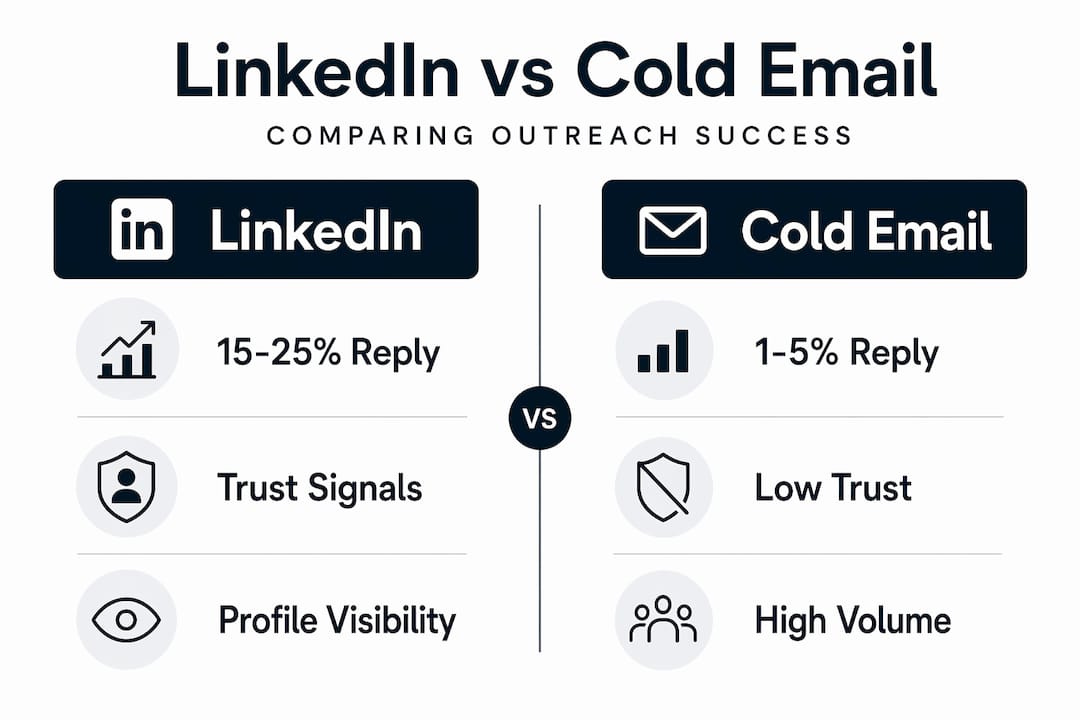
The numbers alone make a compelling case. LinkedIn outreach delivers 15-25% response rates compared to 1-5% for cold email, making prospects 5-8x more likely to respond on LinkedIn. For entrepreneurs running lean operations, that difference is not marginal. It is the gap between a channel that works and one that drains time.
Deliverability is the part most entrepreneurs underestimate. Cold emails face an 18% non-delivery rate to inboxes due to spam filters in 2026, while LinkedIn achieves 100% deliverability. Your message always lands. There is no domain reputation to protect, no SPF record to misconfigure, and no Gmail tab sorting your outreach into promotional oblivion.
The granular data backs this up further. LinkedIn DM reply rates sit at 10.3% versus cold email’s 5.1%, with connection acceptance averaging 29.61%. That acceptance rate climbs significantly when you personalize your request, which we will cover shortly.
| Metric | Cold email | |
|---|---|---|
| Reply rate | 15-37% | 1-5% |
| Deliverability | 100% | ~82% |
| Connection/open rate | 29-60% | 20-40% |
| Cost per message | Higher | Lower |
| Relationship quality | High | Low |
| Best for | High-value prospects | Volume testing |
Here is what makes LinkedIn’s numbers sustainable rather than a one-time spike:
- Personalized connection requests referencing a prospect’s recent post or shared connection consistently outperform generic ones
- Profile visits before messaging signal genuine interest and warm up the prospect before you say a word
- Content engagement from the prospect’s network creates ambient familiarity that cold email simply cannot replicate
- No spam folder means every touchpoint you create actually registers
Pro Tip: Before sending a connection request, spend one week engaging with your target prospect’s posts. A thoughtful comment on their content puts your name in front of them organically. By the time your request arrives, you are not a stranger.
“LinkedIn’s platform architecture is designed for professional discovery. Cold email was built for broadcast. Those two design philosophies produce very different outcomes for the person receiving your message.”
Now that we understand the data proving LinkedIn’s superior engagement rates, let us explore the underlying reasons behind this advantage.
How LinkedIn’s relationship-based platform builds trust cold outreach can’t match
When a cold email lands in someone’s inbox, they have one question: who is this person and why should I care? They have nothing to work with except your subject line and whatever credibility signals you managed to squeeze into 150 words. LinkedIn flips that dynamic entirely.
Your profile does the trust-building before you even send a message. Endorsements, recommendations, shared employers, mutual connections, and a visible content history all communicate legitimacy instantly. LinkedIn provides built-in context via profiles and mutual connections, making recipients think “colleague reaching out” rather than “unknown sender.” That psychological shift is worth more than any subject line optimization.

LinkedIn is a relationship platform where profile, content, and mutual connections create trust signals cold email simply cannot replicate. When you share a mutual connection with a prospect, your outreach carries an implicit endorsement. The prospect’s brain registers it as a warm introduction even if that mutual connection never said a word about you.
Content is the trust multiplier most entrepreneurs leave unused. When you publish consistently on LinkedIn, prospects encounter your thinking before you ever reach out. By the time you send a connection request, they may already have read two of your posts, formed an opinion about your expertise, and decided you are worth talking to. You can build trust through LinkedIn content long before a direct conversation begins.
Key trust signals LinkedIn provides that cold email cannot:
- Visible professional history that prospects can verify in seconds
- Recommendations from real people they may recognize or research
- Mutual connections that function as passive social proof
- Content track record showing your thinking and expertise over time
- Activity signals like recent posts and comments that confirm you are a real, active professional
Pro Tip: Avoid the mistake of sending a connection request with a pitch attached. Reference something specific: a post they wrote, a company milestone, or a shared interest. Generic requests read as automated and get ignored at the same rate as cold email.
“The single biggest mistake entrepreneurs make on LinkedIn is treating it like a faster email list. It is not. It is a trust infrastructure. Use it like one.”
With an understanding of LinkedIn’s trust advantage, let us compare the practical implications of LinkedIn versus cold outreach approaches.
Comparing LinkedIn outreach and cold email: scale, cost, and strategy nuances
LinkedIn is not perfect for every situation, and pretending otherwise would waste your time. Cold email genuinely wins on certain dimensions, and smart entrepreneurs use both channels for what each does best.
Cold email allows you to reach tens of thousands of contacts at minimal marginal cost. You can test five different value propositions simultaneously across segments of 2,000 contacts each and have statistically meaningful data within a week. Cold email wins on volume and cost efficiency at scale, while LinkedIn wins on reply rate and relationship quality. That is not a knock on LinkedIn. It is a reason to use them together.
LinkedIn’s limits are real. You can invite up to 1,000 first-degree connections weekly for events, but standard connection requests run closer to 80-100 per week before the platform flags your account. InMail credits cap out monthly. These limits exist to protect the platform’s quality, and they force you to be selective.
| Factor | Cold email | |
|---|---|---|
| Weekly volume capacity | 80-100 connections | Thousands |
| Cost per message | $0.50-$2+ (time/tools) | Near zero at scale |
| Deliverability | 100% | ~82% |
| Engagement rate | 15-37% | 1-5% |
| Relationship depth | High | Low |
| Best use case | High-value, complex sales | Market testing, volume |
When to favor LinkedIn over cold email:
- You are targeting senior decision-makers who receive hundreds of cold emails weekly
- Your sale requires trust and multiple touchpoints before a conversation happens
- You have a small, well-defined target account list where quality matters more than quantity
- You want to build a long-term referral network, not just close one deal
- Your product or service is high-ticket and relationship-dependent
When cold email still makes sense:
- You need to test a new market quickly with minimal setup cost
- Your target audience is not active on LinkedIn
- You are running awareness campaigns for a lower-ticket offer
- You need volume data to identify which segments respond at all
Pro Tip: Apply LinkedIn to your top 20-30% most valuable target accounts. Use SaaS marketing strategies that treat cold email as a top-of-funnel filter and LinkedIn as the relationship layer for accounts that surface as genuinely interested.
Understanding these differences helps entrepreneurs allocate effort strategically. Next, let us look at practical AI-driven content and automation strategies to maximize LinkedIn outreach effectiveness.
Applying AI-driven content strategies to boost LinkedIn outreach efficiency
The objection most entrepreneurs raise about LinkedIn is time. Personalizing 50 connection requests a week sounds like a part-time job. AI changes that math significantly without sacrificing the authenticity that makes LinkedIn work in the first place.
LinkedIn Premium All-In-One saves entrepreneurs 5-7 hours weekly through AI prospect suggestions, boosting conversions by 61% and profile views by 40%. That is not a trivial efficiency gain for a founder who is also running sales, product, and operations simultaneously.
Beyond LinkedIn’s native tools, third-party AI platforms can draft personalized connection request notes that reference a prospect’s recent post, their company’s latest funding round, or a shared professional interest. The key distinction is that AI drafts and you refine. A message that references a specific detail the prospect actually cares about converts at a completely different rate than one that sounds generated.
Using automation respectfully to warm leads before outreach can improve acceptance rates to nearly 30% and reply rates above 16%. The sequence matters: profile visit, post like, comment, then connection request. Each step signals genuine interest and primes the prospect before you ask for anything.
Best practices for using AI in LinkedIn outreach:
- Always personalize the AI draft with at least one specific detail unique to that prospect
- Avoid automation tools that send mass generic requests, which violate LinkedIn’s terms and destroy your account’s standing
- Track campaign results by segment so you know which message angles produce conversations versus silence
- Use AI for content creation between outreach campaigns to keep your profile active and credible
- Respond manually once a prospect engages. Automation warms the lead. You close it.
Pro Tip: Use an AI content generator for LinkedIn to draft your initial message, then spend 60 seconds adding one line that proves you actually looked at their profile. That single line is what separates a 30% reply rate from a 5% one.
Armed with these AI-driven tactics, entrepreneurs can unlock LinkedIn’s full potential for outreach. Let us conclude with a perspective on why this approach outshines traditional cold outreach.
Why the conventional cold outreach playbook is outdated for entrepreneurs
Here is the uncomfortable truth about cold email as a primary channel: it was never really about relationships. It was about finding the one person in a thousand who happened to need what you sell at the exact moment you emailed them. That is not lead generation. That is timing arbitrage.
LinkedIn forces a different discipline. When you build meaningful LinkedIn relationships, you are creating a network that generates inbound interest, referrals, and warm introductions over time. Tight networks under 2,000 high-value connections generate referrals without cold outreach, and the metric that matters is revenue per connection, not total connection count. Most entrepreneurs have this backward. They chase follower counts and connection numbers that look impressive but produce nothing.
LinkedIn’s warm-first approach combining automation, experimentation, and personalization is the future of scalable relationship selling. The entrepreneurs winning on LinkedIn are not blasting 10,000 messages. They are sending 50 highly targeted, well-researched outreach messages per week and converting a meaningful percentage into real conversations.
Common mistakes entrepreneurs make with cold outreach, and the LinkedIn mindset to adopt instead:
- Mistake: Measuring success by volume sent. LinkedIn mindset: Measure by qualified conversations started.
- Mistake: Treating every prospect identically. LinkedIn mindset: Segment ruthlessly and personalize accordingly.
- Mistake: Giving up after one touchpoint. LinkedIn mindset: Build familiarity through content before the first message.
- Mistake: Automating everything and engaging nothing. LinkedIn mindset: Automate warm-up, humanize the conversation.
- Mistake: Optimizing for opens and clicks. LinkedIn mindset: Optimize for relationships that generate referrals.
The multi-channel approach is where this really compounds. Entrepreneurs who use lead generation strategies that combine LinkedIn relationship-building with targeted cold email follow-up see dramatically better results than either channel alone. LinkedIn builds the trust. Email handles the logistics. Together, they create a pipeline that does not depend on catching someone at the right moment.
Enhance your LinkedIn outreach with Resonate’s AI-powered content tools
Now that you understand why LinkedIn outperforms cold outreach and how AI tools can maximize your time, the next step is putting these insights into a repeatable system.
Resonate’s LinkedIn content generator is built specifically for entrepreneurs who want to show up consistently on LinkedIn without spending hours crafting every post and message from scratch. Resonate trains on your actual writing style and pulls data from your work tools, including Notion, Slack, and HubSpot, to surface post ideas that reflect your real expertise. The result is content that sounds like you, not like a generic AI. Features include:
- Voice-calibrated message drafts that match your tone and professional style
- Content suggestions pulled from your actual work and recent activity
- Engagement analytics that improve over time as the platform learns what resonates with your audience
- Community boosts that amplify your posts immediately after publication for faster reach
Pro Tip: Use Resonate to maintain consistent, high-quality LinkedIn presence even during your busiest weeks. Consistency is what turns a LinkedIn profile into a lead generation asset.
Frequently asked questions
Why does LinkedIn have higher reply rates than cold email?
LinkedIn messages arrive with your full professional profile, mutual connections, and visible content history attached, giving recipients immediate context and credibility that cold emails cannot provide. Prospects are 5-8x more likely to respond on LinkedIn than via cold email as a direct result of this trust infrastructure.
Can cold email still be useful for entrepreneurs?
Absolutely. Cold email is the right tool for reaching large volumes quickly, testing multiple market segments simultaneously, and running broad awareness campaigns for lower-ticket offers. Cold email wins on scale and cost efficiency, which makes it a valuable complement to LinkedIn’s relationship-building strength rather than a replacement.
How can AI tools improve LinkedIn outreach?
AI tools draft personalized messages and automate warm-up activities like profile visits and post engagement, freeing you to focus on actual conversations. LinkedIn Premium All-In-One boosts conversions by 61% and saves entrepreneurs 5-7 hours weekly through AI-driven prospect suggestions and workflow automation.
What is the best approach: LinkedIn outreach, cold email, or both?
The strongest outreach strategies combine both channels in coordinated sequences, using LinkedIn to build trust with high-value targets and cold email to maintain volume and test new segments. Multi-channel campaigns coordinating LinkedIn and email generate 3.5x more replies than email alone, making the combined approach the clear winner for entrepreneurs with the capacity to run both.
Are there limits to how many people I can reach on LinkedIn?
Yes. LinkedIn caps connection requests at roughly 80-100 per week and InMail credits to about 50 per month, intentional limits designed to keep the platform’s quality high and prevent spam. These constraints are why LinkedIn works better as a precision channel than a volume one.
Recommended

Content Writer @ Resonate
Charlotte explores LinkedIn content, personal branding, AI writing, and founder-led marketing at Resonate. She believes the best content comes from real experience, not generic advice, and writes practical insights to help founders turn what they already know into content that people want to read.
Write LinkedIn content that sounds like you
with Resonate's AI Voice Engine