The Content Funnel Hiding in Your Company's Daily Work
What is content repurposing for LinkedIn?
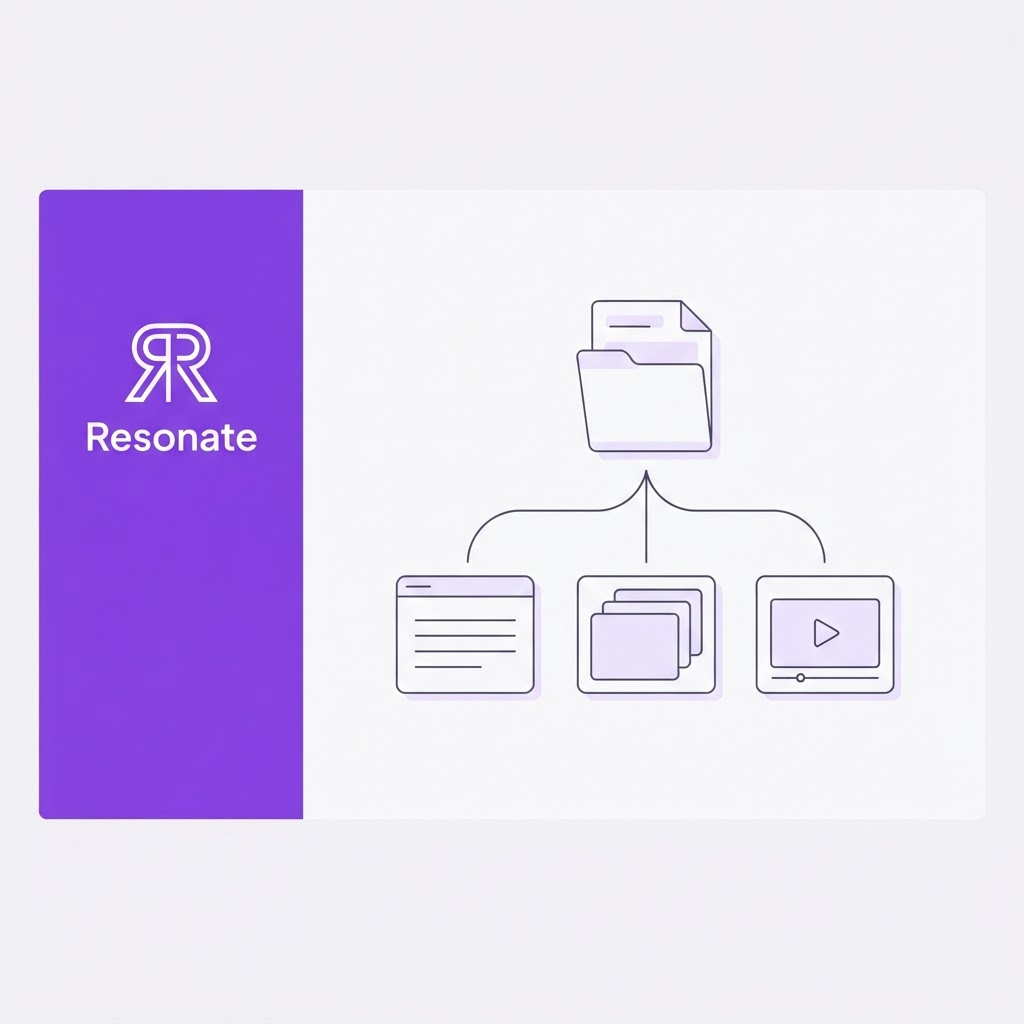
Content repurposing for LinkedIn is the controlled process of turning one approved source of knowledge into several audience-specific assets without changing its meaning or publishing it beyond its permission, accuracy, or useful shelf life.
Your company's daily work already contains an end-to-end content funnel:
- Awareness content is hidden in market observations, strategic debates, operating lessons, and changing customer assumptions.
- Consideration content is hidden in customer questions, support patterns, sales objections, implementation work, and internal frameworks.
- Decision content is hidden in shipped work, product choices, customer outcomes, walkthroughs, and evidence of how your company solves a problem.
The point is not to publish every call, meeting, or document. It is to select high-value sources, map them to an audience and funnel stage, preserve provenance, adapt format and tone, confirm permissions and claims, and measure business impact. In other words: a governed, repeatable system for responsible content repurposing, not a flood of posts.
Tools like Resonate can support components of this workflow - repurposing workflows, AI-assisted drafting, AI critique, voice preservation, and scheduling - while your team keeps full control over sources, permissions, and final publication.
What is a LinkedIn content funnel?
A LinkedIn content funnel matches a message to the audience's current relationship with your company. It ensures your feed does not drift into all broad opinions or all product talk. Each derivative should have a defined job, audience, source, and next action.
These stages are not rigid labels. A person might discover you through an awareness post, save a consideration framework, and later read a customer story before starting a conversation. If your goal is pipeline growth, sequencing posts across these stages is what keeps discovery moving toward action. The framework is useful for LinkedIn content for founders and for broader B2B marketing programs that need to connect education with commercial intent.
For reach without eroding trust, see approaches to publishing without losing authenticity.
Start with the work, but do not repurpose everything
Begin with a source inventory across the places real work happens:
- Strategy documents and leadership notes
- Customer calls, support conversations, and recurring questions
- Product decisions, launch retrospectives, and technical trade-offs
- Sales objections, proposal language, and onboarding questions
- Research reports, webinars, podcasts, presentations, and newsletters
- Slack or team discussions with a considered point of view
- Published posts that generated meaningful discussion or qualified conversations
Practical examples: mining GitHub and Slack data for post ideas and surfacing content ideas from client work can reveal repeatable patterns worth sharing.
A source inventory is not a publication queue. It is a candidate set. For each item, identify the owner, freshness, permission status, and the audience problem it addresses. Avoid the assumption that recent equals relevant.
Prioritise sources by value, not by likes
When several sources compete for attention, score them consistently. A viral opinion may have high reach potential but low commercial value. A recurring customer objection might have a smaller audience but produce a strong consideration series.
Record the score, selection reason, source owner, intended funnel stage, and review date. This makes prioritisation explainable when you choose a recurring customer objection over a more entertaining topic.
Preserve the source before creating derivatives
Every derivative should retain a private source record:
- Original document, recording, message, URL, or data source
- Source date and owner
- Core claim and supporting evidence
- Caveats, limitations, and uncertainty
- Intended audience and funnel stage
- Permission status and required attribution
- Sensitive details removed
- Reviewer and final approval
- Version and expiry date
This prevents content drift, where later derivatives add stronger claims, omit caveats, or lose context. If you automate any part of routing or posting, align procedures with safe posting automation principles so nothing private is published by mistake.
The awareness content hidden in daily work
Top-of-funnel material often emerges from how your team interprets the market: an industry shift, a lesson from a difficult week, a contrarian view from a strategy meeting, or a pattern that reframes a familiar problem.
The best awareness post is not a transcript. It is a clear, audience-relevant idea with a point of view. Remove private context, identify the insight, and add enough explanation that an outsider can understand why it matters. For example: more features do not always make a product easier to buy, because the hidden cost can be decision complexity. That idea introduces your perspective without selling.
Keep the source claim traceable as formats change. Hooks should not delete the qualification that made the original observation accurate. To protect brand tone at scale, consider voice learning that helps preserve your voice across derivatives.
Awareness best practice: name the audience and problem, state the core point of view, cite the source evidence, clarify what you are not claiming, choose a format fit for the job, and add a call to action only when it aids discovery or next steps.
The consideration content hidden in customer work
Middle-of-funnel content is found in customer calls, support questions, sales objections, implementation work, and the frameworks your team uses to solve problems. This material demonstrates competence and context.
Convert raw material into a safe brief before drafting: the customer's problem or question, the claim you are making, the evidence supporting that claim, any caveat or exception, the intended audience and funnel stage, and the next action the reader should take.
One source might become a six-slide carousel explaining the problem, a 60-second video showing the method, a text post with the central lesson, and a newsletter section with deeper context. Each asset should preserve meaning but offer a distinct entry point - a carousel maker supports framework-led document posts while keeping each derivative tied to the approved source.
Protect customer and employee information. Check whether a person or company can be identified, confirm permission covers this channel and format, verify quotations are accurate and in context, ensure anonymisation is sufficient, note any expiry date on claims, and obtain a reviewer's approval.
Track approved use, permitted audience, required attribution, redactions, expiry date, and reviewer sign-off in a source-risk record. When in doubt, treat sensitive material as internal research, not public content.
If you use AI for drafts, pair it with structured critique - see how AI critique improves content quality in practice.
The decision content hidden in results and product work
Bottom-of-funnel content comes from shipped features, implementation choices, customer outcomes, product walkthroughs, before-and-after processes, and other proof of how your approach performs. It does not need to say "buy now." It should reduce uncertainty for a ready buyer.
Apply stronger proof controls at the decision stage: date and measurement period, metric definition and denominator, comparison period or baseline, customer or data owner, context and limitations, permission and attribution, and an expiry or review date.
When you do publish outcomes, structured case-study content often drives longer-lasting conversions than broad opinions. Treat it as proof requiring permission, attribution, and current evidence - not as a shortcut to promotion.
Adapt one source for different audiences
The same idea should not be copied unchanged for every audience. Practitioners need implementation detail. Executive buyers need risk, economics, and fit. Founders may engage with prioritisation lessons. Existing customers need steps to apply the method.
Use a persona-to-funnel matrix to plan derivatives and calls to action, so each variant changes the example, evidence, and next step while preserving the core claim.
Repurpose in a sequence, not a flood
Turn each source into a coherent mini-campaign rather than a burst of lookalike posts. A useful sequence moves from the problem or point of view, to evidence that the problem matters, to the method or framework, to a worked example, to a common objection or limitation, and finally to an invitation to explore the solution.
Calibrate the interval to freshness, format, audience overlap, capacity, and urgency. Mix derivatives with new ideas so your feed does not feel like one asset in different clothing. A content scheduling workflow keeps spacing, approvals, and follow-ups tight without bypassing approval or expiry rules.
Track each post with a series ID, source date and version, persona, funnel stage, format, intended call to action, approval deadline, expiry or review date, and a stop or refresh condition. Stop a sequence when overlap creates fatigue, evidence changes, objectives are met, the source expires, or responses become less relevant.
Check format requirements and accessibility before production
Avoid preventable rework. Maintain a dated spec sheet for text posts, document posts, native video, images, polls, newsletters, and articles. Check current upload acceptance and mobile rendering, text truncation and hook visibility, caption readability and sound-off comprehension, and contrast ratios, alt text, and screen-reader context.
Run upload-and-render tests on representative devices and keep the test date on file, because platforms change.
Accessibility checklist: captions and transcripts, readable type size, sufficient colour contrast, meaningful image descriptions, comprehensible without sound, clear document structure, and links and calls to action that are understandable out of context. Accessibility is not decorative - it determines whether your message lands. The same principle applies when using a LinkedIn content generator: speed is useful only when the final asset remains readable, accurate, and accessible.
Decide whether to repost, refresh, transform, or retire
Older content is not automatically reusable. Repost only when the claim remains accurate and audience overlap is acceptable. Refresh when evidence or context changed. Transform when another audience needs a different explanation. Retire when the claim is outdated, permission expired, or repetition reduces trust.
Keep version history for every derivative: source version, factual review date, changed claims, reviewer, and next review date. This prevents a single outdated source from multiplying across current-looking posts.
Build the weekly content-repurposing operating system
The funnel will not sustain itself. Assign clear ownership for intake, prioritisation, extraction, drafting, design, fact-checking, approval, scheduling, community response, and reporting. A small team may combine roles; a larger team should define handoffs and format-based capacity.
Step 1: Intake
Collect candidate sources from approved systems. Ideas often live in Notion, Slack, GitHub, the CRM, and project docs - see how GitHub and Slack data can fuel post ideas.
Step 2: Prioritise and extract
Score each source for relevance, evidence, derivative yield, value, risk, and effort, then identify the claims, examples, questions, proof, and caveats it contains.
Step 3: Brief and produce
Assign audience, funnel stage, format, call to action, and source reference, then write, design, record, or edit the derivative. An AI writing workflow can accelerate first drafts when used with controls.
Step 4: Quality assurance and approval
Verify facts, permissions, accessibility, voice, links, and formatting, then obtain the required owner or executive sign-off. AI critique can pressure-test clarity and completeness as a review layer, not a substitute for factual or executive approval.
Step 5: Publish, measure, decide
Record the final asset, date, source ID, and distribution surface. Connect attention to intent, conversations, opportunities, or retention, then keep, revise, scale, refresh, or retire the derivative.
Automation can retrieve and organise ideas, saving the founder and team time - content automation and founder time is a useful operational lens. It should not publish private material or declare a customer result safe. Retrieval and routing can be automated; judgement and accountability need an owner.
Measure the funnel beyond likes and views
Repurposing creates activity easily. Proving value requires a measurement tree tied to the funnel stage.
Track production hours and cost per accepted derivative. Use consistent source IDs and campaign labels. Add UTMs where appropriate and capture LinkedIn origin in the CRM. Separate organic posts, direct messages, employee amplification, and paid distribution so one channel does not take credit for another.
LinkedIn content analytics can reveal patterns across published content, and pipeline growth on LinkedIn provides a broader lens for connecting content activity to commercial outcomes. Compare repurposed content to fresh-content baselines or matched ideas where possible.
A derivative that earns more impressions but fewer qualified conversations may be strong for awareness and weak for decision support. A lower-reach customer lesson can be more valuable if it produces relevant opportunities. Define the metric, formula, source, reporting cadence, attribution rule, and decision threshold for every stage.
Frequently asked questions
What is content repurposing for LinkedIn?
Content repurposing for LinkedIn is the process of adapting one approved source into multiple assets while preserving meaning, evidence, permissions, and relevance to each audience. Derivatives may span formats, funnel stages, or calls to action.
What daily work can become LinkedIn content?
Useful sources include strategy documents, customer calls, support questions, product decisions, technical trade-offs, sales objections, implementation notes, research, webinars, podcasts, newsletters, team discussions, and prior posts with meaningful engagement. Select sources for relevance and evidence, not just recency or popularity.
How do I turn one source into multiple LinkedIn posts?
Extract the central claim, evidence, caveats, audience, funnel stage, format, and intended next action, then create a separate brief for each derivative. A customer question might become an awareness opinion, a consideration framework, a decision-stage case example, and an onboarding lesson - each with a distinct entry point.
What is the difference between awareness, consideration, and decision content?
Awareness content helps relevant people recognise a problem or perspective. Consideration content helps them evaluate an approach via frameworks, examples, and problem understanding. Decision content reduces uncertainty about fit, credibility, implementation, and outcomes.
How can I repurpose customer calls safely?
Do not publish raw transcripts. Verify the claim, remove identifying information, obtain permission when required, check whether surrounding details still identify the customer, and record the approved use, reviewer, attribution, and expiry date. If material remains sensitive, treat it as private research.
How often should a company publish repurposed content?
There is no universal frequency. Use source freshness, audience overlap, format capacity, approval bandwidth, and objectives to set cadence. Stop or refresh a sequence when evidence changes, fatigue rises, the objective is met, or relevance drops.
Should old LinkedIn posts be reposted?
Only when the claim remains accurate, audience overlap is acceptable, and the format still fits. Refresh when evidence or context changed. Transform when another audience needs a different explanation. Retire when the claim is outdated, permission expired, or repetition reduces trust.
Can AI automate content repurposing?
AI can help retrieve source material, extract themes, create briefs, adapt formats, and draft derivatives. It should not decide whether private content can be published, whether a customer result is approved, or whether a claim is accurate. Human ownership is required for evidence, risk, voice, and final publication.
How do I measure whether content repurposing is working?
Measure outcomes appropriate to the funnel stage. Awareness: relevant reach and profile visits. Consideration: target-account engagement and qualified questions. Decision: meetings, opportunities, and revenue influence. Track production time and compare repurposed assets with fresh-content baselines.
Final takeaway
Your daily work already contains a complete content funnel. The opportunity is not to publish more internal activity. It is to build a controlled system that turns the right work into the right message for the right audience.
A strong content-repurposing system inventories real work and identifies the source of truth; prioritises sources by relevance, evidence, derivative yield, risk, and effort; maps each derivative to an audience and funnel stage; preserves meaning through source records and change history; adapts the format without repeating the same asset; protects privacy, permissions, factual accuracy, and accessibility; sequences content with expiry, stop, refresh, and retirement rules; and measures qualified attention and business outcomes beyond likes and views.

Content Writer @ Resonate
Charlotte explores LinkedIn content, personal branding, AI writing, and founder-led marketing at Resonate. She believes the best content comes from real experience, not generic advice, and writes practical insights to help founders turn what they already know into content that people want to read.
Write LinkedIn content that sounds like you
with Resonate's AI Voice Engine