Ghostwriter vs AI Ghostwriter: Cost, Speed, and Quality Compared
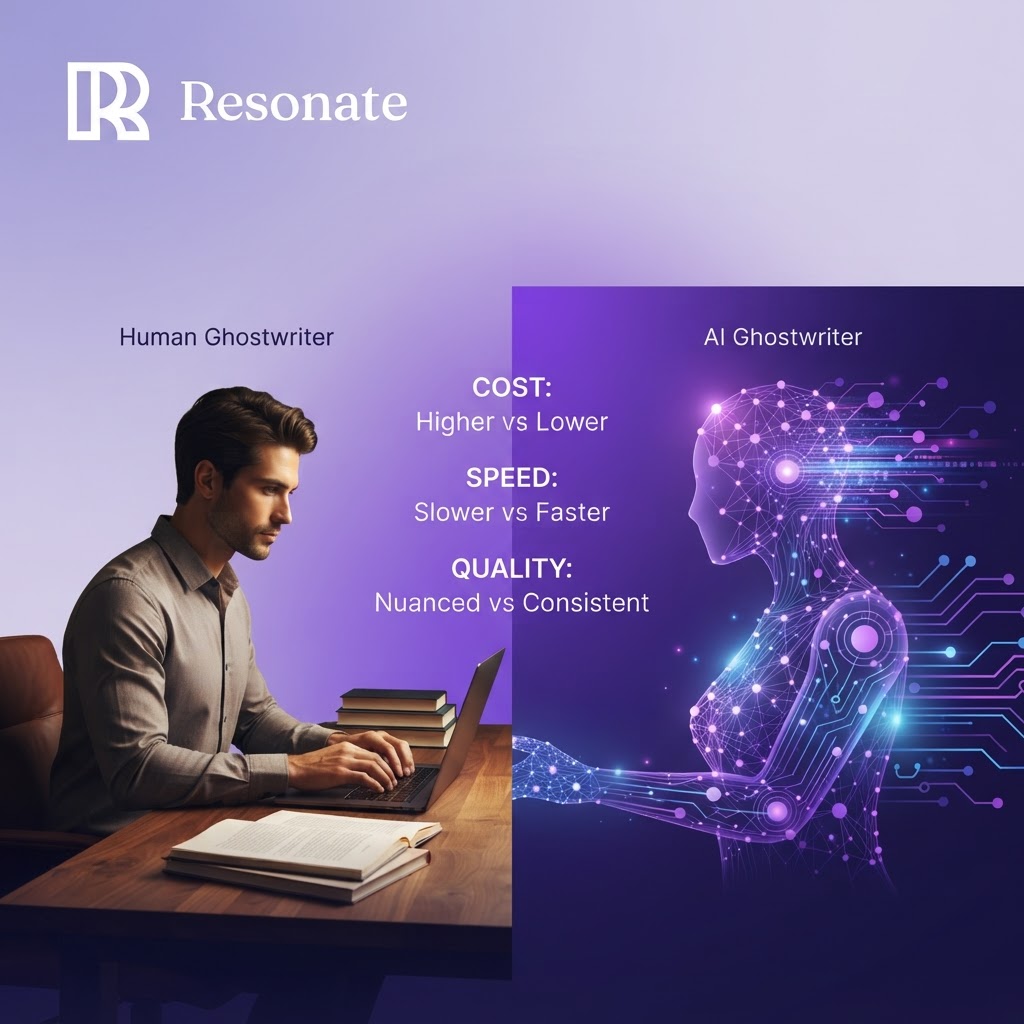
The short version: a human ghostwriter wins on strategic judgement and hand-holding, while an AI ghostwriter wins decisively on cost, speed and predictability - and for most founders in 2026, the AI option now does enough of the human's job to make the maths one-sided. A human runs $2,000 to $4,000 a month for a serious program. A capable AI ghostwriter runs around $99. Here is the full comparison across the three things that actually matter: cost, speed, and quality.
A human LinkedIn ghostwriter typically costs $2,000 to $4,000 per month for a serious program, with a documented range from about $500 to $10,000 or more depending on experience and scope. A capable AI ghostwriter costs roughly $19 to $99 per month, commonly landing under $100. The human wins on strategic judgment and handling reputational-stakes writing like books or op-eds. The AI wins on cost, speed, consistency, and pre-publish quality scoring. For most founders producing regular LinkedIn content, the AI option now does enough of the human's job to make the economics one-sided. Resonate starts under $100 a month and includes idea sourcing, voice-matched drafting, and pre-publish scoring.
Ghostwriter vs AI ghostwriter: full comparison
| Factor | Human ghostwriter | AI ghostwriter |
|---|---|---|
| Typical monthly cost | $2,000 to $4,000 (range $500 to $10,000+) | $19 to $99 |
| Common per-post rate | $200 to $800 per post | Not applicable, typically unlimited posts included |
| Time to first post | 2 to 4 weeks onboarding | Minutes to a few hours |
| Idea sourcing | Weekly call to extract from you | Reads your real work automatically |
| Voice matching | Learns over weeks of interviews and revisions | Calibrated on your existing writing up front |
| Pre-publish scoring | Cannot promise performance | Scores each draft before publishing |
| Scaling to more posts | Costs more per additional post | No extra cost for most tools |
| Strategic judgment | Strong | Improving, but human still leads |
| Ongoing time from you | Standing weekly call | 15 to 45 minutes per week for review and direction |
| Results guarantee | Reputable providers do not guarantee followers or leads | Reputable providers do not guarantee followers or leads |
| Best suited for | Books, op-eds, reputational-stakes writing | Regular LinkedIn posting at volume |
The pattern is clear: the human wins on judgment and high-stakes writing. The AI wins on nearly everything operational.
How much does a human LinkedIn ghostwriter actually cost?
A human LinkedIn ghostwriter in 2026 costs between roughly $500 and $10,000 or more per month, with most founders landing in the $2,000 to $4,000 range for a serious program. Published pricing data puts entry-level freelancers around $500 to $1,500 a month, mid-tier writers and small studios at $1,500 to $4,000, and premium agencies well above $8,000. Some providers bill per post instead of monthly, typically $200 to $800 per post depending on experience and research depth.
The quoted retainer is usually not the final cost. Multiple industry sources document that a typical mid-tier engagement, quoted at $2,000 to $3,000, often runs closer to $4,000 to $6,000 once kickoff fees, revision rounds, and scope creep are added. This is worth budgeting for explicitly rather than discovering after signing.
The sticker price also understates the true cost in a second way: even a mid-tier engagement requires your time, typically a weekly call and rounds of review, and a founder's time is not free. A $2,000 ghostwriter who needs three hours of input a week is not cheaper than a $4,000 one who needs thirty minutes. The real cost is the fee plus the hours spent feeding it.
How much does an AI ghostwriter cost?
A capable AI ghostwriter, or LinkedIn content generator, costs roughly $19 to $99 a month across the current market, commonly landing under $100, which is one-twentieth to one-fortieth of a serious human engagement. For the price of a couple of premium human posts, this typically buys idea sourcing, voice-matched drafting, pre-publish scoring, and scheduling, with no onboarding fee and no weekly call.
Resonate, for instance, starts under $100 a month and includes the ideas engine, engagement prediction, critique agents, and a voice profile calibrated on real writing. Check the pricing page for current tiers, but the order of magnitude is the point: the AI option is a rounding error next to a human retainer.
"AI ghostwriter" is not one category
A common source of confusion is that three genuinely different products are marketed under the same name, and buyers frequently land on the wrong one:
| Category | What it does | Typical price range |
|---|---|---|
| LinkedIn voice tools | Draft ongoing LinkedIn posts calibrated to your voice | $19 to $99/month |
| AI book-writing tools | Generate long-form manuscripts or authority books | $10 to $20/month |
| AI-assisted human agencies | A human-delivered service where the writer uses AI internally, but you still get finished content from a person | $500 to $3,000/month |
An agency's finished-content service and a self-serve LinkedIn voice tool solve different problems at different price points, even though both might describe themselves as "AI ghostwriting." Confirming which category a specific tool falls into before comparing price is a necessary first step, not an afterthought.
Does LinkedIn penalise AI-written content?
This is worth answering precisely, since it affects the actual risk calculation. Available evidence indicates LinkedIn's ranking and moderation systems are built around spam and engagement-quality signals, not around detecting AI authorship specifically. A generic, templated, low-detail post is treated the same way whether it was written by an inexperienced freelancer or generated by AI with no editing. The platform's own stated focus is whether content provides value and generates genuine interaction, not whether a tool assisted in writing it.
The practical implication: the risk is generic, low-effort writing, not AI use itself. A voice-calibrated, specific, well-edited AI draft carries no more platform risk than the same post written entirely by hand. This mirrors the point covered in more depth in the 2026 LinkedIn algorithm breakdown.
Should you disclose that AI helped write your posts?
There is no universal requirement to disclose AI assistance in drafting a LinkedIn post, and most professionals do not. The ethical norm that has emerged across the industry is more about substance than disclosure: the ideas, opinions, and stories in the post should genuinely be yours, whether AI helped articulate them or not. Treating an AI ghostwriting tool the way a writer would treat a grammar checker or an editor, a tool that helps express your actual thinking rather than one that invents thinking on your behalf, is the practical standard most guidance converges on.
Which is faster: a human or an AI ghostwriter?
An AI ghostwriter is dramatically faster. It produces in-voice drafts within minutes once connected to existing writing samples, while a human needs two to four weeks of onboarding before the first post ships. A human ghostwriter has to interview you, study your writing, and iterate for weeks before the voice is right. An AI calibrates on existing posts up front and can begin drafting immediately, often within the first session if roughly 20 or more prior posts are available to learn from.
Speed compounds over time, too. Doubling the posting cadence next month costs a human more money and more of your time. An AI simply drafts more, typically at no extra cost. The gap widens as volume grows rather than staying constant.
Which produces better quality?
This is the most honest part of the comparison: a human ghostwriter still edges ahead on strategic judgment, but a good AI ghostwriter now matches or beats a human on consistency and catches weak posts before they publish. Quality is not one variable. On voice and reliability, a well-trained AI is excellent and never has an off week. On high-level strategy, positioning, narrative arc, and reading a genuinely delicate situation, an experienced human still brings something a tool does not fully replicate.
Two points close the gap further. First, modern AI ghostwriters train on actual writing samples, so voice is no longer the human's exclusive advantage. Second, AI can do something no human can: score a draft's likely engagement before it goes live. A human ghostwriter, however talented, cannot promise a post will perform. An AI that critiques every draft from multiple angles before publishing, such as Resonate's AI critique feature, provides a quality check a human process structurally cannot offer.
A note on guarantees: neither option should be expected to guarantee follower growth or lead volume. Reputable human ghostwriters explicitly avoid promising this, since results depend on factors outside a writer's control, including audience quality, profile optimisation, and industry. The same caveat applies to AI tools. What both can reasonably improve is consistency and voice fidelity, not a specific growth outcome.
What is the realistic weekly time commitment for an AI ghostwriter?
Marketing claims sometimes compress this to "a few minutes," which understates the honest answer. A more accurate range is 15 to 45 minutes per week: reviewing surfaced ideas, editing a draft where needed, and providing occasional strategic direction the system cannot infer on its own, such as a new priority, a shift in positioning, or context on a sensitive topic. This is still a small fraction of the multiple hours per week a human ghostwriter engagement typically requires, but it is not zero, and setting that expectation accurately avoids disappointment during onboarding.
Where does a human ghostwriter still clearly win?
Beyond general "strategic judgment," there are specific categories of writing where a human remains the safer default in 2026:
- Books and long-form manuscripts: Where narrative structure and sustained voice over tens of thousands of words benefit from an experienced editor's judgment.
- Op-eds and bylined pieces for major publications: Where a single piece carries outsized reputational weight and often requires navigating an outlet's specific editorial expectations.
- Genuinely sensitive or high-stakes situations: Such as addressing a crisis, a controversy, or a legally delicate topic publicly, where nuanced judgment about what to say and what to withhold matters more than drafting speed.
Regular LinkedIn posting, the category this comparison is built around, does not carry the same stakes per individual piece, which is exactly why the economics favour AI so heavily here specifically.
Is human vs AI actually the right question?
For a growing share of the market, the honest answer is that this is a false binary. The fastest-growing segment of ghostwriting in 2026 is hybrid: AI handles idea sourcing, drafting, and pre-publish scoring, while a human, often the founder themselves, retains final judgment over what actually gets published. This is functionally different from either a pure human retainer or a fully unattended AI tool, and it is where most serious LinkedIn presences in 2026 actually operate. The "vs" in this comparison is useful for understanding tradeoffs, but the practical answer for most founders is an AI system with a human approval step, not a choice between two fully separate models.
Can one AI ghostwriter handle multiple voices?
Yes, and this matters for founders who need more than one presence: a personal brand alongside a company page, or separate ventures that each need a distinct voice. A properly built AI ghostwriting tool trains an isolated voice profile per account rather than applying one shared style everywhere, so a founder's personal posts and a company's page updates can be produced from the same tool without sounding interchangeable. This is the same underlying mechanism agencies use to manage voice across many clients, covered in more depth in why an agency needs an AI content system for client LinkedIn.
Which should you choose in 2026?
Choose an AI ghostwriter for consistency, speed, and value - see the roundup of AI ghostwriting tools for LinkedIn for how the options compare. Choose a human if a strategist needs to own the whole process and the budget supports it, or if the work involves books, op-eds, or reputational-stakes writing specifically. Here is the practical decision framework:
- Early-stage founder, tight budget, needs consistency: AI ghostwriter. Cost and speed are decisive.
- Founder who wants ideas extracted and drafted but stays in control: AI ghostwriter. This is exactly what modern tools are built for.
- Executive who wants a strategist to own positioning and has the budget: human, or the hybrid model, since many experienced ghostwriters now use AI to draft and spend their own time on strategy.
- Team or agency scaling content across many people or clients: AI ghostwriter, for the per-seat economics.
- Writing a book, an op-ed, or navigating a genuinely sensitive public moment: human, given the reputational stakes involved.
The market has largely already voted on the default case. AI-assisted ghostwriting, where tools handle drafting and humans focus on strategy and approval, is the fastest-growing segment of the category. The pure-human retainer is becoming a premium choice for specific situations rather than the default for ongoing LinkedIn content.
Frequently asked questions
Is an AI ghostwriter cheaper than a human ghostwriter?
Yes, an AI ghostwriter is dramatically cheaper than a human ghostwriter. A human costs roughly $500 to $10,000 or more per month, with most founders paying $2,000 to $4,000 for a serious program, while a capable AI ghostwriter costs roughly $19 to $99 a month. The AI price is typically one-twentieth to one-fortieth of a human engagement, with no onboarding fee and no weekly call, though human retainers often run higher than quoted once revisions and scope creep are included.
Can an AI ghostwriter match a human's writing quality?
A good AI ghostwriter matches a human on voice and consistency and adds pre-publish scoring, while a human still leads on high-level strategy and reputational-stakes writing like books or op-eds. Modern AI tools train on actual writing samples, so voice is no longer the human's exclusive advantage, and AI can predict a draft's likely engagement before publishing, something no human can promise.
How much faster is an AI ghostwriter?
An AI ghostwriter is far faster, producing in-voice drafts within minutes once calibrated, compared with the two to four weeks a human needs to onboard. AI calibrates on existing writing up front rather than learning voice over weeks of interviews and revisions, and it can scale posting volume instantly at typically no extra cost.
Should I hire a human ghostwriter or use an AI tool in 2026?
Most founders producing regular LinkedIn content should use an AI ghostwriter for its cost, speed, and consistency, reserving a human specifically for books, op-eds, or genuinely high-stakes reputational writing. The fastest-growing segment of the market is AI-assisted ghostwriting, where AI handles drafting and humans focus on strategy and approval, making the pure-human retainer a premium choice rather than the default.
Does LinkedIn penalise posts written with AI assistance?
Available evidence indicates LinkedIn's systems target spam and low-quality engagement patterns rather than AI authorship specifically. A generic, low-detail post is treated similarly whether it was written by hand or generated by AI without editing. A specific, voice-matched, well-edited draft carries no additional platform risk simply because AI assisted in writing it.
How much time does an AI ghostwriter actually require each week?
A realistic range is 15 to 45 minutes per week for reviewing surfaced ideas, editing drafts, and providing occasional strategic direction. This is far less than the multiple hours per week a human ghostwriter engagement typically requires, though it is more than the "a few minutes" some marketing claims suggest.
Do human or AI ghostwriters guarantee more followers or leads?
No, reputable providers of either type avoid guaranteeing follower growth or lead volume, since results depend on factors outside a writer's or tool's control, including audience quality, profile optimisation, and industry. Both can reasonably improve consistency and voice fidelity, which are different from a guaranteed growth outcome.
Can one AI ghostwriting tool manage more than one voice?
Yes. A properly built tool trains an isolated voice profile per account, so a founder's personal brand and a separate company page, or multiple ventures, can each maintain a distinct voice from the same tool rather than sounding interchangeable.

Content Writer @ Resonate
Charlotte explores LinkedIn content, personal branding, AI writing, and founder-led marketing at Resonate. She believes the best content comes from real experience, not generic advice, and writes practical insights to help founders turn what they already know into content that people want to read.
Write LinkedIn content that sounds like you
with Resonate's AI Voice Engine