Why Investors Follow Founder Social Presence in 2026
Why Investors Follow Founder Social Presence in 2026

Why investors monitor founder social media presence
Investors follow founder social presence because it tells them something a pitch deck cannot: whether a founder actually understands their market, has earned community trust, and can sustain the narrative that makes a company worth backing. This is not a soft preference. Startups with founders who have three or more Tier-1 media features attract 6.1 times more inbound investor interest and achieve 278% revenue growth over five years versus low-visibility founders, according to the 2026 Baden Bower CEO Visibility Report, which surveyed 527 business owners and executives.
The core reason is information asymmetry. Early-stage companies rarely have audited financials, proven revenue models, or long operating histories. Investors fill that gap with signals, and social media is one of the most accessible and hardest-to-fake channels available. A founder who consistently writes about real customer problems, engages substantively with industry conversations, and responds thoughtfully to criticism is demonstrating market intimacy in public, over time, in a way no curated deck can replicate.
Investors track specific signals, not just follower counts. The metrics that actually move the needle include:
- Engagement trend shifts. A sudden drop in engagement prompts investor questions about product-market fit or team morale.
- Community defense signals. When a founder’s audience pushes back against critics on their behalf, it signals genuine loyalty, not manufactured reach.
- Thoughtful founder responses. How a founder handles a tough public question reveals their composure and market knowledge.
- Content consistency. Founders who post sporadically or only during fundraising rounds look opportunistic. Consistent presence signals conviction.
- Audience composition. Investors look at whether followers include relevant customers, industry peers, and domain experts, not just other founders.
Studies show that 82% of consumers are more likely to trust a company when its leadership is active on social media. Investors are not immune to the same psychology. Visibility signals accountability, and accountability builds the kind of trust that makes a check feel less risky.
Effective social media strategies for early-stage startup founders

1. Set goals that match where you are in the funding cycle
Before posting anything, decide what your social presence is actually for. Building reputation and building pipeline require different content rhythms. Pre-seed founders benefit most from establishing domain credibility, sharing what they are learning, and attracting early believers. Series A founders need to demonstrate traction, customer love, and a clear market thesis. Conflating the two produces content that serves neither goal.
2. Build a personal brand that sounds like you
Authenticity is not a buzzword here. It is a due diligence filter. Investors who read your posts before a meeting will notice immediately if your pitch voice and your online voice are two different people. The most effective founder brands balance professional depth with genuine personality. Share the reasoning behind decisions, not just the outcomes. Admit when something did not work. That transparency is what separates a founder worth backing from a founder who is performing.
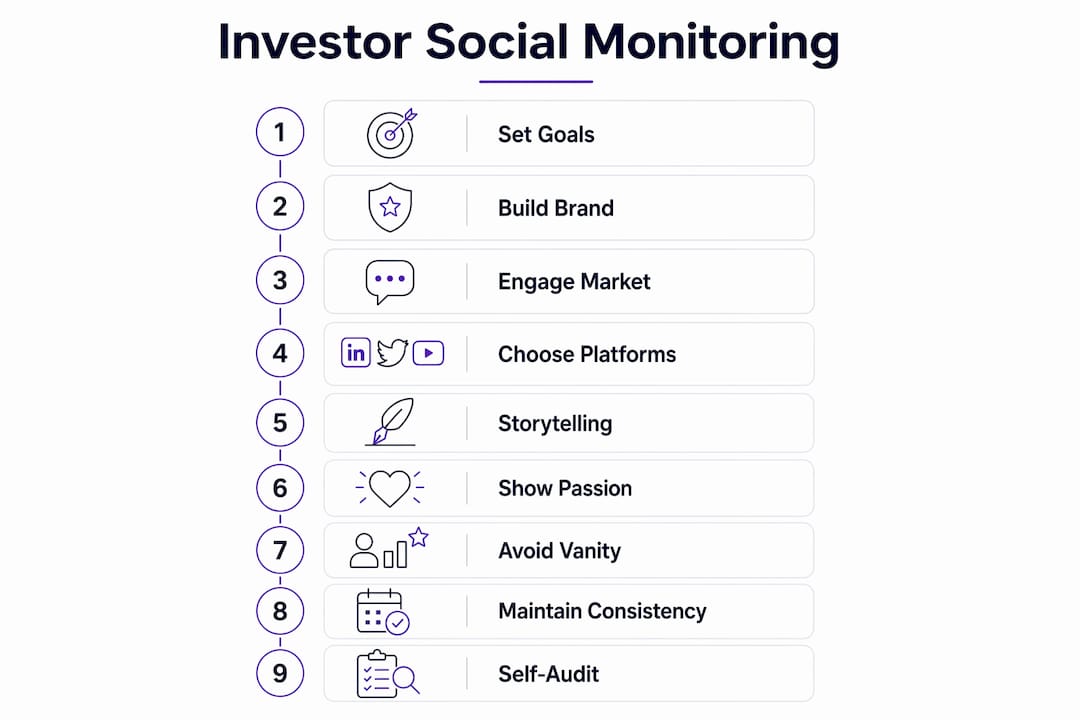
3. Engage with your market, not just your peers
Founders who only talk to other founders on LinkedIn or X are building the wrong audience. The investors watching your feed want to see you in conversation with customers, industry analysts, and domain experts. Commenting on a customer’s post, responding to a critical industry report, or publicly working through a product decision shows market intimacy in a way that self-promotional content never can. This is the social media impact investors are actually looking for. If you want to try this yourself, spin up a draft with Resonate's LinkedIn content generator.
4. Choose platforms based on where your investors and customers live
LinkedIn remains the primary platform for B2B founders attracting institutional investors. X (formerly Twitter) still matters for technical founders in AI, crypto, and developer tools, where thought leadership compounds quickly. Consumer founders with visual products benefit from Instagram and TikTok. The mistake is spreading thin across every platform. Pick two, post consistently, and go deep.

5. Use storytelling, not announcements
Announcements (“We just launched X”) get skimmed. Stories get shared. The most effective founder content follows a simple arc: here is a problem I saw, here is what I tried, here is what I learned. That structure works because it mirrors how investors think about founders. They want to know if you can identify a real problem, test a hypothesis, and update your thinking based on evidence.
6. Let your passion show, visibly
Research from a functional MRI study published in the Journal of Business Venturing found that founders displaying high passion increase investor neural engagement by 39% and investor interest by 26% over founders displaying low passion. That effect does not disappear when the medium shifts from video pitch to LinkedIn post. Enthusiasm, specificity, and genuine conviction come through in writing. Flat, corporate-sounding content signals the opposite of what investors want to see.
7. Avoid empty self-promotion
Posts that exist only to announce awards, press hits, or funding rounds without context read as vanity content. Investors see through it quickly. Every post should offer something: a perspective, a data point, a question worth thinking about. The founders who attract the most investor attention are the ones whose content makes readers smarter, not just more aware that the founder exists.
8. Use tools to maintain consistency without losing your voice
Consistency matters more than frequency. A founder who posts three times a week for six months builds a far stronger signal than one who posts daily for two weeks and then disappears. Tools that connect to your actual work, pulling from Notion, Slack, or HubSpot to surface post ideas grounded in what you are actually doing, help maintain that consistency without turning your feed into generic AI output. Resonate is built specifically for this: it trains on your writing patterns and work data so the content it generates sounds like you, not like a template. You can also schedule LinkedIn posts in advance to stay consistent during busy fundraising periods.
9. Monitor your own presence the way an investor would
Before any fundraising conversation, search your name, your company name, and your most public posts. Look for anything that contradicts your pitch narrative. Check whether your engagement metrics tell a coherent story. Investors will do this. You should do it first.
How founder visibility influences funding outcomes
The research connecting founder visibility to funding outcomes is more specific than most founders realize, and more causal than the conventional wisdom suggests.
Founders displaying high passion increase investor neural engagement by 39% and investor interest by 26%, according to an fMRI study published in the Journal of Business Venturing.
That study used functional MRI imaging to measure how investors’ brains responded to pitch videos with varying levels of displayed founder passion. The finding is not just that passion helps. It is that passion triggers a measurable neurological response that precedes and predicts investment interest. The mechanism matters because it explains why social media presence works even before a founder ever gets in a room with an investor. Posts, videos, and public conversations prime the neural response before the pitch begins.
The trust dimension is equally well-documented. A study analyzing 20,316 ventures on Crunchbase and 1,091 Shark Tank pitches found that founder trustworthiness mediates 36% of the funding impact on venture valuation and up to 66% of venture attractiveness. In a separate randomized experiment with 51 venture capitalists, smiling founders were assessed as having a 16.6% higher probability of a successful exit and were valued $2.1 million more than non-smiling founders. Trustworthiness was the mediating variable, not charm or likability in the abstract.
| Research finding | Source | Key metric |
|---|---|---|
| High-passion founders increase investor neural engagement | fMRI study, Journal of Business Venturing | +39% neural engagement, +26% investor interest |
| Founder trustworthiness mediates funding impact | Crunchbase + Shark Tank analysis (20,316 ventures) | 36% of valuation effect, 66% of venture attractiveness |
| High-visibility founders attract more investor interest | 2026 Baden Bower CEO Visibility Report (527 businesses) | substantially more inbound investor interest |
| Smiling founders valued higher in VC experiment | Randomized experiment, 51 VCs | $2.1M higher valuation, 16.6% higher exit probability |
| Consumers trust brands with visible leadership | Forbes / Edelman data | 82% more likely to trust |
The Wharton research on startup social media adds another layer. Startups active on social media not only attract more investors overall, they disproportionately attract more experienced investors, specifically those who have made more than 100 investments. The effect is strongest when information asymmetry is highest: for ventures outside major VC clusters, for founders without existing network ties to investors, and for early-stage companies without established track records. Social presence does not just help founders who are already well-connected. It most benefits the ones who are not.
The Advertising Week analysis of founder visibility frames this shift clearly: visibility is no longer a marketing tactic. It is a form of capital. Founders like Hailey Bieber with Rhode and Emily Weiss with Glossier demonstrated that personal platforms move products, attract investors, and reduce customer acquisition costs simultaneously. Some investors now factor founder influence directly into valuation models. That is a structural change in how early-stage companies get priced, not a trend that will reverse.
For founders who want to understand how LinkedIn visibility benefits startups specifically, the compounding effect of consistent presence over six to twelve months is where the real advantage accumulates.
Preparing for investor scrutiny: managing your social media presence
Investors do not just browse your feed casually. They come in with specific questions and use your social history to test the answers you give them in person. Understanding how that process works changes how you should manage your presence.
Common red flags investors look for:
- Gaps in posting activity that coincide with known company struggles
- Overly polished content with no genuine engagement or replies
- Defensive or dismissive responses to public criticism
- Inconsistency between the market thesis in your pitch and the topics you actually post about
- Absence from relevant industry conversations where you claim to be a domain expert
What sophisticated investors actually do:
VCs use social media as a truth-testing layer that supplements curated pitch materials. They are not asking “are they good at posting?” They are asking “do they understand their market and customers?” A founder with thoughtful, consistent presence in their domain signals genuine market understanding. A founder with empty or purely promotional content signals they may be running on assumption.
The specific questions investors bring to diligence meetings are more pointed than most founders expect. Rather than “how’s social media going?”, a prepared investor might ask: “We noticed your engagement dropped significantly between January and April. What caused that?” The quality of your answer tells them more about your self-awareness and operational honesty than the engagement numbers themselves.
How to prepare:
- Audit your last 90 days of posts before any investor meeting. Look for gaps, tone inconsistencies, and anything that contradicts your current narrative.
- Track your own engagement metrics in a simple spreadsheet. Know your average engagement rate, your best-performing content categories, and any notable trend shifts.
- Be ready to share that data proactively. Founders who resist sharing social monitoring data during diligence often raise red flags. Sophisticated founders pre-emptively share it.
- Align your content calendar with business milestones. When you close a customer, ship a feature, or hit a metric, post about it with context. This creates a public record that corroborates your pitch narrative.
Pro Tip: Before your first investor meeting, run a search on your name and company across LinkedIn, X, and Google. Screenshot what you find. Then ask yourself: if this were the only information an investor had about me, what would they conclude? Fix anything that creates the wrong impression before the conversation starts.
The risk of over-polishing is real. Profiles that look too curated, with no rough edges, no genuine engagement, and no evidence of real conversations, read as performative to experienced investors. Authenticity is not just a brand value. It is a due diligence signal. The founders who come through scrutiny best are the ones whose online presence and in-person presence tell the same story.
For founders managing their presence across multiple platforms or working with a team, social media marketing frameworks that prioritize consistency and authentic engagement over volume tend to produce the best results under investor scrutiny.
Case studies of funding influenced by founder social presence
The clearest real-world example of founder social presence driving a funding decision comes from Vandaele Capital LLC, which decided to fund Boxtera, a health food subscription startup, specifically because of their effective use of Twitter to reach their target audience. The investor did not discover Boxtera through a warm introduction or a pitch event. The social presence itself was the discovery mechanism, and the quality of that presence was the quality signal. That pattern, social media as both the channel of discovery and the channel of evaluation, is exactly what the Wharton research on startup social media formalizes.
Brian Chesky’s handling of Airbnb’s crisis during the early pandemic is a different kind of case study, one about what happens when a founder’s social presence is tested under pressure. Chesky did not issue a corporate statement. He showed up personally on social media, spoke with specificity about what Airbnb was doing for hosts, and maintained that presence through weeks of uncertainty. The result was not just reputation protection. It deepened customer and investor loyalty at a moment when most companies were losing both. Investors who had backed Airbnb watched that performance and saw exactly the kind of founder behavior that justifies a long-term bet.
The pattern holds at the early stage too. Founders in the 2026 startup environment who have built genuine thought leadership before fundraising consistently report shorter fundraising timelines and more inbound interest from investors who already understand their thesis. The pitch meeting becomes a confirmation conversation rather than an introduction. That shift, from cold pitch to warm validation, is the practical payoff of sustained founder visibility.
What these cases share is not a particular platform or posting frequency. They share a founder who was genuinely present in their market’s conversation, who responded to real situations with real perspective, and whose social history gave investors a longitudinal view of how they think and execute. That is the kind of track record that a deck cannot manufacture and a single meeting cannot establish.
How Resonate helps founders build the presence investors want to see
The gap between knowing you need a consistent social presence and actually maintaining one is where most founders fall short. Fundraising, product development, and team management leave little room for the kind of thoughtful, regular content that builds investor trust over time.
Resonate is built for exactly this problem. The platform connects to the tools you already use, including Notion, Slack, GitHub, and HubSpot, and pulls from your actual work to surface post ideas grounded in what you are doing, not generic templates. It trains on your writing patterns so the content it generates sounds like you. It also includes AI-powered critique from specialized agents that score every draft before you publish, flagging anything that reads as inauthentic, off-brand, or likely to underperform.
For founders preparing for investor scrutiny, Resonate’s analytics track engagement trends over time, giving you the data you need to answer investor questions about your social performance with confidence. The community boost feature amplifies reach immediately after publication, which matters when you are trying to build the kind of engaged audience that signals genuine market traction.
You can start building the presence investors actually look for at Resonate.ai.
Key Takeaways
Investors follow founder social presence because it is the most accessible, longitudinal, and hard-to-fake signal of market understanding, trustworthiness, and conviction available before a term sheet is signed.
| Point | Details |
|---|---|
| Visibility multiplies investor interest | Founders with high media visibility attract 6.1 times more inbound investor interest and achieve 278% revenue growth over five years versus low-visibility founders, per the 2026 Baden Bower report. |
| Trust is the core mechanism | Founder trustworthiness mediates 36% of venture valuation impact and up to 66% of venture attractiveness in research studies. |
| Passion triggers measurable investor response | High-passion founders increase investor neural engagement by 39% and investor interest by 26%, per fMRI research. |
| Social presence is a due diligence layer | VCs use founder social media to verify market understanding, not just to assess posting skill. |
| Transparency beats polish | Founders who proactively share social monitoring data build more investor confidence than those who resist scrutiny. |
Recommended

Content Writer @ Resonate
Charlotte explores LinkedIn content, personal branding, AI writing, and founder-led marketing at Resonate. She believes the best content comes from real experience, not generic advice, and writes practical insights to help founders turn what they already know into content that people want to read.
Write LinkedIn content that sounds like you
with Resonate's AI Voice Engine