Client Attraction Through Content: Your LinkedIn Guide
Client Attraction Through Content: Your LinkedIn Guide

Client attraction through content is the deliberate practice of creating and distributing targeted, value-driven content that draws ideal clients toward you, captures their attention at the right moment, and moves them into a sales conversation. It is not blogging for visibility. It is pipeline architecture built around buyer intent.
The core components of an effective content attraction strategy include:
- Content intent alignment: every piece maps to a specific stage of the buyer journey, from awareness to decision
- Buyer persona targeting: content speaks directly to the problems, language, and goals of a defined ideal client
- Conversion mechanisms: each post or article connects to a CTA, lead magnet, or gated asset that captures contact information
- Engagement strategy: systematic replies, DMs, and community interaction that build trust and signal responsiveness
- Platform fit: on LinkedIn, professional credibility and algorithmic timing shape what gets seen and by whom
LinkedIn sits at the center of this for most B2B professionals. It is where buyers research vendors, where thought leaders build authority, and where a single well-timed post can open five conversations. The formats, the algorithm, and the audience make it the highest-leverage platform for professional client engagement through content.
What strategies actually attract clients through LinkedIn content?
The content mix matters more than most people realize. A feed of pure educational posts builds credibility but rarely triggers buying conversations. A feed of case studies and wins attracts interest but can feel like a highlight reel. Successful LinkedIn thought leadership balances personal stories, actionable frameworks, and specific client results - because each type does a different job.
Practical strategies that move the needle:
- Post 2 - 3 times per week at minimum. Consistency compounds; sporadic posting resets your algorithmic standing every time you go quiet.
- Lead with the problem, not the solution. Posts that open with a pain point your ideal client recognizes stop the scroll faster than posts that open with your credentials.
- Use specific CTAs over generic ones. “Comment ‘framework’ and I’ll send you the template” outperforms “let me know your thoughts” because it gives readers an exact action and signals what they’ll get.
- Carousel posts and video with captions are the highest-engagement formats. Carousel posts generate significant engagement, and LinkedIn Live substantially outperforms static posts in engagement.
- Case study posts are particularly powerful for conversion. A post structured as “client had problem X, we did Y, result was Z” attracts buyers at the decision stage who are already sold on the category and just need to trust the provider. See why case study posts drive lasting conversions.
- Employee amplification doubles engagement compared to brand-only posts. When colleagues share and comment authentically, organic reach expands in ways paid promotion cannot replicate at the same cost.
Pro Tip: The first 60 minutes after you publish are the most important. LinkedIn’s algorithm uses early engagement velocity to decide how widely to distribute your post. Reply to every comment within that window, ask a colleague to engage immediately, and avoid editing the post during this period. That single habit can dramatically extend your reach without spending anything.. If you want to try this yourself, spin up a draft with Resonate's LinkedIn content generator.

Why do most content strategies fail to attract clients?
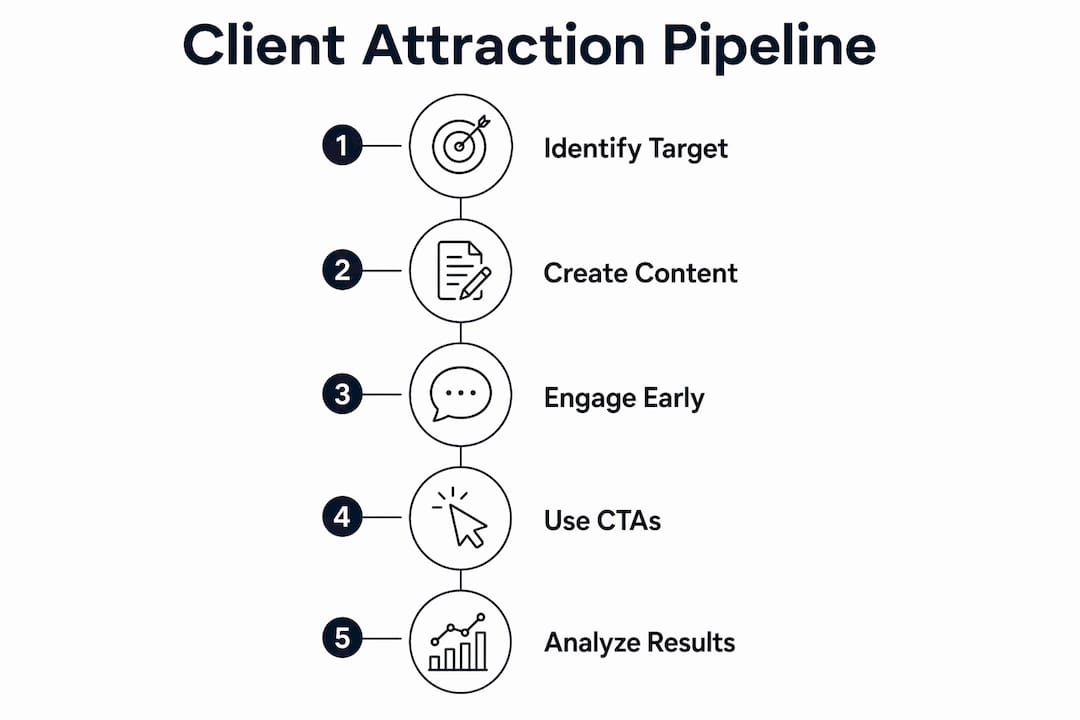
The most common failure is prioritizing publishing volume over conversion architecture. Professionals post consistently, build an audience, and still generate no pipeline because nothing in their content captures a lead or prompts a next step.
The specific breakdowns:
- No capture mechanism. A post without a CTA connected to a lead magnet, gated asset, or DM prompt generates traffic and goodwill but no contact information.
- Content not mapped to the buyer journey. Top-of-funnel awareness posts are useful, but if every post is educational and none address buying-stage concerns, prospects never move forward.
- Neglecting post-publication engagement. Publishing and disappearing kills algorithmic reach and signals to commenters that the conversation is one-sided.
- The 100/0 trap. Going all-educational or all-promotional both underperform. Buyers need to trust you before they buy, but they also need to know you sell something.
- Generic CTAs. “Follow for more” or “share if you agree” are low-friction but low-yield. They do not move anyone closer to a sales conversation.
- Ignoring platform dynamics. Posting at 2 AM on a Sunday, using formats the algorithm deprioritizes, or skipping hashtag strategy all reduce distribution before a single person reads the content.
The fix is treating content as a pipeline rather than a publishing schedule. Every piece needs a role, a CTA, and a next step.
How AI-powered tools like Resonate sharpen your client attraction results
AI tools have moved well past grammar checking. The real value is in personalization, consistency, and the kind of analytical feedback that most professionals never get on their LinkedIn content.
Resonate connects directly to your work tools - Notion, Slack, GitHub, HubSpot - and surfaces post ideas from your actual work rather than generic industry topics. That specificity is what makes content feel authentic rather than templated. The platform trains on your individual voice patterns, so generated posts sound like you wrote them, not like a press release.
| AI Feature | Direct Benefit for Client Attraction |
|---|---|
| Voice calibration | Posts match your real writing style, building authentic trust |
| Work tool integrations | Ideas surface from real projects, not generic prompts |
| Community boost | Amplifies reach in the critical post-publication window |
| AI critique agents | Scores drafts before publishing to catch weak CTAs and structure |
| Engagement analytics | Identifies which content types drive pipeline, not just likes |
| Safety guardrails | Prevents account bans from over-automation |
| MCP API access | Connects content workflow to broader marketing systems |
Additional benefits professionals see in practice:
- Faster idea generation tied to real client work, not brainstorming from scratch
- Consistent posting cadence without the weekly “what do I write about” paralysis
- Pre-publish critique that flags posts likely to underperform before they go live
- Analytics that improve over time as the platform learns what your audience responds to
The AI critique feature is particularly useful for professionals who know their content could be stronger but lack an outside perspective. Getting a draft scored before publishing changes the quality ceiling on every post.
How to build a conversion-focused client attraction pipeline on LinkedIn
A pipeline is not a content calendar. It is a system where each piece of content has a defined role, a capture mechanism, and a follow-up path.
- Map content to funnel stages. Top-of-funnel posts address broad pain points and build awareness. Mid-funnel content (frameworks, how-tos, comparisons) captures leads through gated assets. Bottom-funnel posts (case studies, ROI breakdowns, direct offers) prompt buying conversations.
- Connect every post to a capture point. A gated asset or lead magnet tied to each post converts readers into named contacts. Without this, content generates reach but no pipeline.
- Build nurture sequences triggered by engagement. When someone downloads your lead magnet or DMs you after a post, that interaction should trigger a follow-up sequence, not a one-off reply.
- Track pipeline metrics, not vanity metrics. Impressions and follower counts are interesting. Conversations started, leads captured, and deals influenced are what matter.
- Tailor content to buyer personas. A CFO and a marketing director have different problems, different vocabularies, and different buying triggers. Content that speaks to one often alienates the other.
- Follow up in DMs after meaningful engagement. Someone who comments thoughtfully on three posts in a row is a warm lead. A brief, non-salesy DM referencing their comment is a natural next step, not a cold pitch.
B2B content marketing generates three times more leads than outbound channels at 62% lower cost, but only when the full pipeline connects. Traffic without capture is brand awareness. Capture without nurture is a list that never converts.
Pro Tip: Use Resonate’s scheduling and analytics together. Schedule posts for peak engagement windows, then review which formats and topics generated DMs or profile visits within 48 hours. That feedback loop, run consistently, tells you exactly what content your specific audience responds to - no guesswork, no generic best-practice lists.
How do you measure whether your LinkedIn content is actually attracting clients?
Vanity metrics are easy to track and mostly useless for measuring client attraction. The metrics that actually tell you whether your content strategy is working are further down the funnel.
Leading indicators (signal content is resonating):
- Comment quality, not just count. Thoughtful comments from your ideal client profile mean the content is reaching the right people.
- Profile visits from target-company employees after a post goes live.
- DM volume and the nature of those messages - curiosity about your work beats “great post.”
Pipeline metrics (signal content is converting):
- Leads captured through gated assets linked from posts.
- Sales conversations that originated from a LinkedIn post or connection.
- Revenue influenced by content, tracked through CRM tagging.
The gap between impressions and pipeline is where most strategies leak. A post with 10,000 impressions and zero DMs has a conversion problem, not a reach problem. Fixing the CTA or the content format will do more than chasing more followers. Platforms like Resonate surface engagement analytics that connect post performance to real business outcomes, making it easier to see which content types are actually pulling clients into your pipeline rather than just inflating your feed metrics.
Key Takeaways
Client attraction through content only works when every post connects to a capture mechanism, a defined buyer stage, and a follow-up path.
| Point | Details |
|---|---|
| Content intent alignment | Map every post to a buyer journey stage so content moves prospects forward, not just educates them. |
| Capture mechanisms matter | Every piece of content needs a CTA tied to a lead magnet or gated asset to generate pipeline contacts. |
| LinkedIn timing is critical | Engaging within the first 60 minutes post-publication triggers algorithmic amplification and extends reach. |
| AI tools improve consistency | Resonate’s voice calibration and AI critique raise content quality and posting cadence without extra effort. |
| Measure pipeline, not vanity | Track DMs, leads captured, and revenue influenced - impressions alone tell you nothing about client attraction. |
Recommended

Content Writer @ Resonate
Charlotte explores LinkedIn content, personal branding, AI writing, and founder-led marketing at Resonate. She believes the best content comes from real experience, not generic advice, and writes practical insights to help founders turn what they already know into content that people want to read.
Write LinkedIn content that sounds like you
with Resonate's AI Voice Engine